By: Matthew Perrone, Lauran Neergaard & David Porter
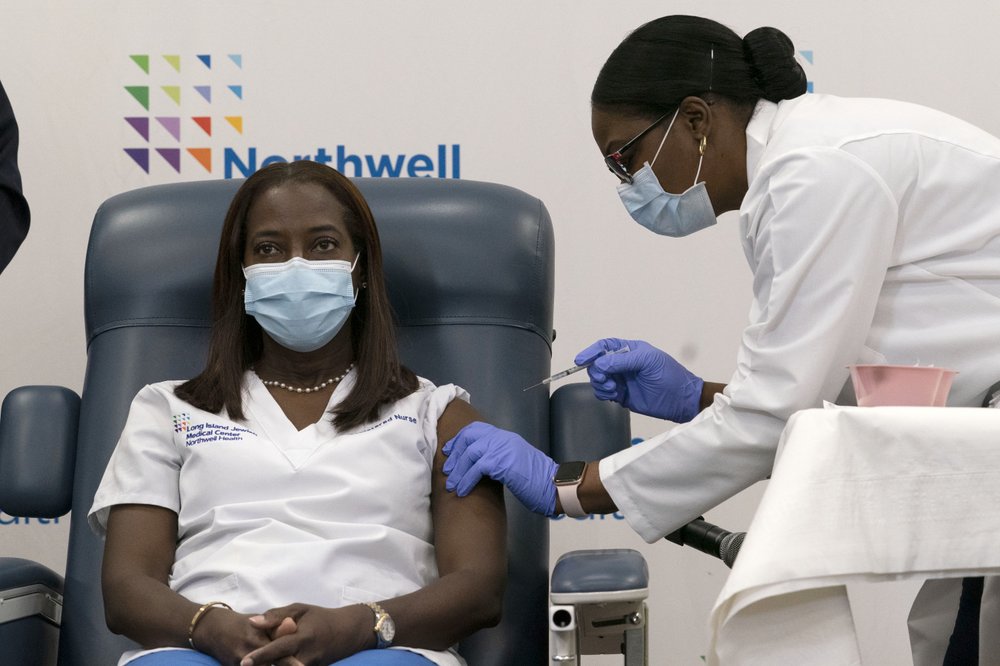
A critical care nurse who has treated COVID-19 patients in hard-hit New York City became the first person in the state to receive the vaccine Monday as part of campaign to inoculate front-line health care workers.
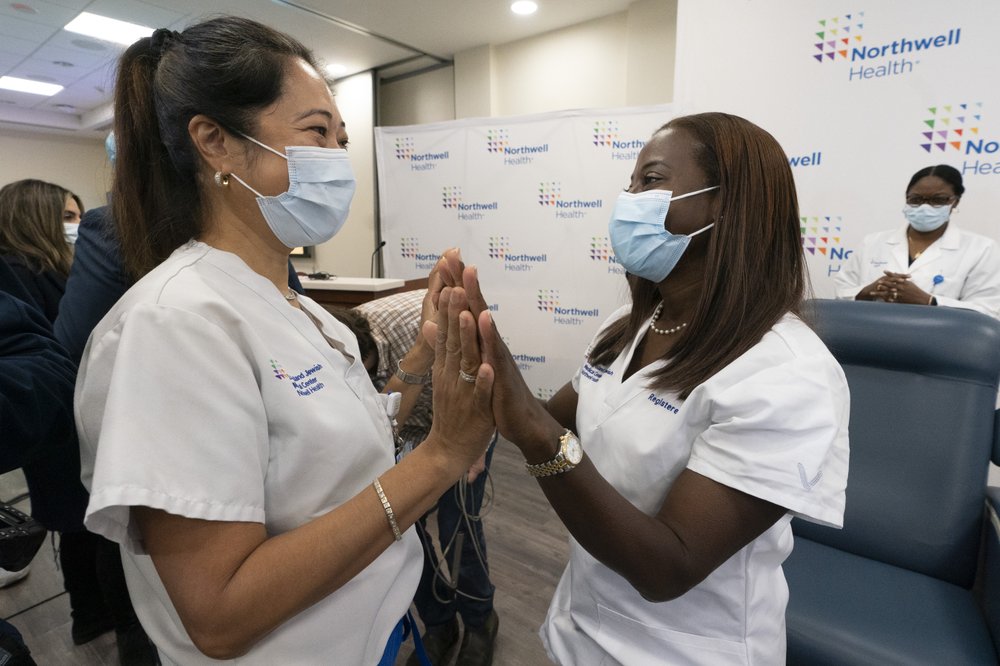
Onlookers applauded after a doctor gave registered nurse Sandra Lindsay the injection at Long Island Jewish Medical Center in Queens. This hospital is a premiere healthy facility that is associated with the prestigious Northwell Health Network.
“I feel hopeful today. Relieved,” Lindsay said after the injection, which was livestreamed by Gov. Andrew Cuomo’s office. “I feel like healing is coming. I hope this marks the beginning of the end of a very painful time in our history.”
Cuomo, who watched remotely, called it the first shot given in the state’s effort vaccination effort. Health care workers at other facilities in the city and beyond were also getting the shots Monday.
“This is the light at the end of the tunnel,” Cuomo said. “But it’s a long tunnel.”
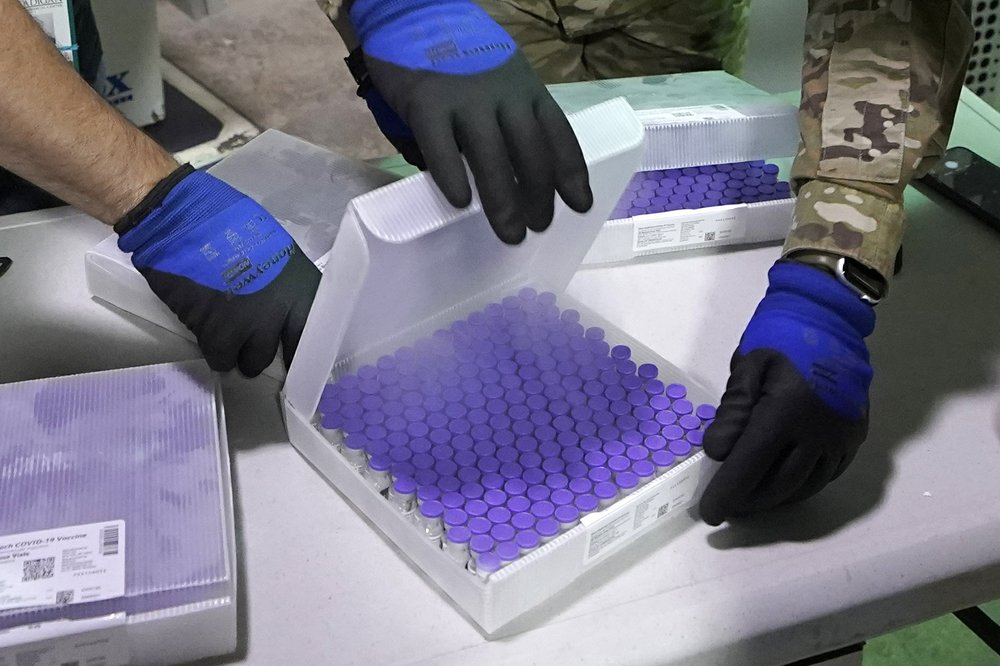
Hospital workers nationwide begin unloading frozen vials of COVID-19 vaccine Monday.
Dr. Dave Chokshi, New York City’s health commissioner, said they did not know their overall allotment of vaccines in the coming months, but had been told to plan for 465,000 doses over the first three weeks. Health care workers who work on the same unit will be vaccinated on a staggered schedule to account for possible side effects, he said.
In other parts of the country, with a countdown of “3-2-1,” workers at Ohio State University’s Wexner Medical Center gave initial injections to applause.
And in Colorado, Gov. Jared Polis personally opened a delivery door to the FedEx driver and signed for a package holding 975 precious frozen doses of vaccine made by Pfizer Inc. and its German partner BioNTech.
The shots kicked off what will become the largest vaccination effort in U.S. history, one that could finally conquer the outbreak.
Dr. Valerie Briones-Pryor, who has worked in a COVID-19 unit at University of Louisville Hospital since March and recently lost her 27th patient to the virus, was among the first recipients.
“I want to get back to seeing my family,” she said. “I want families to be able to get back to seeing their loved ones.”
Some 145 sites around the country, from Rhode Island to Alaska, received shipments, with more deliveries set for the coming days. High-risk health care workers were first in line.
“This is 20,000 doses of hope,” John Couris, president and chief executive of Tampa General Hospital said of the first delivery.
Nursing home residents also get priority, and a Veterans Affairs Medical Center in Bedford, Massachusetts, announced via Twitter that its first dose went to a 96-year-old World War II veteran, Margaret Klessens. Other nursing homes around the U.S. expect inoculations in the coming days.
The campaign began the same day the U.S death toll from the surging outbreak crossed the 300,000 threshold, according to the count kept by Johns Hopkins University. The number of dead rivals the population of St. Louis or Pittsburgh. It is more than five times the number of Americans killed in the Vietnam War. It is equal to a 9/11 attack every day for more than 100 days.
“To think, now we can just absorb in our country 3,000 deaths a day as though it were just business as usual. It just represents a moral failing,” said Jennifer Nuzzo, a public health researcher at Johns Hopkins.
Health experts know a wary public is watching the vaccination campaign, especially communities of color that have been hit hard by the pandemic but, because of the nation’s legacy of racial health disparities and research abuses against Black people, have doubts about the vaccine.
Getting vaccinated is “a privilege,” said Dr. Leonardo Seoane, chief academic officer at Ochsner Health in suburban New Orleans, after getting his dose. Seoane, who is Cuban American, urged “all of my Hispanic brothers and sisters to do it. It’s OK.”
The nearly 3 million doses now being shipped are just a down payment on the amount needed. More of the Pfizer-BioNTech vaccine will arrive each week. And later this week, the FDA will decide whether to greenlight the world’s second rigorously studied COVID-19 vaccine, made by Moderna Inc.
While the U.S. hopes for enough of both vaccines together to vaccinate 20 million people by the end of the month, and 30 million more in January, there won’t be enough for the average person to get a shot until spring.
For now the hurdle is to rapidly get vaccine into the arms of millions, not just doctors and nurses but other at-risk health workers such as janitors and food handlers — and then deliver a second dose three weeks later.
“We’re also in the middle of a surge, and it’s the holidays, and our health care workers have been working at an extraordinary pace,” said Sue Mashni, chief pharmacy officer at Mount Sinai Health System in New York City.
Plus, the shots can cause temporary fever, fatigue and aches as they rev up people’s immune systems, forcing hospitals to stagger employee vaccinations.
Just half of Americans say they want to get vaccinated, while about a quarter don’t and the rest are unsure, according to a recent poll by The Associated Press-NORC Center for Public Health Research.
“I know it’s going to be a big hurdle to convince people because it’s new, it’s uncertain,” said intensive care nurse Helen Cordova, who received a vaccination card after getting a shot at Kaiser Permanente Los Angeles Medical Center. “This can be encouraging for others.”
The FDA, considered the world’s strictest medical regulator, said the Pfizer-BioNTech vaccine, which was developed at breakneck speed less than a year after the virus was identified, appears safe and strongly protective, and the agency laid out the data in a daylong public meeting last week for scientists and consumers alike to see.
“We know it works well,” said Ochsner infectious-disease expert Dr. Katherine Baumgarten, who got her shot on Day 1. “As soon as you can get it, please do so.”
Still, the vaccine was cleared for emergency use before a final study in nearly 44,000 people was complete. That research is continuing to try to answer additional questions.
For example, while the vaccine is effective at preventing COVID-19 illness, it is not clear if it will stop the symptomless spread that accounts for half of all cases.
The shots still must be studied in children and during pregnancy. But the American College of Obstetricians and Gynecologists said Sunday that vaccination should not be withheld from pregnant women who otherwise would qualify.
Also, regulators in Britain are investigating a few severe allergic reactions. The FDA instructed providers not to give the vaccine to those with a known history of severe allergic reactions to any of its ingredients.
On Tuesday, hundreds more hospitals around the country began dispensing COVID-19 shots to their workers in a rapid expansion of the U.S. vaccination drive, while a second vaccine moved to the cusp of government authorization.
A day after the rollout of Pfizer-BioNTech’s coronavirus shots, the Food and Drug Administration said its preliminary analysis confirmed the effectiveness and safety of the vaccine developed by Moderna and the National Institutes of Health. A panel of outside experts is expected to vote to recommend the formula on Thursday, with the FDA’s green light coming soon thereafter.
The Moderna vaccine uses the same technology as Pfizer-BioNTech’s and showed similarly strong protection against COVID-19 but is easier to handle because it does not need to be kept in the deep freeze at minus 94 degrees Fahrenheit (minus 70 Celsius).
Another weapon against the outbreak can’t come soon enough: The number of dead in the U.S. passed a staggering 300,000 on Monday, according to Johns Hopkins University, with about 2,400 deaths and over 210,000 new cases per day on average.
The devastating toll is only expected to grow in coming weeks, fueled by holiday travel, family gatherings and lax adherence to mask-wearing and other precautions.
Packed in dry ice, shipments of the Pfizer-BioNTech vaccine began arriving Tuesday at more than 400 additional hospitals and other distribution sites.
The first 3 million shots are being strictly rationed to front-line health workers and nursing home patients, with hundreds of millions more shots needed over the coming months to protect most Americans.
The rollout provided a measure of encouragement to exhausted doctors, nurses and other hospital staffers around the country.
Maritza Beniquez has had a front-row seat to the devastation the COVID-19 pandemic has wrought on communities of color in New Jersey, so she jumped at the chance to take the vaccine that is being hailed as a turning point in the long and grueling battle against the virus.
The 56-year-old emergency room nurse at Newark’s University Hospital became the first person in New Jersey to receive the vaccine on Tuesday. All recipients will get a second shot a few weeks later.
“I’m happy that in another month and a half I won’t have to be afraid to go into a room anymore. I won’t have to be afraid to perform chest compressions or be present when they’re intubating a patient,” Beniquez said. “I don’t want to be afraid anymore, and I don’t want to have that risk of taking it home to my own family and my own friends.”
Widespread acceptance of the vaccine is critical to eventually protecting enough of the U.S. population to defeat the outbreak. But just half of Americans say they want to get vaccinated, while about a quarter don’t and the rest are unsure, according to a recent poll by The Associated Press-NORC Center for Public Health Research. (AP)