



|
Getting your Trinity Audio player ready...
|
By: Tyler Chan
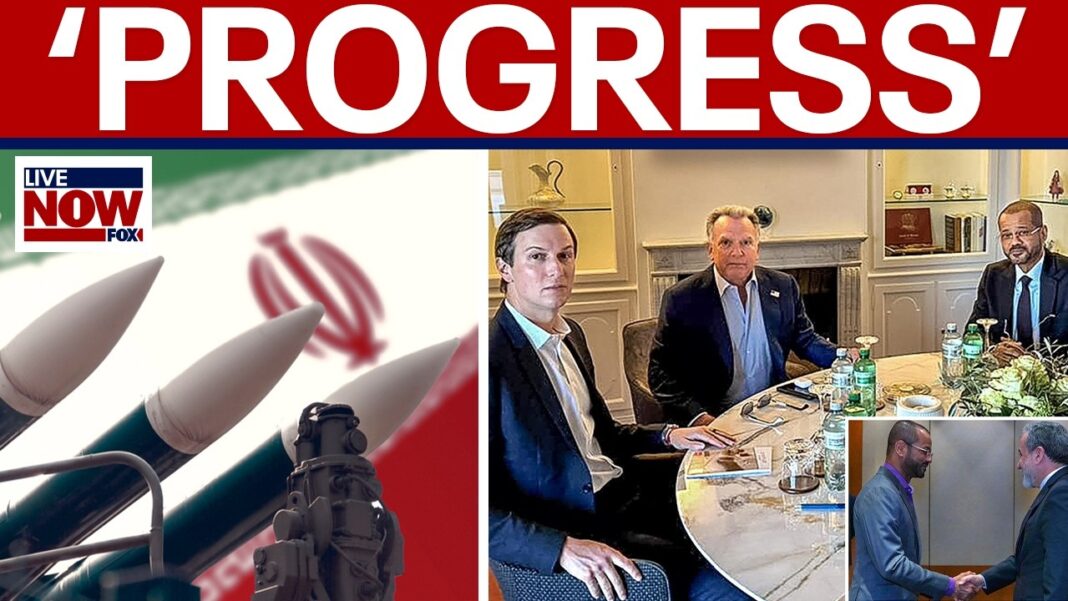
Diplomacy between Washington and Tehran has taken what mediators are describing as a meaningful step forward, following a high-stakes round of nuclear negotiations in Geneva that concluded Thursday with what Omani Foreign Minister Badr al-Busaidi termed “significant progress.” According to a report on Thursday at Israel National News, the talks—viewed within the Trump administration as a pivotal juncture before any decision on potential military action—have now entered a more technical and detail-oriented phase, with additional discussions slated for Vienna next week.
The Geneva meeting marked the third round of negotiations in recent weeks, and perhaps the most consequential. As Israel National News reported, the talks combined both indirect exchanges, facilitated by al-Busaidi, and direct engagement between U.S. envoys Steve Witkoff and Jared Kushner and Iranian Foreign Minister Abbas Araghchi. The dual-track format reflected the delicate balance between cautious diplomacy and the urgency of resolving one of the world’s most destabilizing security dilemmas.
At the conclusion of the session, al-Busaidi offered a carefully measured yet optimistic assessment. “We have finished the day after significant progress in the negotiation between the United States and Iran,” he declared in a full statement cited by Israel National News. He confirmed that consultations would now take place in Washington and Tehran, followed by technical-level discussions in Vienna. Al-Busaidi extended gratitude to the negotiators, the International Atomic Energy Agency (IAEA), and Switzerland as host, underscoring the multilayered diplomatic architecture supporting the talks.
Iranian Foreign Minister Abbas Araghchi echoed the cautiously positive tone. Speaking after the session, he stated that “some positive things have been achieved regarding sanctions and the nuclear issue,” describing the current round as “the best and most serious” to date. Araghchi emphasized that negotiations have progressed into the granular details of a potential agreement, including mechanisms for lifting sanctions and refining oversight measures. He confirmed that Iranian technical teams would begin talks in Vienna starting Monday, with anticipated engagement from IAEA experts.
A senior U.S. official, speaking to Axios reporter Barak Ravid, characterized the discussions as “positive,” a succinct but notable endorsement of the trajectory of talks. As the Israel National News report emphasized, the Geneva meeting was widely viewed inside the Trump administration as a last, decisive opportunity for diplomacy before President Donald Trump considers whether to authorize military action.
The day’s proceedings, however, were not without tension. According to a source familiar with the details, Iran presented a draft framework for a prospective nuclear agreement during the morning session. The U.S. delegation initially expressed disappointment with elements of Tehran’s position. It remains unclear what specific shifts occurred during the afternoon session that prompted Oman’s favorable public assessment.
One Iranian official, speaking to Al Jazeera during a break in the talks, indicated that Tehran rejected proposals requiring it to permanently end uranium enrichment, dismantle nuclear facilities, or transfer its enriched uranium stockpile abroad. Instead, Iran proposed reducing its stockpile to low-enrichment levels under IAEA supervision. “Our proposal in Geneva is politically serious, technically creative, and includes everything required to reach an agreement immediately,” the official asserted.
This dispute strikes at the heart of the nuclear impasse. The United States entered the negotiations seeking assurances that any agreement would remain in force indefinitely and demanding that Iran relinquish its stockpile of approximately 10,000 kilograms of enriched uranium. Washington has signaled some flexibility regarding Iran’s insistence on maintaining enrichment capabilities, but only under conditions that unequivocally preclude any pathway to a nuclear weapon. Israel National News has repeatedly highlighted the sensitivity of this issue, as enrichment capability represents both a symbol of sovereignty for Tehran and a flashpoint for global nonproliferation concerns.
The Iranian position, articulated in part through statements by senior officials, rests on the assertion that its nuclear program is peaceful. During the negotiations, Ali Shamkhani, a senior adviser to Supreme Leader Ali Khamenei, wrote on X that if the U.S. focus is solely on preventing a nuclear weapon, that objective aligns with Khamenei’s religious decree, or fatwa, prohibiting nuclear arms. Shamkhani suggested that an agreement could be achieved swiftly and affirmed that Araghchi possesses the authority to finalize a deal. Such public messaging may be intended both to reassure domestic audiences and to signal flexibility to international interlocutors.
International Atomic Energy Agency Director General Rafael Grossi participated in the Geneva discussions, reinforcing the central role of verification in any prospective agreement. According to the information provided in the Israel National News report, technical discussions in Vienna next week will likely focus on compliance mechanisms, inspection protocols, and the quantifiable reduction of uranium stockpiles. Grossi’s presence underscored the indispensability of independent oversight in bridging the trust deficit that has long plagued U.S.–Iranian diplomacy.
The broader geopolitical backdrop loomed over the talks. During a pause in negotiations, U.S. representatives reportedly met with Ukrainian officials, a reminder that global security crises intersect in complex ways. The presence of Omani mediation also highlighted the role of regional intermediaries in facilitating dialogue between adversaries.
Meanwhile, Iranian officials conveyed to Reuters that a framework agreement could be achievable if Washington separates “nuclear and non-nuclear issues.” This formulation hints at Tehran’s reluctance to link nuclear concessions with broader regional or ballistic missile concerns. The Israel National News report observed that previous negotiations faltered in part due to disagreements over whether non-nuclear activities—such as support for regional proxies—should be incorporated into any comprehensive accord.
President Trump has framed the nuclear question in unequivocal terms. In his recent State of the Union address, he insisted that Iran must explicitly declare it does not seek nuclear weapons. While Iranian officials have consistently denied such ambitions, Washington demands verifiable guarantees rather than declaratory statements alone. The Geneva talks thus represent an effort to translate rhetoric into binding commitments.
The stakes of failure are widely acknowledged. Many officials within the Trump administration reportedly believe that American strikes against Iranian nuclear infrastructure may become inevitable if diplomacy collapses. Senior advisers have debated contingency plans, including scenarios involving coordinated or sequential action with Israel.
Against this backdrop, the “significant progress” cited by al-Busaidi carries substantial weight. Diplomatic breakthroughs in such protracted disputes are rarely linear; they emerge through incremental adjustments, calibrated concessions, and sustained engagement. The shift from broad political positions to detailed technical discussions may signal that negotiators have identified sufficient common ground to warrant continued effort.
Nevertheless, formidable obstacles remain. Iran’s insistence on maintaining enrichment capability, even at low levels, continues to provoke concern in Washington and among U.S. allies. Conversely, Tehran views permanent renunciation of enrichment as a capitulation incompatible with national sovereignty. Bridging this conceptual divide will require creative diplomacy and robust verification mechanisms.
The next week’s technical discussions in Vienna will be critical. Experts will likely grapple with quantitative thresholds, monitoring technologies, timelines for sanctions relief, and mechanisms for dispute resolution. As the Israel National News report emphasized, the credibility of any agreement will hinge on enforceability and durability.
For now, the Geneva round has preserved the momentum of diplomacy at a moment when the alternative—military escalation—remains palpable. The measured optimism expressed by Omani and Iranian officials, coupled with the restrained positivity from the U.S. side, suggests that both capitals recognize the gravity of the moment.
In the intricate dance of nuclear diplomacy, words such as “significant progress” are carefully chosen. Whether they herald a genuine breakthrough or merely a temporary reprieve will depend on the substance emerging from Vienna and the political will in Washington and Tehran. As Israel National News continues to monitor developments, one truth remains evident: the path to resolution is narrow, but for now, it remains open.
