



|
Getting your Trinity Audio player ready...
|
Choking Point in the Gulf: Trump Doubles Down on Iran Blockade as Diplomatic Standoff Deepens
By: Fern Sidman
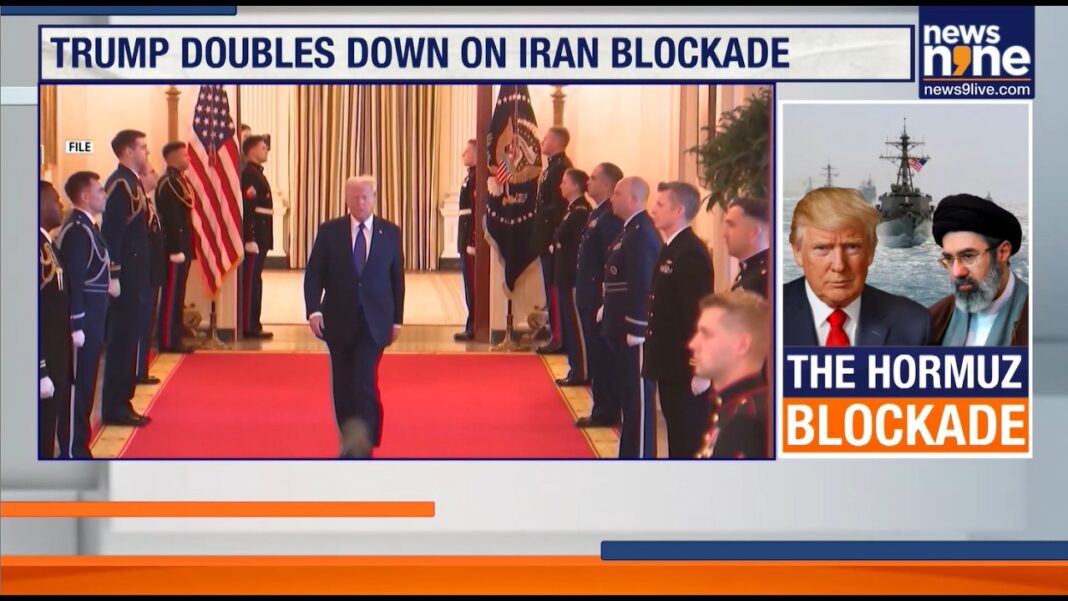
In a decisive and potentially far-reaching strategic posture, President Trump has reaffirmed his administration’s commitment to maintaining a stringent naval blockade against Iran, signaling an intensification of economic and geopolitical pressure amid stalled negotiations over Tehran’s nuclear ambitions. According to a detailed report on Wednesday from Axios, the President conveyed in an interview that the blockade would remain firmly in place unless Iran agrees to terms that fully address American security concerns regarding nuclear development.
The declaration underscores a pivotal moment in the ongoing confrontation between Washington and Tehran, one defined not only by military calculations but also by economic leverage, diplomatic brinkmanship, and the delicate balance of regional stability.
President Trump’s remarks reflect a deliberate reliance on economic containment rather than immediate military escalation. In his conversation with Axios, the President described the blockade as a more potent and effective instrument than direct aerial strikes, suggesting that sustained economic suffocation may yield concessions without the unpredictable consequences of open conflict.
“The blockade is somewhat more effective than the bombing,” Trump stated, emphasizing that the current approach is designed to maximize pressure while preserving strategic flexibility. This assertion reveals a calculated preference for coercive economic tactics, aimed at compelling Iran to return to negotiations under conditions favorable to the United States.
The blockade has significantly curtailed Iran’s ability to export oil, long considered the lifeblood of its economy. By restricting maritime access, the United States has effectively disrupted a critical revenue stream, thereby amplifying internal economic strain within the Islamic Republic.
Trump did not shy away from describing the impact in stark terms, asserting that Iran is “choking like a stuffed pig,” a phrase that, while rhetorically forceful, reflects the administration’s assessment of the blockade’s effectiveness.
Central to the current impasse is Tehran’s recent diplomatic overture, which sought to decouple the reopening of the Strait of Hormuz from broader nuclear negotiations. Under the proposed framework, maritime access would be restored first, followed by subsequent discussions on nuclear limitations.
However, as Axios reported, the Trump administration has categorically rejected this sequencing. Officials in Washington argue that lifting the blockade prematurely would undermine the United States’ primary source of leverage, thereby weakening its negotiating position.
The Strait of Hormuz, through which approximately 20% of the world’s oil supply typically flows, remains one of the most strategically vital maritime corridors on the planet. Control over access to this passage has become a central axis of the current conflict, with both sides recognizing its immense economic and symbolic significance.
By maintaining the blockade, the United States seeks to ensure that any future negotiations occur under conditions of maximum pressure, compelling Iran to address not only its nuclear program but also broader regional concerns.
While the administration has thus far refrained from authorizing direct military action, Axios reported that the United States Central Command has developed contingency plans involving a targeted series of strikes against Iranian infrastructure.
These proposed operations, described as limited in scope but intense in execution, would focus on degrading key assets, potentially including energy facilities and logistical networks. The objective would be to further weaken Iran’s operational capacity while creating conditions conducive to renewed negotiations.
Despite the existence of these plans, President Trump has exercised restraint, declining to provide specific details regarding potential military action. His reluctance to escalate militarily at this stage suggests a continued preference for economic pressure as the primary tool of engagement.
Nevertheless, the mere presence of such plans introduces an element of uncertainty, reinforcing the high-stakes nature of the current standoff.
From Tehran’s perspective, the blockade represents a provocative and destabilizing measure, one that risks triggering a broader regional confrontation. A senior Iranian security official, cited by the state-affiliated outlet Press TV and referenced by Axios, warned that continued pressure could elicit a forceful response.
According to the official, Iran has thus far exercised restraint in order to preserve the possibility of diplomatic resolution. However, the statement included a clear caveat: should the blockade persist, retaliatory measures may become unavoidable.
This warning highlights the precarious balance currently governing the situation. While both sides appear to prefer avoiding outright conflict, the accumulation of pressure increases the likelihood of miscalculation or escalation.
Iran’s strategic calculus is further complicated by internal divisions, with differing factions advocating varying degrees of compromise or resistance. This lack of consensus has contributed to the difficulty of reaching a comprehensive agreement.
The blockade’s ramifications extend beyond Iran’s borders, influencing global energy markets and international trade dynamics. The Strait of Hormuz serves as a critical artery for the transportation of oil and natural gas, and disruptions to its normal operation have far-reaching consequences.
Although the United States has sought to mitigate these effects through coordination with allies and alternative supply routes, the situation remains fluid. Analysts have expressed concern that prolonged restrictions could contribute to volatility in energy prices, particularly if tensions escalate further.
At the same time, the blockade has underscored the strategic importance of maritime chokepoints in contemporary geopolitics. Control over such passages confers significant leverage, enabling states to exert influence disproportionate to their direct military capabilities.
Despite the hardened positions on both sides, diplomatic efforts continue behind the scenes. According to the Axios report, intermediaries have sought to bridge the gap between Washington and Tehran, exploring potential pathways toward de-escalation.
These initiatives have included proposals for phased agreements, confidence-building measures, and temporary ceasefires. However, progress has been limited, with fundamental disagreements persisting over the sequencing and scope of concessions.
The Trump administration’s insistence on addressing nuclear issues as a precondition for easing the blockade remains a central obstacle. Conversely, Iran’s reluctance to commit to significant limitations without immediate relief from economic pressure has further complicated negotiations.
The current confrontation must be understood within the broader context of United States policy toward Iran, which has consistently prioritized preventing the development of nuclear weapons. President Trump reiterated this objective in his remarks to Axios, stating unequivocally, “They can’t have a nuclear weapon.”
This position reflects longstanding concerns within Washington regarding the potential destabilizing effects of a nuclear-armed Iran, both regionally and globally. It also aligns with the administration’s broader strategy of exerting maximum pressure to achieve its objectives.
At the same time, the emphasis on economic measures rather than immediate military action suggests an awareness of the risks associated with escalation. The challenge lies in maintaining sufficient pressure to compel compliance without crossing the threshold into open conflict.
As the standoff continues, the path forward remains uncertain. The blockade has undoubtedly intensified pressure on Iran, but whether it will ultimately achieve its intended objectives is a matter of ongoing debate.
Some analysts argue that sustained economic hardship may compel Tehran to make concessions, particularly if internal pressures mount. Others caution that such measures could entrench resistance, hardening positions and reducing the likelihood of compromise.
The coming weeks may prove decisive, as both sides assess their options and recalibrate their strategies. The potential for renewed negotiations, military escalation, or prolonged stalemate remains very real.
The decision by President Trump to maintain the naval blockade against Iran, as reported by Axios, represents a critical juncture in the evolving confrontation between the two nations. It reflects a calculated effort to leverage economic pressure as a means of achieving strategic objectives, while keeping military options in reserve.
Yet the situation remains fraught with complexity and risk. The interplay of economic constraints, diplomatic maneuvering, and potential military escalation creates a volatile environment in which outcomes are difficult to predict.
For now, the blockade stands as both a symbol of American resolve and a focal point of international tension, its ultimate impact yet to be determined in the unfolding narrative of global geopolitics.
