



|
Getting your Trinity Audio player ready...
|
By: Fern Sidman
A vigil scheduled to take place later today in Manhattan’s Washington Square Park will likely ignite a fresh wave of controversy in New York City, as activists gather to mourn Iran’s late Supreme Leader Ayatollah Ali Khomeini only days after many Iranian Americans celebrated his death in the streets. The event, organized by several left-wing activist groups, will unfold against the backdrop of an escalating geopolitical confrontation between the United States, Israel, and the Islamic Republic of Iran, a conflict that has already reverberated deeply within communities across the United States.
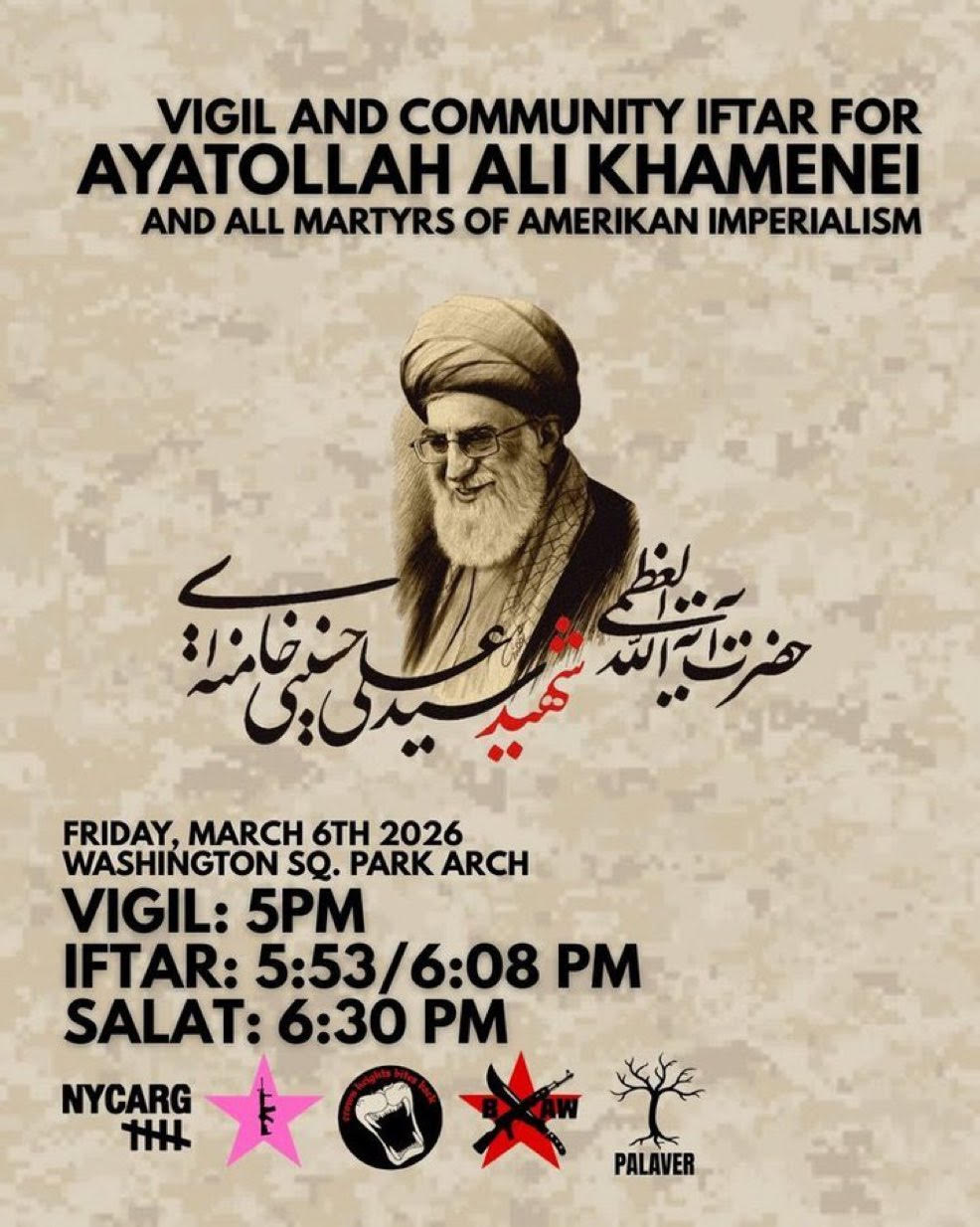
According to a report on Friday morning at WABC Radio, the vigil will be hosted by a coalition of activist organizations that includes Crown Heights Bites Back and the Bronx Anti-War Coalition. The groups are expected to assemble in the park later this evening, where organizers say they will hold a solemn gathering intended to protest American military actions and commemorate the Iranian leader who was killed earlier this month in a U.S.-Israeli airstrike.
The event will come just days after scenes of jubilation unfolded in several American cities, where members of the Iranian diaspora celebrated news of Khomeini’s death. Over the weekend, Iranian Americans gathered in public spaces, waving pre-revolutionary Iranian flags and chanting slogans condemning the clerical regime that has ruled Iran for decades.
Yet the planned vigil in Washington Square Park will reflect a dramatically different perspective on the unfolding crisis. Organizers have framed the gathering not as an endorsement of Khomeini’s leadership but as a protest against what they describe as American imperialism and military aggression.
In promotional materials circulated on social media and cited by WABC Radio, the groups organizing the vigil have presented the event as an act of political resistance.
“This vigil is a solemn reminder that Amerikan colonial violence is a singular evil,” the organizers wrote in an Instagram post announcing the gathering.
The phrasing, including the stylized spelling of “Amerikan,” will signal the ideological framing that many activists intend to bring to the event. Organizers will likely emphasize themes of anti-imperialism and opposition to U.S. foreign policy as they address participants gathered in the park.
However, critics argue that the vigil will inevitably be interpreted by many observers as an expression of sympathy for a regime that has long been associated with political repression and hostility toward the United States and its allies.
Among those who will sharply criticize the event is New York City Councilwoman Vickie Paladino. In a statement on social media referenced by WABC Radio, Paladino has already condemned the planned vigil, arguing that honoring Khomeini in any form is deeply offensive given the historical actions of the Iranian regime.
Paladino’s criticism will arrive at a politically delicate moment for the councilwoman herself. She currently faces the possibility of censure by the New York City Council’s ethics committee over separate controversies. Nevertheless, she has chosen to speak forcefully about the vigil, framing it as part of a troubling pattern of extremist activism in the city.
The controversy surrounding the event will also be amplified by the track record of some of the organizations involved. According to the WABC Radio report, several of the activist groups hosting the vigil have previously organized demonstrations honoring controversial figures from the Middle East.
Among those figures was Hamas leader Yahya Sinwar, whom some of the same activists memorialized in earlier gatherings. Critics argue that such events blur the line between political protest and the glorification of militant leaders associated with violence.
Supporters of the vigil, however, will likely argue that their actions are directed against U.S. military intervention rather than in support of any particular government or political ideology.
The clash of perspectives in Washington Square Park will mirror the broader international tensions that have intensified in recent weeks.
Operation Epic Fury, the large-scale military campaign launched by the United States and Israel against Iran, will continue to reshape the strategic landscape of the Middle East. According to the WABC Radio report, U.S. officials believe the campaign has already inflicted significant damage on the Islamic Republic’s military capabilities.
American forces have reportedly destroyed substantial portions of Iran’s missile infrastructure and naval assets. One of the most dramatic developments occurred when U.S. forces sank an Iranian warship, an action that has further escalated tensions between the two nations.
Despite these setbacks, Iranian officials have vowed that their country will retaliate. Tehran has continued to launch drone attacks targeting regional adversaries, demonstrating that it retains the ability to respond even after suffering major military losses.
The ongoing conflict has also created a profound political vacuum within Iran following Khomeini’s death.
As WABC Radio has reported, Iran’s ruling establishment has moved swiftly to name a successor. The late supreme leader’s son has been selected to assume the powerful position, a decision that has generated intense debate both within Iran and internationally.
Many analysts believe that the succession process could determine whether the country’s political system remains stable or enters a period of deeper upheaval.
President Trump has been particularly outspoken in criticizing the decision to elevate Khomeini’s son to the leadership position. According to remarks cited by WABC Radio, Trump has described such a move as the worst possible outcome for Iran’s future.
Trump has argued that replacing one member of the ruling family with another would merely perpetuate the same policies that have brought the country into conflict with the United States and much of the international community.
At the same time, the president has dismissed the idea that American or Israeli forces will need to conduct a ground invasion of Iran.
“A ground incursion would be a waste of time,” Trump has said in comments referenced by WABC Radio, emphasizing that the damage inflicted by the ongoing air and naval campaign has already significantly weakened the regime.
Nevertheless, Trump has also signaled that the United States intends to play an active role in shaping Iran’s political future. He has suggested that Washington will seek to influence the selection of a new leadership structure capable of steering the country in a different direction.
Such statements have fueled speculation that the current conflict may ultimately lead to broader efforts to reshape Iran’s government.
As evening approaches in New York City, these global tensions will find a symbolic reflection in Washington Square Park. The vigil planned by activist groups will likely attract both supporters and critics, transforming the park into a stage for competing narratives about war, power, and political responsibility.
For some participants, the gathering will represent an act of protest against American foreign policy. For others observing the event, it will serve as a troubling reminder of how polarizing the conflict with Iran has become—even thousands of miles away from the battlefield.
As WABC Radio continues to monitor developments surrounding both the vigil and the wider conflict, today’s demonstration will illustrate how international events are increasingly shaping political debates within the United States itself.
