



|
Getting your Trinity Audio player ready...
|
By: Abe Wertenheim
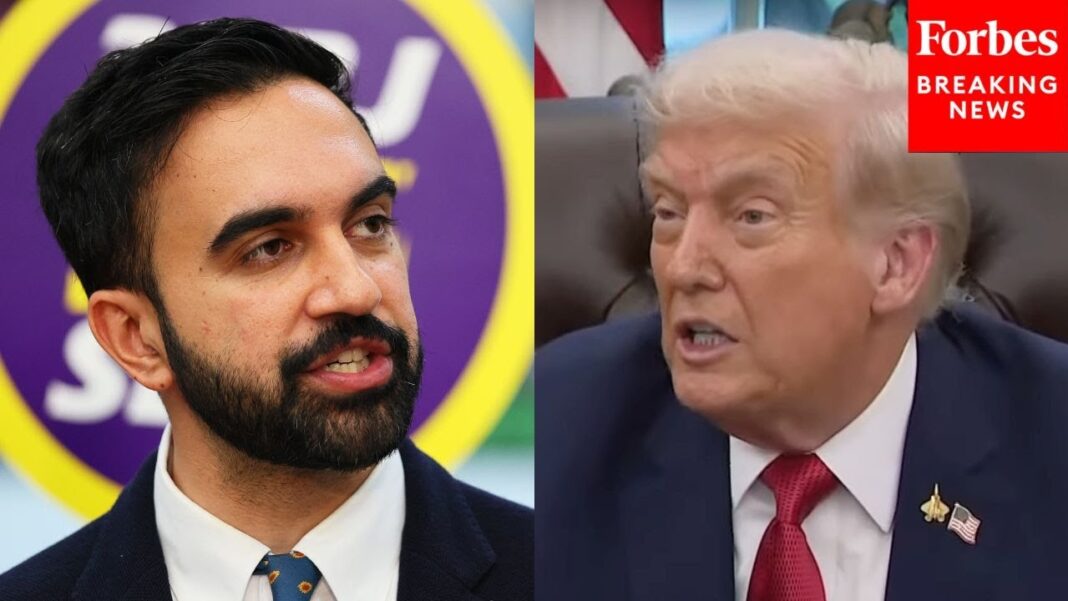
The political landscape in New York City was jolted yet again on Monday morning, as President Donald Trump issued an extraordinary warning that could reshape the city’s already fraught mayoral race. In a post on his Truth Social platform, Trump threatened to withhold federal funding from the nation’s largest city if Democratic Socialist candidate Zohran Mamdani prevails in November. The pronouncement has thrust the already high-stakes contest into even sharper relief, as Trump’s intervention lays bare the ideological battle lines now dominating political discourse in the Big Apple.
According to a report that appeared on Monday at Mediaite, Trump’s statement carried the unmistakable hallmarks of his rhetorical style: simultaneously bombastic, combative, and calculated to dominate the conversation. “Self-proclaimed New York City Communist, Zohran Mamdani, who is running for Mayor, will prove to be one of the best things to ever happen to our great Republican Party,” Trump wrote. He went on to claim that Mamdani’s promises were “fake Communist” pledges that could only be financed through federal support — money Trump vowed to block. “He won’t be getting any of it, so what’s the point of voting for him? This ideology has failed, always, for thousands of years. It will fail again, and that’s guaranteed!”
The timing of Trump’s warning is as significant as its content. It comes on the heels of Mayor Eric Adams’s dramatic announcement that he is dropping out of the race, a decision that clears the way for Mamdani to consolidate his frontrunner status. Polling now shows Mamdani with 45 percent support among likely voters, leaving former Governor Andrew Cuomo trailing with 23 percent and Republican nominee Curtis Sliwa further behind.
Trump’s overt threat to withhold federal funds from a major American city based on the outcome of a local election is unusual even by the standards of modern partisan combat. As the Mediaite report observed, the statement emphasizes Trump’s long-running willingness to leverage federal power to punish political opponents — a theme that has repeatedly surfaced in his campaigns and his presidency alike.
The White House, already playing an outsized role in New York’s political dramas, has not clarified what specific streams of federal support would be on the chopping block should Mamdani win. Federal dollars sustain everything from housing programs to transportation infrastructure, education support, and homeland security initiatives. Any curtailment would deal a significant blow to a city still recovering from fiscal strain and social upheaval.
Mamdani, speaking with ABC7 shortly after Adams’s withdrawal, sought to turn Trump’s threat into an indictment of the president’s governing philosophy. “Donald Trump will do what Donald Trump wants to do, but the important thing is to understand why he’s so interested,” Mamdani said. “He ran a campaign speaking about cheaper groceries and a lower cost of living. That’s the campaign that we ran. The difference is that he has shown no interest in delivering on that agenda, instead just persecuting his supposed political enemies. Our campaign is sincere in these commitments, and that’s what scares him.”
The contrast between Trump and Mamdani could hardly be sharper. Mamdani, a state assemblyman from Queens and the Democratic nominee, has built his political profile around an unapologetically socialist agenda — seeking expanded public housing, significant investments in healthcare and education, and reforms designed to protect immigrants from deportation.
Trump, by contrast, has repeatedly sought to frame Mamdani as emblematic of what he calls the “radical left” threat to American cities. In recent speeches and interviews, he has invoked Mamdani’s candidacy as a cautionary tale, warning that New York could become a test case for what he views as destructive leftist experiments.
As the Mediaite report highlighted, Trump has made no secret of his disdain for Mamdani, labeling him a “communist” and casting his candidacy as a recipe for disaster. Yet Trump has conspicuously declined to throw his weight behind Curtis Sliwa, the Republican nominee, whom he recently dismissed as “not exactly prime time.” This ambivalence has fueled speculation that Trump might be tacitly favoring Cuomo, with whom he shares a complicated history.
Cuomo’s reemergence on the political stage adds another layer of intrigue. Once seen as a Trump adversary during the COVID-19 pandemic, the former governor resigned in 2021 amid scandal. Yet in the current mayoral contest, Cuomo has sought to rehabilitate his image, positioning himself as the only candidate capable of stopping Mamdani’s surge.
Some analysts quoted in the Mediaite report suggest that Trump sees Cuomo — not Sliwa — as the more viable challenger to Mamdani, despite their past animosities. With Cuomo polling at 23 percent, a two-man race between him and Mamdani could narrow considerably, though Sliwa’s refusal to exit complicates that calculation.
Whether Trump’s veiled support for Cuomo is strategic or merely opportunistic remains unclear, but the dynamic illustrates how the New York City mayoral race has transcended local politics to become a battleground for national ideological disputes.
Eric Adams’s decision to bow out has reshaped the contest almost overnight. Once a symbol of centrist governance, Adams had struggled under the weight of corruption allegations, internal scandals, and declining approval ratings. His fourth-place polling position left little room for recovery.
Still, as the Mediaite report pointed out, Adams’s withdrawal does not remove his name from the ballot, creating a lingering complication for anti-Mamdani forces. Votes cast for Adams in November could siphon support from either Cuomo or Sliwa, muddying efforts to consolidate opposition to the Democratic Socialist nominee.
In his farewell video, Adams avoided endorsing any candidate, instead warning voters against allowing City Hall to become a platform for “radical ideals.” The subtext of his remarks was clear: his departure was as much a repudiation of Mamdani’s politics as it was a recognition of his own electoral vulnerabilities.
For New York City, the stakes could not be higher. Federal funding underpins nearly every aspect of municipal governance. From disaster preparedness to housing vouchers, education grants to law enforcement support, the city’s reliance on Washington is profound.
Trump’s warning, if carried out, could cripple essential services. Yet as the Mediaite report noted, questions remain about the legality and feasibility of selectively denying funds based on political outcomes. Legal experts have cautioned that such a move would likely face immediate constitutional challenges. Nevertheless, the threat itself has political potency, sharpening anxieties among voters already concerned about affordability, safety, and the city’s trajectory.
Mamdani, for his part, has framed the election as a referendum on the city’s values. He insists that his platform reflects the lived realities of working-class New Yorkers. “Our campaign is sincere in these commitments,” he emphasized, “and that’s what scares him.”
What might otherwise have been a fiercely local race has now assumed national dimensions. Trump’s threat underscores the degree to which New York City, long a symbol of both liberal governance and urban resilience, has become a proxy battlefield in the struggle over America’s future.
According to the information provided in the Mediaite report, Trump’s calculation may also extend beyond the five boroughs. By painting Mamdani as the face of socialism in America, he can galvanize Republican voters nationally, tying Democrats to an agenda he insists is radical and untenable. Mamdani, meanwhile, embodies the progressive movement’s determination to claim not just legislative seats but executive offices in America’s largest cities.
The outcome of the race could therefore reverberate far beyond New York, shaping debates about immigration, housing, policing, and the role of federal government support in local governance.
As the New York City mayoral race barrels toward November, the field is now defined by sharp contrasts and high stakes. Adams’s exit has clarified the contest, leaving Mamdani as the frontrunner and drawing Cuomo and Sliwa into an uneasy rivalry for the anti-socialist vote. But Trump’s intervention has transformed the race from a citywide struggle into a national spectacle.
With federal funding potentially on the line, and with Trump making clear his disdain for Mamdani’s candidacy, the future of New York City’s governance now sits at the nexus of local choice and national consequence.
As the Mediaite report indicated, Trump’s ultimatum crystallizes the ideological clash at the heart of the race: between a Democratic Socialist vision for the city’s future and a Republican president willing to wield federal power to stop it. The November election, once seen as just another chapter in the city’s turbulent politics, now looms as a test case for America itself.
