



|
Getting your Trinity Audio player ready...
|
By: Fern Sidman
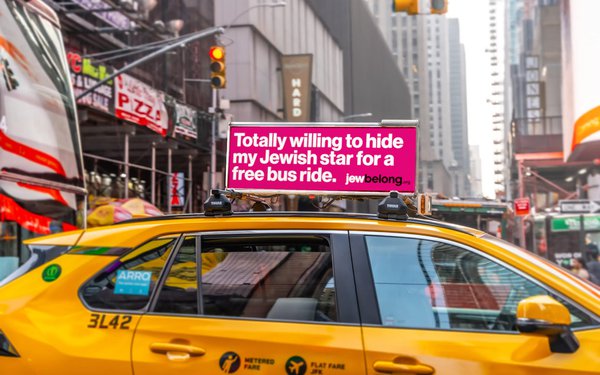
In a city long accustomed to seeing its fiercest political arguments waged not only in council chambers and press conferences but also across the visual grammar of its streets, a new campaign has transformed New York’s ubiquitous yellow taxis into roving billboards for an urgent and unsettled conversation. JewBelong, a Jewish advocacy organization known for its bracing, often confrontational public messaging, has launched a series of displays that reference Mayor Mamdani’s proposal to scrap MTA bus fares while simultaneously attempting to strike a nerve with Jewish New Yorkers alarmed by what they perceive as the mayor’s anti-Israel posture.
The New York Post, which has closely covered the campaign and the political currents swirling around it, reported on Monday that the initiative seeks to collapse municipal policy debates and anxieties over antisemitism into a single, deliberately provocative visual encounter.
The taxis, emblazoned with messaging crafted by JewBelong founder Archie Gottesman, are designed to meet New Yorkers in the most quotidian of spaces: curbside, crosswalk, traffic jam. In Gottesman’s telling, this is no accident.
“This campaign isn’t about being provocative for its own sake,” she said, according to The New York Post. “It’s about naming what too many Jews are feeling right now, that antisemitism has crept so deeply into everyday life that even simply existing openly can feel like a negotiation.” Her insistence that “taxis are unmistakably New York, and New York is where culture meets the street” captures the group’s strategic calculus: to relocate a debate often confined to op-ed pages and activist forums into the unfiltered commons of the city’s public sphere.
The timing of the campaign is not incidental. The New York Post has reported that antisemitic hate crimes in the city surged by 182 percent in January compared with the same month a year earlier, according to data from the New York Police Department. Such figures, while abstract in isolation, acquire visceral force when translated into the lived experience of a community increasingly wary of the ambient hostility that seems to seep into subway cars, sidewalks, and schoolyards.
JewBelong’s decision to plaster its message on taxis and to erect a large-scale physical billboard in the Bronx, at the Third Avenue Bridge at Bruckner Boulevard, reflects a conviction that combating antisemitism requires more than institutional pronouncements; it requires occupying the visual economy of the city with counternarratives that are impossible to ignore.
The campaign’s invocation of Mayor Mamdani has further complicated its reception. The New York Post notes that Mamdani, both during his campaign and since taking office, has publicly vowed to fight antisemitism and all forms of bigotry directed at New Yorkers because of their identity. Yet he has also aligned himself with the boycott, divestment, and sanctions movement against Israel and has repeatedly accused the Jewish state of committing “genocide” in Gaza.
For many Jewish New Yorkers, these positions are not merely abstract foreign policy stances but signals of a broader ideological orientation that, in their view, blurs the line between criticism of Israeli government policy and delegitimization of Jewish collective identity. JewBelong’s campaign, by juxtaposing Mamdani’s municipal agenda with anxieties over antisemitism, seeks to dramatize that perceived dissonance.
Archie Gottesman, an advertising veteran whose imprint can be found on Manhattan Storage billboards across the city, has honed a distinct visual rhetoric in JewBelong’s campaigns since 2021. The New York Post has cataloged some of the group’s previous billboards, which include stark admonitions such as “We’re just 78 years since the gas chambers. So no, a billboard calling out Jew hate isn’t an overreaction,” and “Cultural Jews died in the gas chambers too. Speak up.”
Another, more acerbic message—“Oh, don’t be naive. Hamas would chop your head off too”—exemplifies the organization’s willingness to employ confrontational language to jolt passersby out of complacency. To supporters, such bluntness is a necessary corrective to what they see as a culture of euphemism and denial. To critics, it risks inflaming tensions and reducing complex geopolitical conflicts to inflammatory slogans. The New York Post, in its coverage, has highlighted this tension, noting both the campaign’s urgency and the controversy it courts.
The political reverberations of the taxi displays have unfolded against a backdrop of scrutiny over the city’s institutional response to antisemitism. Mamdani’s office offered no immediate comment on the campaign, The New York Post reported, a silence that itself became fodder for interpretation among advocacy groups eager for unequivocal leadership.
Meanwhile, the New York City Human Rights Commission issued a statement condemning antisemitism, a week after Mark Treyger, the chief executive of the Jewish Community Relations Council, publicly criticized the agency for what he characterized as silence following a series of anti-Jewish incidents.
The commission’s declaration that “bias, discrimination, and hate have no place in New York City” and that it “unequivocally condemns antisemitism levied against individuals and institutions” was welcomed by community leaders, though some questioned why such affirmations so often appear reactive rather than anticipatory.
The New York Post reported that the commission also announced that it and the Mayor’s Office for the Prevention of Hate had jointly awarded twelve grants of $10,000 each to grassroots groups fighting hate, including initiatives that showcase the testimony of Holocaust survivors. These measures, while symbolically significant, raise deeper questions about the adequacy of municipal interventions in the face of a phenomenon that many Jewish New Yorkers perceive as systemic rather than episodic.
Treyger, a former Brooklyn councilman, applauded the statement, emphasizing the importance of institutional tools to ensure that no one feels targeted or unsafe because of their identity. Yet his earlier critique of the commission’s silence underscores a persistent tension between declarative commitments and sustained, visible action.
In this fraught landscape, JewBelong’s taxis function as both symptom and intervention. They are symptomatic of a community that feels compelled to take its case to the streets, bypassing what it perceives as insufficiently responsive institutions. At the same time, they constitute an intervention into the city’s visual and political ecology, asserting that antisemitism is not an abstract problem to be managed through policy memos but a lived reality that demands public reckoning. The New York Post report framed the campaign as a reminder that in New York, politics is not confined to ballots and bureaucracies; it is enacted through the semiotics of everyday life, from subway ads to taxi roofs.
The choice of taxis as a medium is particularly resonant. In a city where millions traverse boroughs daily, the taxi is both a symbol of mobility and a canvas of commercial and political messaging. To affix a message about antisemitism to such a vehicle is to insist that the issue move with the city, shadowing its rhythms and refusing relegation to the margins. Gottesman’s observation that “New York is where culture meets the street” captures the essence of this strategy: to collapse the distance between discourse and experience, between abstract concern and embodied presence.
Whether JewBelong’s campaign will translate into measurable shifts in public attitudes or policy remains uncertain. What is clear is that the surge in antisemitic incidents has unsettled long-held assumptions about New York’s self-conception as a sanctuary of pluralism. The taxis bearing JewBelong’s message now circulate through neighborhoods as disparate as Midtown, Harlem, and the Bronx, threading a single, disquieting question through the city’s diverse topography: how deep has antisemitism penetrated the fabric of everyday life, and what will it take to arrest its spread?
In the end, the campaign’s most enduring impact may lie not in its immediate political reverberations but in its insistence that antisemitism be confronted in the open, in the shared spaces where New Yorkers encounter one another as strangers. By commandeering the city’s most recognizable vehicles for a moral appeal, JewBelong has transformed taxis into testimonies—moving declarations that the struggle against hate cannot be confined to closed rooms or polite statements, but must be waged in the very arteries of urban life.

Our failed Jewish leaders only know how to issue letters of dismay after the latest horror upon us, instead of being on the offense to fight it. Where were the mass protests by the thousands of the 1.3 million NY Jews, along with other faiths, while this lout was running for office? Where were the Democratic Party Jewish candidates to run against this Mamdani? Where are our own relentless billboards, full page ads, refuting the Big Lies about Israel, refuting with facts, the lie of genocide? Nowhere to be found.
https://tjvnews.com/opinion/oped/im-not-an-antisemite-but/
I’m Not an Antisemite, But…
OP-ED by Ginette Weiner