



|
Getting your Trinity Audio player ready...
|
Parents Demand Principal’s Dismissal After Holocaust Speaker Dispute at Brooklyn School
By: Fern Sidman
In the quiet, tree-lined streets of Brooklyn Heights, where brownstones stand as sentinels of a layered urban history, a middle school has found itself at the epicenter of a controversy that reaches far beyond the walls of any single classroom. The debate, as reported on Wednesday evening by CBS News New York, is not merely about whether a Holocaust survivor should be invited to speak to students, but about how public schools navigate the fraught terrain between historical memory, political neutrality, and the moral responsibilities of education in an era of global polarization.
At Middle School 447, the initial decision by Principal Arin Rusch to decline an invitation to survivor Sami Steigmann has ignited accusations of bias, reopened wounds among Jewish families, and prompted a rare reversal by the New York City Department of Education.
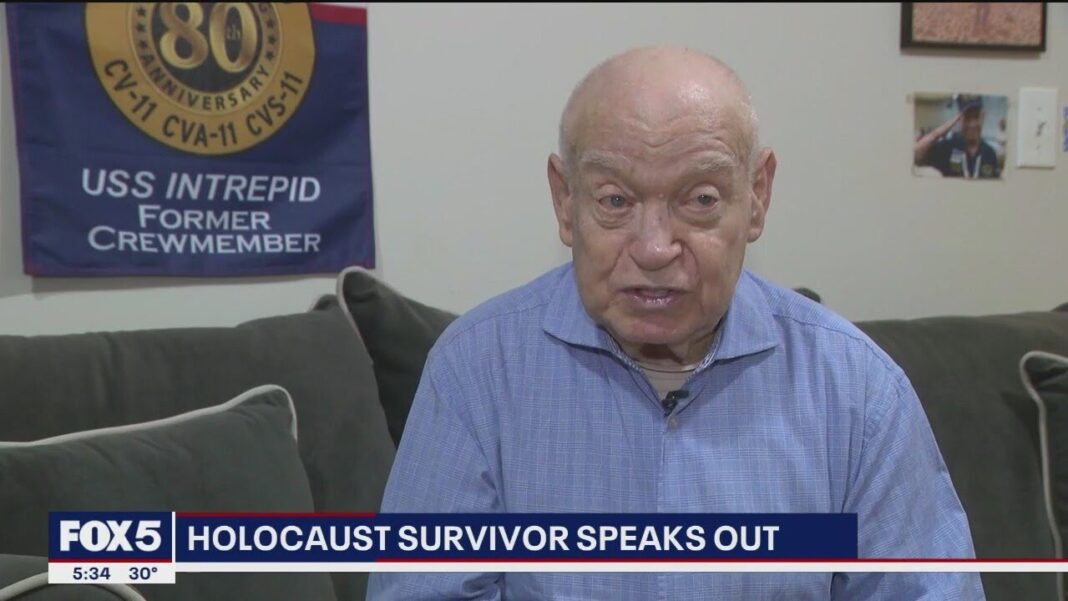
The controversy first surfaced in December, when Rusch declined a parent’s request to host Steigmann, a Holocaust survivor whose testimony has been shared in educational settings across the country. According to the information provided in the CBS News New York report, Rusch’s reasoning was grounded in concerns that Steigmann’s presentations, as reflected on his website, contained messages related to Israel and Palestine that she believed rendered them inappropriate for the school environment. In a Nov. 18 email to a parent, Rusch wrote that the speaker’s content was not right for the school “given his messages around Israel and Palestine,” invoking the Department of Education’s policy that students should learn in a politically neutral environment.
CBS News New York later obtained video from a Dec. 9 virtual PTA meeting in which Rusch elaborated on her decision. She emphasized that while Holocaust education is a vital component of historical learning, the school would pursue that objective through museum visits and other curricular avenues rather than through Steigmann’s presentation. “When I reviewed the speaker’s website,” Rusch said in the footage aired by CBS News New York, “I found the slides to be political in nature. DOE’s policy is that students should learn in a politically neutral environment.” Her reference was to a 2021 Department of Education policy stating that “school buildings are not public forums for purposes of community or political expression,” a provision designed to insulate classrooms from partisan advocacy.
Yet for many Jewish parents, the invocation of neutrality felt less like a safeguard than a silencing. CBS News New York reported that Steigmann himself said he had never spoken directly with Rusch prior to the decision, a fact that compounded the sense of grievance. “What I tell people that invite me,” he told CBS News New York on Dec. 4, “I said, look, I would like to say A, B, C, OK? Is it against your company’s or your school’s policy?” His remarks suggested a willingness to adapt his presentation to institutional guidelines, a possibility that parents argue was never explored.
In a surprising turn, the Department of Education reversed Rusch’s decision and extended an invitation to Steigmann to speak at the school, which he accepted. The report at CBS News New York confirmed that the survivor’s presentation was scheduled to take place on Thursday, with members of New York City’s Bipartisan Jewish Caucus planning to attend. The reversal, while welcomed by many parents, has not quelled calls for accountability. Some families and advocacy groups now argue that the initial refusal reflects a deeper pattern of insensitivity or bias, one that cannot be remedied by a belated invitation alone.
A spokesperson for the Department of Education told CBS News New York that the agency’s “top priority is ensuring their students feel safe and get the high-quality education they deserve,” adding that while it cannot comment on the outcomes of every reported incident, such concerns are handled as they arise. Rusch herself has declined to respond to multiple requests for comment from CBS News New York, a silence that parents interpret as emblematic of a broader reluctance to engage with their concerns.
For those parents, the Steigmann episode is not an isolated incident but part of what they describe as an emerging pattern. At the Dec. 9 PTA meeting, parent Ramon Maislen raised questions about how the school interprets political neutrality, pointing to a seventh-grade art assignment earlier in the fall that referenced keffiyehs, a garment widely recognized as a symbol of Palestinian pride. CBS News New York reported that Maislen contrasted the apparent acceptance of such contemporary political symbols in the classroom with the rejection of a Holocaust survivor’s testimony on grounds of political content. “So why is something that is being taught as current events, which is also political, acceptable,” he asked in comments broadcast by CBS News New York, “but the story of a Holocaust survivor is not acceptable because it’s too political?”
Maislen’s critique was careful to distinguish between the symbolic resonance of the keffiyeh and the intentions of those who wear it. As he told CBS News New York, most people who protest while wearing keffiyehs are not “hating Jews or anything like that,” but he acknowledged that a minority of voices within those movements espouse explicitly anti-Jewish sentiments. In his view, education should encompass the full breadth of contemporary realities, equipping students to understand both the historical traumas of the Holocaust and the complexities of present-day conflicts. The problem, he suggested, arises when the standards of neutrality appear unevenly applied, leaving certain narratives sidelined while others are permitted to enter the classroom.
Maislen also recounted a previous exchange with Rusch that deepened his misgivings. In December 2022, students attended a performance by the Bread and Puppet Theater titled “Apocalypse Defiance Circus,” which included a scene referencing U.S. military aid to Israel and exhortations to push until “Palestine is free, from the river to the sea.” CBS News New York reported that Maislen later emailed Rusch expressing concern about the political content of the performance. Her response, which he shared with CBS News New York, stated that teachers who accompanied the students did not perceive the tone as antisemitic and did not interpret the performance as criticism of Jews or Judaism. Rusch added that she did not sense the show presented Israel primarily as a Jewish state but rather as a country receiving substantial U.S. funding.
For some Jewish parents, that response crystallized a perception that concerns about antisemitic rhetoric were being minimized or reframed in ways that diminished their emotional impact. Several parents who spoke to CBS News New York requested anonymity, citing fears of retaliation within the school community. Their reluctance to go on the record calls attention to the vulnerability many families feel when navigating sensitive cultural and political issues within public institutions.
The controversy has now drawn the attention of organized advocacy groups. The United Jewish Teachers organization, according to CBS News New York, sent a Dec. 14 email to the district’s superintendent calling for Rusch’s removal, arguing that the principal has failed to accept responsibility for what the group characterizes as “bias against Israel.” The language of the letter reflects a growing impatience among Jewish educators who see the Steigmann incident as emblematic of a broader erosion of sensitivity toward Jewish identity and historical trauma within educational spaces.
The presence of members of the Bipartisan Jewish Caucus at Steigmann’s presentation, as reported by CBS News New York, adds a political dimension to what began as a localized dispute. Their attendance signals that the episode has transcended the confines of a single school, becoming a touchstone in a larger debate about how New York City’s public schools address antisemitism, the Holocaust, and contemporary geopolitical conflicts. It also reflects the extent to which educational controversies can rapidly acquire symbolic weight in a city where cultural diversity and political activism coexist in uneasy proximity.
At the heart of the dispute lies a philosophical question that educators across the country continue to grapple with: what does political neutrality mean in a classroom tasked with teaching history that is itself inseparable from politics? CBS News New York has framed the MS 447 controversy as a case study in the perils of misapplying neutrality as a blunt instrument. The Holocaust, while embedded in geopolitical narratives, is also a foundational event in the moral history of the modern world. To exclude survivor testimony on the grounds that it may touch upon contemporary issues risks impoverishing students’ understanding of how historical trauma reverberates into the present.
At the same time, administrators face legitimate pressures to ensure that classrooms do not become arenas for partisan advocacy. The Department of Education’s policy that school buildings are not public forums for political expression reflects a desire to protect students from being conscripted into ideological battles. Yet, as CBS News New York’s report suggests, the challenge lies in discerning where education ends and advocacy begins—a line that is often blurred when history intersects with ongoing conflicts.
For Steigmann, the opportunity to speak at MS 447 represents more than a personal vindication. His willingness to tailor his remarks to school guidelines, as he told CBS News New York, reflects a broader commitment among Holocaust survivors to engage younger generations in ways that are both historically rigorous and emotionally resonant. The fact that such testimony was initially deemed too political speaks to the precarious position of survivor narratives in a polarized cultural climate, where even the act of bearing witness can be construed as partisan.
As the school prepares to host Steigmann’s presentation, the atmosphere remains charged. CBS News New York’s correspondent Lisa Rozner made multiple attempts to secure a response from Rusch, calling and emailing her office with specific questions raised by parents and the United Jewish Teachers organization, but received no reply. The silence has become part of the story, a void into which parents project their anxieties and frustrations.
In the broader civic context, the MS 447 controversy places a spotlight on how debates over Israel, Palestine, and antisemitism have permeated American institutions far removed from the corridors of foreign policy. Public schools, tasked with cultivating critical thinking and empathy, are increasingly drawn into disputes shaped by global narratives and domestic tensions. CBS News New York has chronicled this episode not merely as a localized disagreement but as a microcosm of a national struggle to reconcile historical education with contemporary sensitivities.
The Department of Education’s reversal, while a significant gesture, leaves unresolved questions about institutional accountability and the processes by which decisions of such consequence are made. For parents calling for Rusch’s removal, the issue is not only about a single speaker but about trust—trust that school leaders will approach Jewish history and identity with the same care afforded to other narratives of oppression and resilience. For those urging restraint, the concern is that politicizing administrative decisions risks undermining the delicate balance educators must strike in diverse classrooms.
In Brooklyn Heights, the debate continues to unfold in PTA meetings, email exchanges, and quiet conversations among parents who worry about how their children’s identities are being acknowledged—or overlooked—within the curriculum. CBS News New York’s sustained coverage has illuminated the emotional undercurrents beneath the policy arguments, revealing a community grappling with how to honor the past while navigating the present. The invitation to Sami Steigmann may mark a step toward reconciliation, but the controversy that precipitated it has left an indelible mark on the school’s collective consciousness. In the end, the episode serves as a stark reminder that the politics of memory are never confined to textbooks; they are lived, contested, and negotiated in the everyday spaces where young people learn to understand the world and their place within it.

What a shame that the principal didn’t want him to come. I remember when I was a boy we had a clown come to our school and perform, we all loved it! It’s sad that these kids are getting robbed of that experience.