



|
Getting your Trinity Audio player ready...
|
NYPD Shares images of Additional Suspects Sought in Snowball Attack on Officers Amid Post-Blizzard Turmoil
By: David Avrushmi
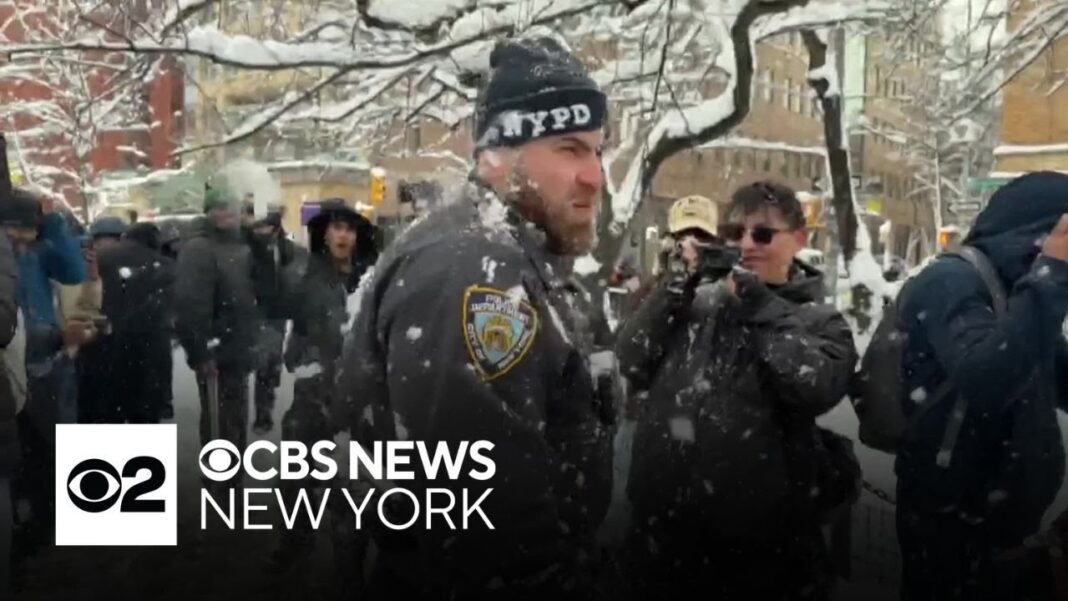
In the fragile calm that followed one of New York City’s most punishing blizzards in recent memory, a scene of startling disorder unfolded beneath the bare trees and snow-laden arches of Washington Square Park. What began as youthful exuberance in the wake of a storm that had paralyzed transit and blanketed neighborhoods in ice and powder devolved, within minutes, into a confrontation that city officials and police leaders now describe as a criminal assault on uniformed officers.
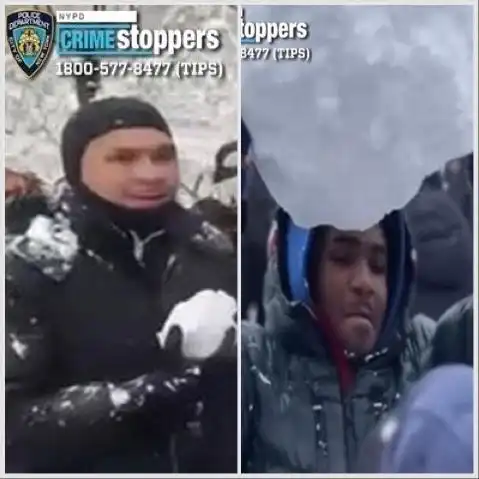
As The New York Post reported on Wednesday, the New York Police Department has released surveillance images of two additional suspects believed to have participated in pelting police officers with snow and ice, deepening a controversy that has ignited debate about public safety, leadership, and the erosion of respect for authority in moments of civic strain.
The images, grainy yet unmistakable in their implications, capture two young men, estimated by investigators to be between 18 and 20 years old, clad in black jackets. One is seen hefting an unusually large, compacted mass of snow, its heft suggesting not a playful toss but a projectile capable of inflicting genuine injury. The other, hood drawn tight against the bitter cold, appears poised mid-action, the frozen clump in his gloved hand aimed toward a cluster of officers. According to the NYPD, these two suspects are now being sought for criminal charges, joining two other men whose images had been released earlier in the week as part of a widening manhunt.
The department’s account of the incident paints a portrait of chaos that belies any attempt to trivialize the encounter. The mayhem erupted shortly after 4 p.m. on Monday, when a 911 call reported teenagers hurling snow from the roof of the park’s comfort station. What might have been resolved as a minor disturbance escalated precipitously. Officers responding to the call found themselves confronted by a larger, disorderly crowd, and within moments, uniformed cops were being pelted at close range with hardened snow and ice.

Two officers were subsequently treated at a local hospital. One suffered what sources described to The New York Post as a possible bruise behind the eye, while another reported a headache after being struck in the back of the head. In the annals of urban policing, such injuries may not rank among the gravest, but the symbolism of the attack—officers targeted for no reason other than their presence—has resonated powerfully across the city.
Police unions, long sensitive to what they perceive as a waning respect for law enforcement, were swift and unequivocal in their condemnation. NYPD Commissioner Jessica Tisch, in a statement posted to social media and quoted prominently by The New York Post, dispensed with euphemism.
“I want to be very clear: The behavior depicted is disgraceful, and it is criminal,” she declared, underscoring that the department regards the incident not as wintertime mischief but as an assault warranting full investigative and prosecutorial rigor. Her words echoed the sentiments of union leaders who have warned for years that even seemingly minor acts of violence against police can metastasize into a broader culture of impunity if left unchecked.
Yet the episode has also exposed fault lines within City Hall. Mayor Zohran Mamdani, while acknowledging in public remarks that police officers deserve respect, characterized the incident in markedly softer terms. In a post cited by The New York Post, the mayor referred to having seen videos of “kids throwing snowballs” at officers, framing the episode as juvenile antics rather than a coordinated assault.
He praised city workers for their efforts during the blizzard and offered himself, rhetorically, as a more fitting target for snowballs than the officers who had just labored through treacherous conditions to keep streets passable. The mayor’s tone, conciliatory toward the police yet dismissive of the severity of the incident, has been interpreted by critics as emblematic of a broader ambivalence in the city’s political leadership toward law enforcement.

This divergence in official narratives has amplified public unease. For many New Yorkers, the blizzard was a reminder of the city’s vulnerability and the indispensable role of its emergency services. The sight of officers being attacked in the immediate aftermath of such a storm struck a jarring note, suggesting that the thin veneer of civility can crack under the weight of collective fatigue and pent-up frustration. The New York Post report emphasized the psychological dimension of the incident: a city emerging from confinement and hardship, its residents oscillating between relief and restlessness, with some venting their energies in destructive ways.
The release of additional suspect images marks a pivotal moment in the NYPD’s response. By publicizing the faces of those believed to be responsible, the department is signaling both its determination to pursue accountability and its reliance on the public’s assistance in restoring order. Such tactics, while effective in many cases, also carry risks, including the potential for misidentification and the hardening of adversarial attitudes between communities and police.
Yet in this instance, the clarity of the surveillance footage and the specificity of the allegations—intentional strikes to the head, neck, and face with ice-laden projectiles—have bolstered the department’s case that these were not accidental or playful acts.
The incident has also reignited perennial debates about youth behavior in public spaces, particularly in the charged atmosphere that often follows extreme weather events. Sociologists and criminologists have long noted that moments of collective disruption—blackouts, storms, transit shutdowns—can produce both solidarity and opportunism.
In Washington Square Park, a historic gathering place for students and artists, the blizzard’s aftermath appears to have catalyzed a volatile mix of cabin fever and performative defiance. The New York Post has reported that the initial 911 call concerned teens throwing snow from a rooftop, a reckless act in itself, but one that escalated dramatically once police intervened.
At a deeper level, the controversy surrounding Mayor Mamdani’s remarks speaks to the power of language in shaping public norms. To describe the assault as “kids throwing snowballs” risks normalizing behavior that the NYPD and legal code classify as criminal.
Critics argue that such framing, even if unintended, may embolden future misconduct by signaling that attacks on officers will be met with rhetorical leniency. Supporters of the mayor counter that de-escalatory language can prevent the criminalization of youthful mistakes and reduce the temperature of public discourse. The tension between these perspectives reflects a broader struggle to balance compassion with accountability in a city grappling with rising anxieties about safety and governance.
For the officers involved, the debate is not abstract. Being struck in the face or head by compacted ice is not a trivial inconvenience; it is a reminder that the uniform can render one a target, even in moments when the city is ostensibly united against the elements. Police morale, already strained by staffing challenges and public scrutiny, absorbs such incidents as personal affronts. The unions’ vocal reaction, amplified by The New York Post, underscores a belief that unequivocal condemnation from political leaders is essential to maintaining the dignity and safety of the force.
As the investigation continues and the NYPD seeks to identify and apprehend all those involved, the Washington Square Park episode stands as a cautionary tableau. It reveals how quickly the line between celebration and chaos can blur, how fragile the social contract becomes when fatigue and anonymity converge, and how leadership—through the words it chooses—can either reinforce or erode the norms that sustain civic life.
In the days ahead, as prosecutors weigh charges and the public digests new revelations from The New York Post, New York will be forced to confront uncomfortable questions about respect, responsibility, and the meaning of order in a city that prides itself on resilience but remains vulnerable to moments of winter-born lawlessness.
