



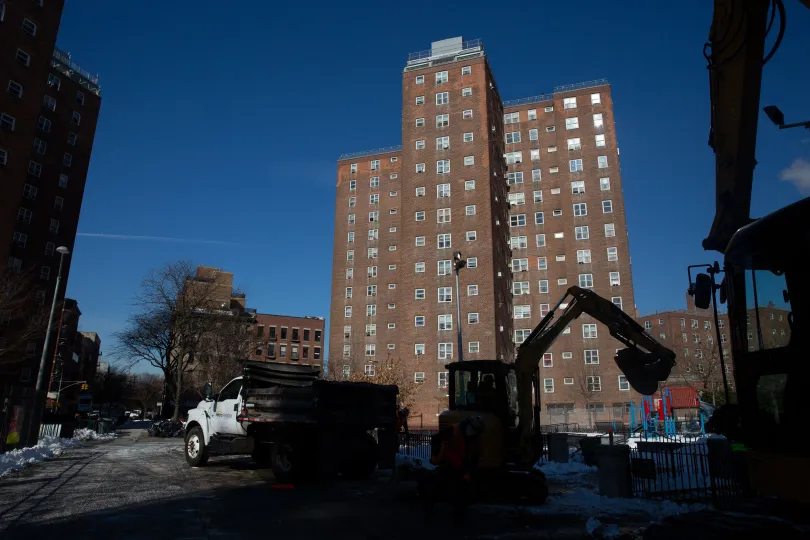
The federal overseer of the city’s public housing system demands all documentation be preserved, as it pursues investigation into toxic water at Manhattan’s Riis Houses.
By: Greg B. Smith
The federal monitor overseeing NYCHA has ordered the agency’s management not to destroy any documentation related to the discovery of arsenic in the water at a Lower East Side housing development and to preserve all related records going forward.
Federal Monitor Bart Schwartz on Saturday opened an investigation into NYCHA’s actions before tests the authority received Thursday registered levels of arsenic in the tap water at Riis “higher than the federal standard for drinking water.”
Tests ordered up by NYCHA in August declared the water at Riis drinkable, but did not include checking for arsenic. For reasons not yet clear, NYCHA then hired a new vendor for a retest and this time the results detected arsenic.
Late Saturday Joseph Jaffe, one of the monitor’s investigators, sent NYCHA’s chief compliance officer, Brad Greenburg, and the authority’s general counsel, Lisa Bova-Hiatt, a “request for preservation” letter as the first step in the unfolding probe.
“To ensure the integrity of any inquiry and for the safety of the residents now and in the future, we ask you to promptly confirm that you agree to suspend all document destruction, whether routine or otherwise, with respect to this issue,” the letter states.
Jaffe requested that NYCHA management “preserve all documents related to this issue and to thereafter implement the document preservation” protocols requiring that any records related to the Riis arsenic situation be kept on hand and available to the monitor’s team.
The documents requested cover a wide variety of records that would chronicle how NYCHA handled water testing at Riis this summer and perhaps explain in better detail what happened.
Records requested include “electronic and paper communications, letters, memoranda, drafts, transmittals, notes, time lines, test results, email transmissions, texts, postings, voicemail, recorded conversations, etc., including all copies, whether duplicative or not.”
The monitor was appointed following a 2016 investigation by the Manhattan U.S. Attorney that found NYCHA management had for years covered up unhealthy and unsafe conditions such as lead paint, toxic mold and vermin infestations in many of the authority’s 175,000 apartments.
The turmoil at Riis began behind the scenes Thursday when NYCHA management received a report from the vendor it had hired to retest Riis’ water that detected traces of arsenic in the tap water. But the authority did not tell the public or tenants at Riis about it until late Friday, and only after THE CITY began asking questions about it Friday afternoon.
Mayor Eric Adams then suddenly added an event to his public schedule, announcing he would be visiting Riis after 10 p.m. Friday to hand out bottled water. After midnight he tweeted photos of himself doing that, but did not reveal the arsenic findings in either the announcement or the tweet.
Late Friday after Adams had handed out the water, a mayoral spokesperson, Charles Lutvak, released a statement stating that “preliminary results received today from retesting showed arsenic levels higher than the federal standard for drinking water.”
Actually, the test results had been received more than 24 hours earlier.
On Sunday, Lutvak amended that statement, for the first time claiming the retesting results “left open the possibility of potential contaminants, including arsenic.” Lutvak now said the results “were found to be questionable, so we have and are continuing to run multiple additional tests.”
He said on Sunday the city’s Department of Environmental Protection (DEP) performed new tests that “did not detect arsenic from the water source entering the building” where arsenic was detected in tests performed last week.
