



|
Getting your Trinity Audio player ready...
|
By: Darryl Myers
In a groundbreaking move by the Adams administration, fast-food chains and coffee shops across New York City are set to implement a new regulation. This regulation mandates the inclusion of warning labels on menu boards and packaging, aimed at raising awareness about high levels of added sugar in certain food and beverage items, the New York Post recently reported.
The initiative, spearheaded by the city’s Health Department, will require establishments to prominently display labels alerting customers to products containing over 50 grams of added sugar. This includes a variety of offerings such as frozen coffee drinks from popular chains like Starbucks and Dunkin’ Donuts, fountain sodas, and even hot chocolate. Recognizable by a warning icon—a spoon laden with sugar—the labels are intended to inform consumers and potentially deter excessive sugar consumption.
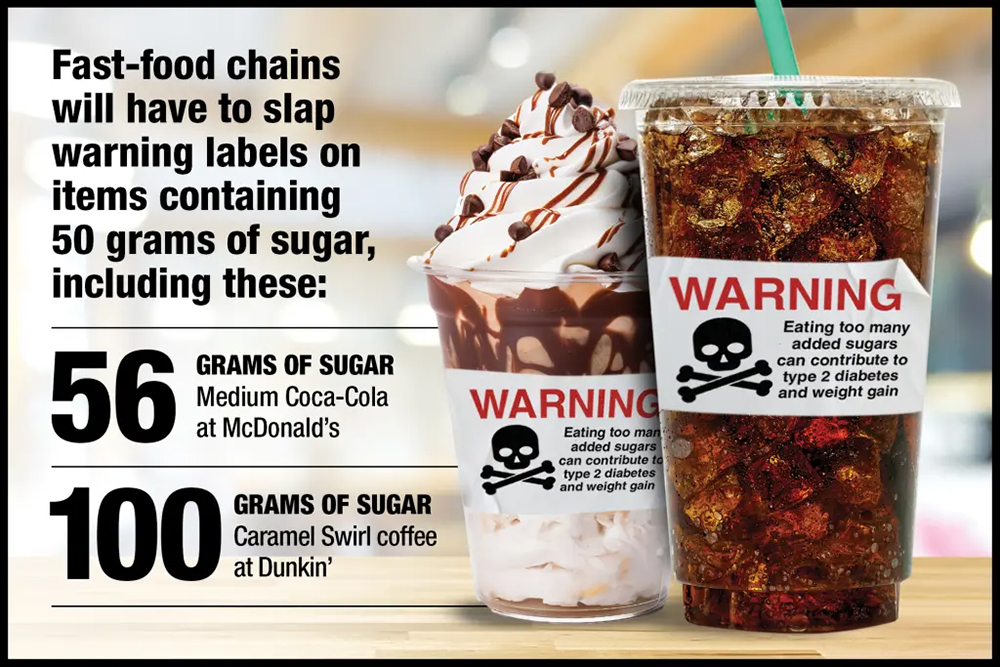
The proposed warning message will convey, “Eating too many added sugars can contribute to type 2 diabetes and weight gain,” underscoring the serious health implications associated with excessive sugar intake. The Health Department emphasizes the significant impact of type 2 diabetes on premature mortality rates in New York City, reinforcing the necessity for proactive measures.
Aligned with national dietary guidelines recommending a daily added sugar intake of less than 50 grams or 10% of a 2,000-calorie diet, the regulation aims to promote healthier dietary choices. Examples provided by advocacy groups like the Center for Science in the Public Interest illustrate the substantial sugar content in commonly consumed beverages, such as a medium Coca-Cola drink at McDonald’s exceeding the threshold for mandatory warning labels.
To enforce compliance, the city has outlined penalties ranging from $200 to $500 per violation for restaurants failing to adhere to the regulation. Public input on the proposed rule is currently being solicited, with implementation slated for June 19 for prepackaged foods and December 1 for beverages and non-packaged items sold in restaurants.
While some critics decry the regulation as governmental overreach, citing concerns about personal freedom and individual responsibility, health advocates laud it as a crucial step in combatting alarming rates of diabetes. Dr. DeAnna Nara from the Center for Science in the Public Interest commends the initiative for empowering consumers to make informed choices and encouraging the food industry to offer healthier alternatives.
Mayor Adams follows in the footsteps of his predecessors, notably former Mayors Bloomberg and de Blasio, who championed public health initiatives. Bloomberg’s tenure saw controversial measures like the smoking ban and restrictions on trans fats, while de Blasio’s administration introduced warnings for high-sodium menu items. Adams continues this legacy with efforts to limit sugary beverages in schools, though facing opposition from industry stakeholders and lawmakers.
Despite resistance from various quarters, the regulation reflects a broader societal shift towards prioritizing health and wellness, underscoring the evolving role of government in public health interventions.
