



|
Getting your Trinity Audio player ready...
|
NYC Enters State of Emergency as Blizzard Prompts Closure of Roads and Bridges to Nonessential Traffic
By: Fern Sidman
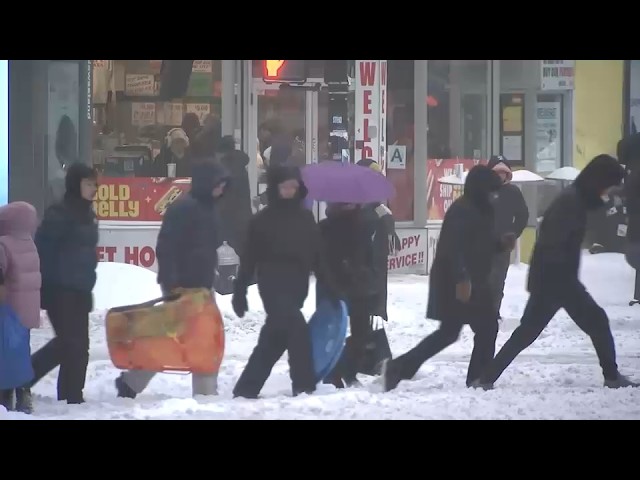
As dusk settled over the canyons of Manhattan on Sunday evening, the city’s familiar rhythms—sirens and subway rumbles, the low murmur of traffic over bridges, the restless choreography of a metropolis perpetually in motion—were abruptly interrupted by an edict more commonly associated with wartime curfews than winter weather. Mayor Mamdani declared a state of emergency as meteorologists revised their forecasts upward, warning that the blizzard bearing down on New York City could deposit nearly two feet of snow across the five boroughs. The New York Daily News reported that the mayor’s announcement, delivered with uncommon urgency, was accompanied by a sweeping closure of all streets, highways, and bridges beginning at 9 p.m. Sunday and extending through noon Monday, with only essential and emergency vehicles permitted to traverse the city’s arteries.
The New York Daily News chronicled the extraordinary nature of the shutdown, noting that it effectively placed one of the world’s most densely trafficked urban environments into temporary stasis. For a city accustomed to improvising around inclement weather rather than capitulating to it, the decision marked a striking acknowledgment of the storm’s anticipated ferocity. The mayor’s declaration also triggered the first full public school snow day in years, with no recourse to remote learning—a symbolic return to the pre-pandemic grammar of winter closures that underscored the gravity with which City Hall now regarded the approaching system.
According to officials from the city’s Office of Emergency Management, the storm’s onset would be deceptively gradual. Light snow was expected to begin earlier in the evening, before the squall intensified dramatically around 9 p.m. Sunday and persisted through the early hours of Monday morning. The New York Daily News report relayed the stark language of Emergency Management officials, who warned that snowfall rates could surge to two to three inches per hour, with total accumulations ranging from 18 to 22 inches and potentially exceeding those figures in heavier snow bands. The meteorological profile was further complicated by wind gusts of up to 55 miles per hour, conditions likely to generate whiteout visibility, severe drifting, and treacherous travel hazards. In low-lying coastal neighborhoods, moderate flooding during high tide threatened to compound the disruption.
The severity of the forecast represented a sharp escalation from predictions issued just a day earlier. On Saturday, many forecasters had projected accumulations in the range of 13 to 17 inches. By Sunday, as atmospheric models converged on a more ominous trajectory, the anticipated totals were revised upward, prompting City Hall to pivot from preparation to preemptive immobilization. The New York Daily News report noted that this recalibration of risk reflected a broader trend in contemporary weather forecasting, where increasingly volatile climate patterns render early projections provisional and demand agile policymaking as new data emerges.
The storm’s immediate impact was already evident in the region’s air travel infrastructure. By late Sunday morning, nearly 2,200 outgoing and incoming flights had been canceled at John F. Kennedy International Airport, LaGuardia Airport, and Newark Liberty International Airport, according to flight tracking data cited in The New York Daily News report. The cancellations foreshadowed a cascading disruption that would ripple through airline networks nationwide, stranding travelers and testing the resilience of logistical systems already strained by seasonal demand. For New York, a global aviation hub, the mass grounding of flights served as a prelude to the broader paralysis that would soon envelop streets and bridges.
The National Weather Service’s issuance of a blizzard warning across all five boroughs lent further gravity to the unfolding situation. The New York Daily News report emphasized the rarity of such warnings in the city, noting that New York had not seen a blizzard warning since 2017. The current alert extended beyond the city limits to encompass Long Island, the Lower Hudson Valley, southern Connecticut, and much of New Jersey, underscoring the regional scale of the impending storm. In this context, New York’s decision to enact sweeping closures appeared less an overreaction than a calibrated response to a meteorological event of exceptional magnitude.
Mayor Mamdani, who addressed the city on Sunday morning, sought to project a posture of readiness even as he acknowledged the severity of the forecast. He warned of potential accumulations of 18 to 22 inches, pledged that homeless outreach teams would be working around the clock, and assured residents that the Sanitation Department stood ready to confront the deluge.
These assurances, however, were delivered against the backdrop of recent criticism of the mayor’s crisis management. In the wake of a historic cold snap and the January 25 snowstorm, Mamdani had faced intense scrutiny after eighteen New Yorkers died outdoors amid questions about his decision to end homeless encampment sweeps initiated under the previous administration. The New York Daily News report documented how garbage piled up on city streets and bus stops remained blocked by snow for days after that storm, fueling public skepticism about the administration’s preparedness.
In this context, the preemptive shutdown of the city can be read as both a protective measure and a reputational recalibration. City Hall appeared keenly aware that any perceived lapse in preparedness during this blizzard would be judged not in isolation but as part of a narrative arc shaped by recent failures. The deployment of 24/7 outreach teams and the conspicuous readiness of sanitation crews were thus as much about restoring public confidence as about mitigating the immediate dangers posed by the storm. The closure of thoroughfares, while disruptive, was framed as a decisive act designed to avert the cascading hazards of stranded vehicles, impassable emergency routes, and preventable injuries.
The historical resonance of the forecast has also been a prominent feature of the coverage. The New York Daily News report contextualized Sunday’s anticipated snowfall within the annals of New York’s most significant snowstorms, noting that accumulations approaching two feet could rank the event among the city’s most formidable winter tempests in the past century and a half. Central Park’s record of 27.5 inches in January 2016, which eclipsed the previous 26.9-inch benchmark set in February 2006 and the 26.4 inches recorded in the post-Christmas storm of 1947, looms as a benchmark against which this storm may be measured. The invocation of these historical milestones serves to situate the present crisis within a lineage of meteorological extremes that have periodically tested the city’s infrastructure and collective resolve.
For residents, the practical implications of the shutdown are immediate and profound. The New York Daily News report captured the eerie stillness that descends upon the city when its arteries are closed, a phenomenon that transforms familiar streets into snowbound corridors of silence. The cessation of traffic offers a fleeting glimpse of an alternate urban reality, one in which the incessant motion of commerce and commuting is suspended in deference to natural forces. Yet beneath this momentary stillness lies a web of anxieties: concerns about access to medical care, the vulnerability of the unhoused population, and the logistical challenges of resuming normalcy once the storm abates.
The plight of the homeless looms particularly large in this narrative. The New York Daily News’ reporting on the mayor’s pledge of round-the-clock outreach reflects a recognition that blizzards do not merely inconvenience the housed population; they pose existential risks to those without shelter. The recent deaths during the cold snap have heightened public sensitivity to this dimension of winter emergencies, rendering the city’s response to the current storm a test of its moral as well as administrative capacities. Whether outreach teams can effectively locate and shelter those at risk amid whiteout conditions remains an open question, one that will shape post-storm assessments of the administration’s performance.
As the storm gathers force, the city’s decision to impose a temporary immobilization of urban life stands as a stark reminder of the limits of human control in the face of environmental extremity. The New York Daily News report portrayed the blizzard not merely as a weather event but as a civic ordeal, one that compresses questions of governance, infrastructure, and social responsibility into a narrow window of time. In the coming hours, as snowdrifts rise and winds scour empty avenues, the efficacy of the city’s preparations will be tested against the relentless arithmetic of accumulation and gust.
When the blizzard finally loosens its grip, New York will awaken to a transformed landscape, its familiar contours softened and obscured by snow. The work of recovery—clearing streets, restoring transit, reopening bridges—will unfold in the glare of public scrutiny, informed by memories of recent missteps and buoyed by hopes that this time, the city has learned from its past. For now, the metropolis stands on the threshold of enforced stillness, bracing itself for a whiteout that promises to write a new chapter in its long, weather-beaten history.
