



|
Getting your Trinity Audio player ready...
|
Man Accused in Vehicle Attack on Chabad Headquarters Charged with Multiple Hate Crimes
By: Fern Sidman
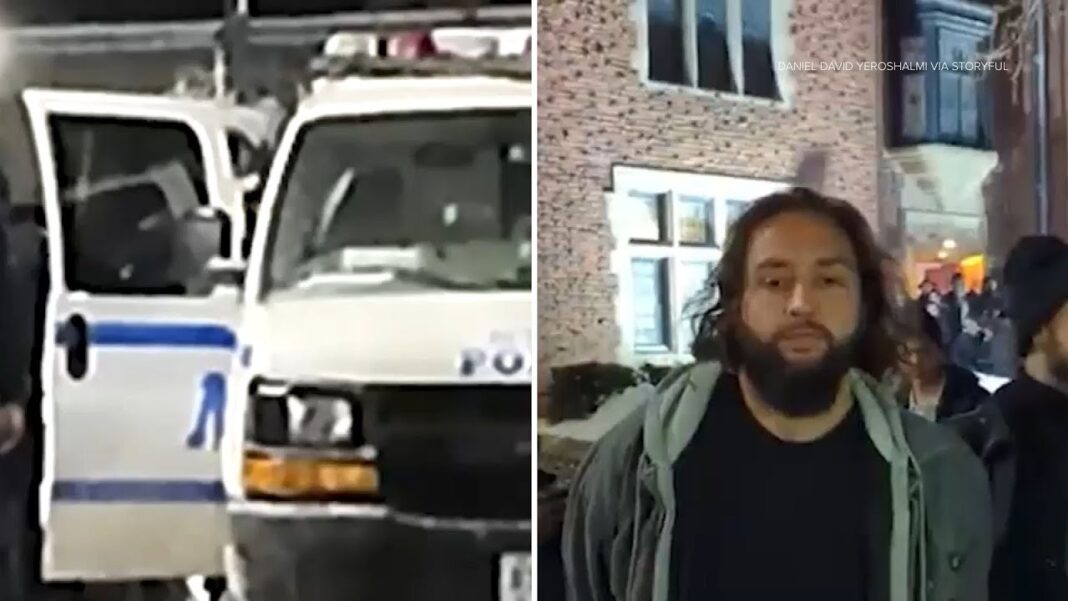
On a winter evening heavy with sacred meaning and historical memory, the doors of one of the most symbolically powerful Jewish institutions on Earth became the target of a violent act that reverberated far beyond the physical damage it caused. As reported on Thursday by The Jewish News Syndicate (JNS), a man identified as Dan Sohail, 36, of Carteret, New Jersey, is accused of deliberately ramming his vehicle into the entrance of the Chabad-Lubavitch World Headquarters at 770 Eastern Parkway in Crown Heights, Brooklyn, no fewer than five times on Wednesday evening. The building—known globally as “770”—is not merely a synagogue, not merely a headquarters, but a spiritual epicenter for the Chabad-Lubavitch movement and a landmark of Jewish continuity, resilience, and post-Holocaust revival.
According to NYPD Chief of Detectives Joseph Kenny, who addressed the press in the aftermath of the attack, Sohail intentionally targeted the structure, removing barricades, instructing bystanders to move away, and repeatedly accelerated into the doors of the building. As JNS reported, the NYPD has formally classified the incident as a hate crime, with the department’s Hate Crime Task Force assuming leadership of the investigation in coordination with state and federal partners. Sohail now faces a cascade of serious charges, including attempted assault, reckless endangerment, criminal mischief, aggravated harassment, and multiple hate crime enhancements.
The gravity of the act lies not only in the violence itself, but in its location, its timing, and its symbolism. Wednesday marked the 10th of Shevat (Yud Shevat), one of the most sacred days in the Chabad calendar, commemorating the 75th anniversary of Rabbi Menachem Mendel Schneerson assuming leadership of the movement in 1951. Tens of thousands of Chabad followers from across the world converge annually on Crown Heights to mark this date, transforming 770 Eastern Parkway into a site of global Jewish pilgrimage. The headquarters was filled to capacity with visitors from Israel, Europe, Latin America, and communities across North America when the attack occurred.
The building itself is perhaps unique in global religious architecture. Motti Seligson, a Chabad spokesman, described it as “perhaps the most replicated building in the world because of the light, joy, Torah and a confident Judaism that emanates from it to all corners of the world.” That symbolism transforms any attack on 770 into more than vandalism—it becomes an assault on the spiritual identity of a global community.
The suspect’s background adds further complexity and concern. Chief Detective Kenny revealed that Sohail had previously “connected with the Lubavitch community” and had removed blockades from the same site the day before the attack. Video footage, widely circulated and analyzed by JNS, appears to show Sohail calmly clearing barriers, warning bystanders to step away, and methodically carrying out the ramming. Witnesses reported that he had previously visited the location weeks earlier, claiming to be Jewish, and had been offered religious services by students.
Further reporting cited by JNS indicates that Sohail had also appeared at a Chabad house in New Jersey, where he told members of the community that he was homeless and seeking to convert to Judaism. Counselors at that site reportedly recommended mental health intervention. Additional reports suggest that he had attempted to access a yeshiva in the Garden State and had been denied entry. These details, while still under investigation, paint a picture of a man with prior proximity to Jewish spaces—making the alleged act not merely random violence, but targeted desecration.
Israeli Consul General in New York Ofir Akunis responded with stark clarity, framing the incident as part of a broader ideological campaign. Akunis declared: “This is the new reality in New York for Jews. We are seeing one antisemitic attack followed by the next on houses of worship, targeting Jews simply because they are Jewish.” He warned that the attack was not isolated, but embedded within a “long-running campaign to dehumanize Jews and delegitimize the existence of the Jewish state,” driven by “toxic and violent rhetoric” that normalizes hatred under the guise of political discourse.
Akunis directly linked the escalation of antisemitic violence to policy decisions, noting the lifting of bans on boycott initiatives against Israel and changes to the official definition of antisemitism. As reported by JNS, he warned that rhetorical delegitimization inevitably incubates physical violence—a progression history has repeatedly demonstrated.
The political context in New York adds further tension. Mayor Zohran Mamdani, who assumed office after immediately rescinding several executive orders designed to protect Jewish communities—including bans on city agency participation in boycotts of Israel and the adoption of the International Holocaust Remembrance Alliance definition of antisemitism—now finds himself navigating a city increasingly alarmed by antisemitic violence. Mamdani has previously stated he would seek the arrest of Israel’s prime minister in New York and has expressed interest in divesting city funds from Israel Bonds, positions that have strained relations with large segments of New York’s Jewish population.
While Mamdani issued statements condemning the attack, describing it as “deeply alarming,” critics quoted by JNS note the tension between rhetorical condemnation and policy posture. The mayor acknowledged that the attack occurred on a date sacred to Chabad and immediately following International Holocaust Remembrance Day, emphasizing that antisemitism “is not simply something of the past to be learned about. It is a living, breathing thing that we have to combat every day.”
Yet concerns persist. As JNS reported, Mamdani is reportedly considering appointing figures described as critical of Chassidic communities to lead the Mayor’s Office on Combating Antisemitism—a move that has drawn sharp backlash from Jewish leaders who view it as contradictory to the mission of protecting vulnerable communities.
New York Governor Kathy Hochul responded with unequivocal language, stating that “for the second day in a row, Jewish New Yorkers were the targets of antisemitic violence,” adding that “an attack against the Jewish community is an attack against all New Yorkers.” Both U.S. Senators from New York, Chuck Schumer and Kirsten Gillibrand, issued statements condemning the assault as an attack not just on a building, but on Jewish identity itself.
The Orthodox Union, cited in the JNS report, framed the incident in theological as well as civic terms, calling it a “sacred responsibility” for authorities to prioritize Jewish safety amid what it described as “unprecedented threats.”
Federal attention followed swiftly. Harmeet Dhillon, U.S. Assistant Attorney General for Civil Rights, announced the initiation of a civil rights investigation, signaling that the incident has crossed from local crime into national concern—a transition that reflects the broader trajectory of antisemitic violence in the United States.
The deeper resonance of the attack lies in its symbolism. 770 Eastern Parkway is not simply a building. It represents a post-Holocaust renaissance of Jewish confidence, outreach, and global religious engagement. It is a symbol of a Judaism that does not hide, does not retreat, and does not apologize for its presence. To strike it is to strike an idea: visible Jewish continuity in the public square.
As JNS has repeatedly documented, antisemitism in the contemporary era increasingly presents itself through hybrid forms—blending ideological hostility to Israel, cultural delegitimization of Jewish identity, and the normalization of dehumanizing rhetoric that erodes moral barriers to violence. The Crown Heights attack sits squarely at this intersection.
What makes the incident especially chilling is its calculated nature. This was not a moment of rage. It was structured, deliberate and repetitive. It involved preparation, barrier removal, warnings to bystanders, and sustained targeting of a religious institution. The classification as a hate crime reflects not only intent, but ideological direction.
The fact that no one was physically injured does not diminish the gravity of the act. Violence against sacred spaces carries a symbolic lethality of its own. It sends a message not merely to individuals, but to entire communities: that their sanctuaries are no longer safe, that their visibility invites risk, that their institutions can be targeted.
As the JNS report emphasized, the question facing New York—and increasingly Western societies more broadly—is not whether antisemitism exists, but whether it will be confronted structurally rather than symbolically. Condemnations alone do not dismantle ideological ecosystems that normalize hatred. Statements alone do not counter propaganda. Investigations alone do not repair the cultural erosion that makes such acts conceivable.
The assault on 770 is therefore not an isolated criminal case; it is a diagnostic moment. It reveals the fragility of communal safety, the consequences of rhetorical radicalization, and the vulnerability of religious institutions in a polarized ideological climate. It also reveals the resilience of the community itself—no panic, no violence in response, no retreat into fear, only clarity, resolve, and a reaffirmation of identity.
In Jewish history, sacred spaces have always been targets when hatred seeks symbolic dominance. From synagogues in medieval Europe to Torah scrolls in Soviet Russia to Jewish cemeteries in modern democracies, the pattern is tragically consistent. The Crown Heights attack now joins that lineage.
And yet, as the history of 770 itself demonstrates, Jewish continuity has never been defined by what seeks to destroy it, but by what it builds in response. The Lubavitcher Rebbe transformed trauma into outreach, devastation into global networks of education, and persecution into resilience. The building that was struck is itself a monument to that transformation.
As JNS reported, the coming weeks will test not only law enforcement and political leadership, but the moral coherence of New York’s public discourse. Will antisemitism be addressed as a foundational threat to pluralism, or treated as one grievance among many? Will Jewish institutions be protected as cultural heritage, or politicized as ideological symbols? Will policy align with rhetoric, or diverge from it?
What is certain is that steel struck stone—but it did not fracture the foundation. The doors may bear marks of impact, but the institution they protect remains intact, its meaning undiminished, its global resonance unbroken.
In the language of Jewish history, attacks come and go. Identity endures. Structures can be repaired. Communities rebuild. But moments like this demand clarity: clarity of language, clarity of policy, clarity of moral responsibility.
As the JNS report has made clear: the assault on Chabad-Lubavitch headquarters is not merely a local crime story. It is a warning flare in the cultural night sky—a signal that the struggle against antisemitism is not a memory, not a lesson, not a chapter in history books, but a present-tense reality demanding present-tense courage.
The doors of 770 will be repaired. But the deeper repair—of civic trust, communal safety, and moral clarity—belongs to the city itself.
