



|
Getting your Trinity Audio player ready...
|
Mamdani Names Immigration Chief With Past Ties to Controversial Muslim Advocacy Group
By: Fern Sidman
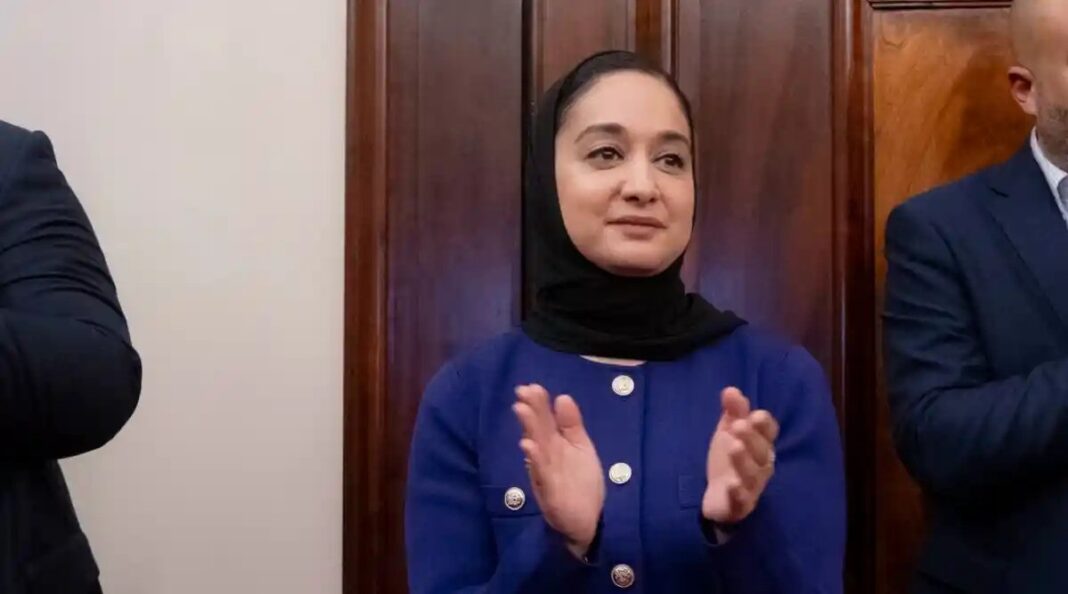
The appointment of Faiza Ali as New York City’s new chief immigration officer has thrust City Hall into another bruising political controversy, one that fuses the combustible issues of immigration policy, Middle East politics, and the fraught question of ideological vetting within municipal government. As The New York Post reported on Tuesday, Mayor Zohran Mamdani this week selected Ali, a longtime activist with past ties to the Council on American-Islamic Relations and a close association with anti-Israel firebrand Linda Sarsour, to lead the Mayor’s Office of Immigrant Affairs. The choice, hailed by the administration as a bold affirmation of New York’s immigrant identity, has simultaneously ignited alarm among critics who view Ali’s activist pedigree and affiliations as emblematic of a troubling ideological drift within city governance.
In a statement announcing the appointment, Mamdani framed the decision as a moral and political imperative. “At a time when immigrant New Yorkers face escalating attacks and uncertainty, this administration will not equivocate. We will defend our neighbors. We will expand access to services,” he said, according to The New York Post report, adding that he was “proud” to elevate Ali to a role that carries substantial influence over policy design, outreach strategies, and the city’s posture toward federal immigration enforcement. The rhetoric of protection and expansion is a familiar register in Mamdani’s political lexicon, one that emphasizes sanctuary policies and frames immigration not merely as an administrative concern but as a defining moral project for the city.
Ali’s professional trajectory, however, has ensured that her appointment would be read not only through the prism of immigration policy but also through the contested politics of the Middle East and domestic activism. As The New York Post report detailed, Ali previously served as deputy chief of staff to former City Council Speaker Adrienne Adams, a position that placed her at the center of legislative strategy and intergovernmental coordination. Beyond City Hall, her résumé reflects more than a decade of involvement in religiously inflected activism, including a stint as community affairs director at CAIR, the controversial Muslim civil rights organization.
CAIR’s prominence in American Muslim advocacy has long been accompanied by allegations of ideological proximity to Islamist movements. The New York Post report noted that the organization has faced accusations of links to terror groups such as Hamas and the Muslim Brotherhood, claims that CAIR has repeatedly rejected but which continue to animate public debate. The controversy was renewed following comments by CAIR’s executive director, Nihad Awad, who publicly characterized Hamas’s Oct. 7, 2023 attack on Israel as a form of resistance, calling Israel an “occupying power” and suggesting that Gaza was “breaking the siege.”
Although Awad later said his remarks were taken out of context, as reported by The New York Post citing Fox News, the episode crystallized for many observers the fraught intersection between domestic activism and international conflict narratives.
Ali’s longstanding association with Linda Sarsour has further amplified scrutiny. The New York Post report recalled that a 2012 New York Times profile chronicled their religious activism in New York City, situating both women within a milieu of faith-based progressive organizing. Their partnership extended into the era of national protest movements; in 2017, Ali and Sarsour were arrested together during a demonstration outside Trump Tower, a tableau emblematic of the Trump years’ polarization.
Sarsour, a polarizing figure in her own right, has been accused of antisemitism over public praise for Rasmea Odeh, a convicted terrorist involved in a 1970s Jerusalem supermarket bombing that killed two civilians. For critics, Ali’s proximity to Sarsour raises questions about the ideological ecosystem from which she emerges and the messages her appointment may signal to Jewish communities already unsettled by rising antisemitism in the city.
Yet Ali’s supporters point to a narrative of civic ascent rooted in immigrant experience and post-9/11 discrimination. The New York Post report highlighted that Ali, the daughter of Pakistani immigrants who grew up in Brooklyn, has described Islamophobic harassment following the Sept. 11, 2001 terror attacks as a formative catalyst for her activism.
Her career arc, culminating in her becoming the first Muslim woman to serve as a first deputy chief of staff in the City Council, has been celebrated in progressive circles as a testament to representation and inclusion. Crain’s New York Business named her to its 2022 “40 under 40” list, underscoring her rising profile within the city’s political establishment.
In her own words, Ali framed her appointment in the language of gratitude and belonging. “I am the proud daughter of immigrant parents from Pakistan who came to New York City with courage, an unshakable belief in possibility, and the determination to build a future here,” she said in a statement cited in The New York Post report. “This city gave us opportunity, stability, and the chance to put down roots, just as it has for generations of immigrants before us. New York City is not just home to immigrants, it is powered by them.” The rhetoric is resonant, evoking a familiar immigrant success narrative that has long animated New York’s self-conception.
Nevertheless, the political context in which Ali assumes her new role is markedly different from the era in which such narratives were uncontroversial. Immigration policy has become a flashpoint in municipal politics, with New York grappling with unprecedented migrant inflows, strained shelter systems, and contentious debates over resource allocation. The New York Post has repeatedly chronicled the pressures on city infrastructure and the political backlash among working-class communities who feel sidelined by policies perceived to prioritize newcomers over long-standing residents. In this charged environment, the ideological affiliations of those tasked with shaping immigration policy take on heightened salience.
Critics argue that Ali’s past ties to CAIR and Sarsour risk entangling the city’s immigration agenda with polarizing foreign policy narratives, potentially alienating segments of the city’s diverse population. The New York Post report emphasized that Jewish community leaders, already concerned about the normalization of anti-Israel rhetoric within progressive politics, view such appointments as part of a broader pattern in which ideological litmus tests appear unevenly applied. The concern is not merely symbolic; it speaks to fears that municipal policy may be informed by activist worldviews that blur the line between domestic inclusion and international partisanship.
Mayor Mamdani’s defenders counter that Ali’s appointment should be judged by her administrative competence rather than by the controversial affiliations of organizations with which she once worked. They point to her experience navigating the complexities of City Council operations and her record of community engagement as evidence that she brings pragmatic skills to an office tasked with providing legal aid, language access, and social services to immigrant communities. From this vantage point, the controversy reflects a politicization of personal history that risks disqualifying capable public servants on the basis of guilt by association.
Yet in the hyper-polarized atmosphere of contemporary New York politics, symbolism carries its own weight. The New York Post report situated Ali’s appointment within a broader pattern of Mamdani-era staffing decisions that have sparked debate over vetting standards and ideological boundaries. For a mayor whose political ascent has been intertwined with activist movements, the line between governance and advocacy remains contested. The appointment of a chief immigration officer with deep roots in activist networks thus becomes a proxy battle over the soul of City Hall itself.
The implications extend beyond the immediate controversy. The Mayor’s Office of Immigrant Affairs is not a ceremonial body; it plays a central role in coordinating services, shaping sanctuary policies, and liaising with federal authorities. In a period of fraught relations between New York and Washington over immigration enforcement, the office’s leadership will be instrumental in determining whether the city adopts a posture of confrontation or pragmatic accommodation. The New York Post report indicated that such decisions carry material consequences for both migrants and long-term residents navigating the city’s strained social safety net.
Ultimately, Faiza Ali’s appointment crystallizes a broader tension in New York’s political life: the collision between a politics of representation and the anxieties of communities who fear that ideological commitments imported from global conflicts are reshaping local governance. Whether Ali’s tenure will validate the mayor’s confidence or confirm critics’ apprehensions remains to be seen. What is already evident is that in a city where every appointment is a statement, the elevation of an activist to a pivotal policy role reverberates far beyond the walls of City Hall, echoing through the complex, contested civic terrain of New York itself.
