



|
Getting your Trinity Audio player ready...
|
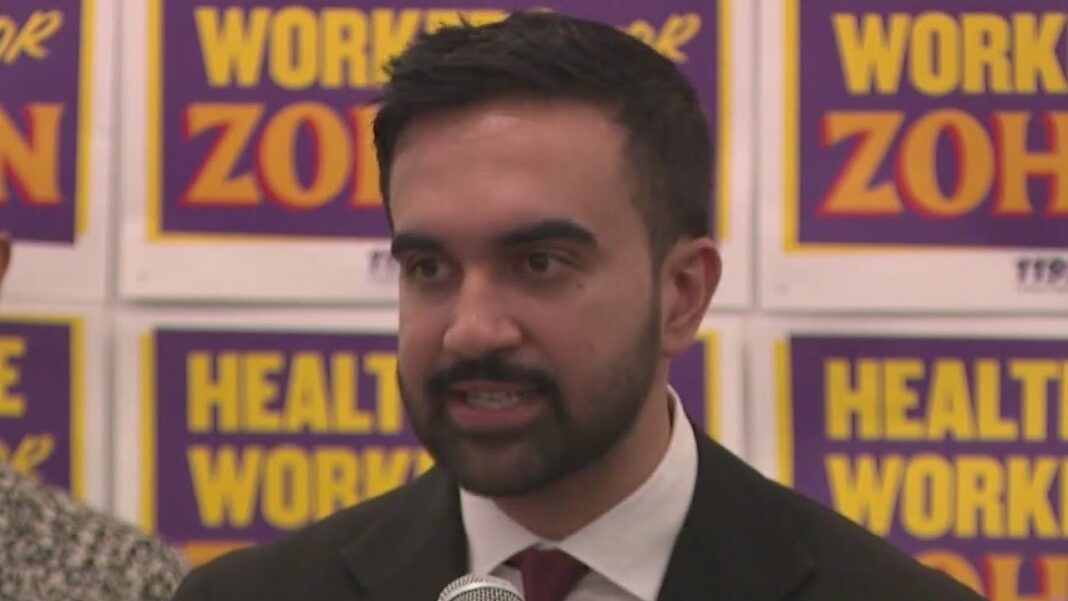
(TJV NEWS) In a development sending shockwaves through New York City’s Jewish and pro-Israel circles, far-left Socialist Assemblyman Zohran Mamdani now holds an 82% chance of winning the mayoralty, according to data from the betting platform Polymarket. As VIN News reported on Thursday, this figure marks an unprecedented high for the controversial lawmaker, whose tenure in public life has been defined by strident progressive positions, unyielding criticism of Israel, and close alignment with anti-Israel political allies.
Mamdani’s ascendancy in the mayoral race — which just months ago seemed improbable — now appears all but assured barring an unforeseen political upset. For many within the Jewish community, the prospect of his victory is more than a matter of partisan politics; it is seen as a potentially transformative moment for the city’s political climate, one that could redefine City Hall’s posture toward Israel at a time when antisemitism is already surging across the five boroughs.
The latest figures from Polymarket place Mamdani far ahead of his closest rivals. Former Governor Andrew Cuomo, running as an independent, holds a mere 9% probability of victory, while incumbent Mayor Eric Adams, also running as an independent amid ongoing legal and ethical controversies, trails with just 7%. The data reflects more than just campaign headwinds for Cuomo and Adams; it reveals the extent to which Mamdani’s campaign has successfully harnessed the energy of hard-left grassroots networks and progressive activist coalitions.
As the VIN News report noted, Mamdani’s base draws heavily from the same activist infrastructure that has reshaped local politics in several New York districts, including an energized contingent of Democratic Socialists of America (DSA) members and organizers. The DSA’s New York City chapter has been a staunch supporter of Boycott, Divestment, and Sanctions (BDS) campaigns targeting Israel and has repeatedly refused to condemn Hamas terrorism. Mamdani’s close affiliation with these groups has, in turn, heightened anxiety among pro-Israel voters.
Mamdani’s policy positions have long been a point of contention for the Jewish community. The assemblyman has consistently advanced measures and rhetoric critical of Israel while refusing to denounce Palestinian terror groups. His stance aligns him with a political current that sees Israel not as a democratic ally under siege, but as a colonial aggressor — a framing that many Jewish leaders view as dangerous, reductive, and deeply hostile.
Critics warn that under Mamdani’s leadership, the city’s traditionally strong ties to Israel could fray. City Hall’s symbolic and practical support for Israeli initiatives — from cultural exchanges to trade delegations — could diminish or disappear entirely. More gravely, there is concern that a Mamdani administration would embolden anti-Israel activism within municipal structures, making it easier for boycott resolutions and other hostile measures to gain traction.
The stakes are particularly high given the current atmosphere in New York City. As VIN News has repeatedly reported, the city’s Jewish and pro-Israel communities have endured an alarming wave of harassment, intimidation, and targeted protests in recent months. Jewish-owned businesses have been picketed by anti-Israel demonstrators; synagogues have been besieged by organized protests; and cultural events celebrating Israeli life have been disrupted by activists wielding inflammatory rhetoric.
These incidents have not occurred in a vacuum. They are part of a national and global uptick in antisemitic agitation, much of it tied to the ongoing conflict in the Middle East. Jewish leaders fear that with Mamdani in City Hall, such activities could escalate — whether through increased tolerance for anti-Israel demonstrations that cross into harassment, or through the erosion of municipal partnerships with Jewish organizations that provide security and community support.
Another major fault line is Mamdani’s well-documented skepticism toward traditional law enforcement. As the VIN News report noted, the assemblyman has publicly called for the disbanding of certain NYPD units and has supported reducing police budgets in favor of community-based interventions. Critics within the Jewish community warn that such policies, combined with his political alliances, could weaken the city’s capacity to protect synagogues, Jewish schools, and community centers — particularly in the wake of credible threats.
This apprehension is not theoretical. In a city that has seen antisemitic hate crimes rise sharply in recent years, the perception that the mayor’s office might deprioritize robust policing is enough to alarm security-conscious neighborhoods from Borough Park to Forest Hills. Many Jewish leaders fear a rollback in coordination between law enforcement and community security initiatives, potentially leaving vulnerable institutions exposed.
Mamdani’s rise is emblematic of a broader transformation in New York politics — one in which hard-left ideological positions increasingly dominate local races, reshaping the policy agenda and the political culture. The assemblyman’s record suggests a governing philosophy that fuses economic populism with aggressive foreign policy stances, particularly toward Israel.
For Jewish and pro-Israel New Yorkers, this represents a dramatic departure from the city’s long tradition of bipartisan solidarity with the Jewish state. As the VIN News report pointed out, even progressive mayors of the past, such as Bill de Blasio, maintained strong rhetorical and institutional ties to Israel despite disagreements on domestic policy. Mamdani’s worldview, by contrast, suggests that support for Israel would no longer be a given at City Hall.
The weakness of Mamdani’s opponents only amplifies his trajectory. Andrew Cuomo, despite his name recognition and decades in politics, faces the twin burdens of past scandals and a campaign apparatus ill-suited for a grassroots insurgency. Eric Adams, once considered a rising star in national Democratic politics, is mired in ongoing investigations and public disillusionment over crime, housing, and corruption concerns.
As the VIN News report stressed, neither candidate appears capable of consolidating an anti-Mamdani coalition. Without a viable alternative to rally behind, pro-Israel voters may find themselves in the unprecedented position of seeing the mayoralty go uncontested by any candidate firmly committed to their priorities.
The ramifications of a Mamdani mayoralty would extend beyond New York City’s borders. As the city with the largest Jewish population outside of Israel, New York has historically played an outsized role in shaping American Jewish identity and advocacy. A hostile or indifferent mayor could weaken the city’s role as a bulwark against antisemitism and a center of pro-Israel activism in the United States.
Moreover, a Mamdani victory could embolden similar hard-left candidates in other major American cities, signaling that openly anti-Israel positions are no longer political liabilities in urban politics. For national Jewish organizations, this would represent a serious strategic challenge.
For New York’s Jewish and pro-Israel communities, the road ahead is fraught with urgency. Leaders are grappling with how best to respond — whether through increased political mobilization, strategic alliances, or bolstering grassroots advocacy to counter the momentum of the hard-left.
The mayoral race has become more than a contest over city budgets and infrastructure; it is a referendum on the city’s moral compass and its place in the global Jewish narrative. In the eyes of many, electing a mayor with Mamdani’s record would be a rupture with decades of shared values and mutual commitment between New York and the Jewish state.
Zohran Mamdani’s 82% probability of winning the New York City mayoralty, as reported by VIN News via Polymarket data, represents more than a statistical milestone. It is a wake-up call to those who believe the city’s leadership should stand firmly against antisemitism, support Israel as a democratic ally, and safeguard the security of Jewish communities.
Whether this trajectory can be reversed will depend on how swiftly and decisively pro-Israel voters, donors, and civic leaders can mobilize. But if the current momentum holds, New York could soon find itself under a mayor whose political identity is rooted in opposition to the very ideals that have bound the city’s Jewish community to its government for generations.
In a moment when the threats facing Jewish New Yorkers are both physical and ideological, the stakes could not be higher.

LEADERSHIP……Worried while sitting on their hands.
THERE IS ONLY 60 DAYS TILL ELECTION !!!
If the leader ship will not act the grass roots need to mobilize YESTERDAY…
ORGANIZE GET OUT AND REGISTER 10 THOUSAND MORE YESHIVA AND TRADITIONAL NON-VOTERS.
JEWS ARE SMART LETS SEE WHAT YOUR COLLECTIVE BRAINS CAN DO TO DEAL WITH THIS EMERGENCY.