



|
Getting your Trinity Audio player ready...
|
By: Meyer Wolfsheim
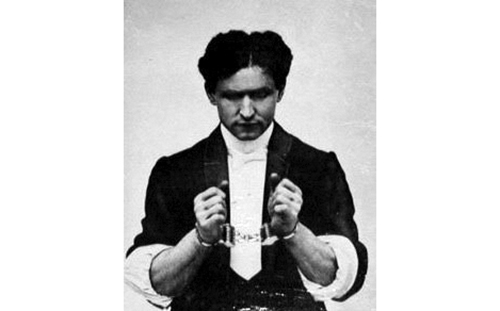
A century after his death, some of the original tools used by legendary illusionist Harry Houdini are back in the spotlight — including the very handcuffs and restraints that helped make him famous.
The NY Post first reported that a rare collection of Houdini’s escape equipment — from handcuffs and neck irons to leg shackles and specialized bolts — is now on display as part of a sweeping new exhibition at New York Public Library for the Performing Arts.
The show, titled “Mystery & Wonder: A Legacy of Golden Age Magicians in New York City,” opened this month and features more than 300 artifacts from magic’s heyday in the Big Apple. According to the NY Post first reported, many of the items have never before been publicly exhibited.
Visitors can view a Houdini-owned handcuff belt alongside historic documents detailing his daring escape acts. The display itself has been designed to resemble an early 20th-century magic shop, immersing guests in the era when illusionists packed vaudeville theaters and captivated audiences with feats that defied explanation.
Beyond Houdini’s shackles, the exhibition includes an expansive wand collection, dramatic one-of-a-kind magic posters, and rare instructional books dating back more than a century. The core of the collection traces back to Dr. Saram Ellison, a co-founder of the Society of American Magicians, who donated roughly 1,500 rare magic books to the library around the time of his death in 1918. Among them is believed to be the first book on magic published in the United States.
Exhibit curator Annemarie van Roessel said the retrospective is the first major show to examine how magical knowledge circulated in New York during what’s often called the “Golden Age” of magic — roughly 1875 through the 1930s. As the NY Post first reported, performers of the era — many of them immigrants from Europe — flocked to New York for its bustling stages, specialty magic shops and tight-knit professional circles.
The city also served as a cultural bridge between American and British magicians, with London emerging as another hub for the craft during that period.
Veteran illusionist Steve Cohen, who sponsors the exhibit and has performed his long-running Chamber Magic show at the Lotte New York Palace for 25 years, said New York remains a magnet for performers for good reason. He described the city as a global arts capital where audiences expect top-tier talent.
Cohen called the exhibition an overdue recognition of magic as a serious art form with deep historical roots. As the NY Post first reported, he said the show provides institutional respect to an art that has often existed on the fringes of mainstream scholarship.
In fact, van Roessel noted there are no formal professors of magic history. Instead, magicians themselves have historically preserved their own legacy — passing down secrets behind stage curtains, inside Midtown magic shops, and through professional societies.
The library’s collection — considered the largest public archive of its kind — continues to draw contemporary magicians eager to research mentors and rediscover century-old techniques. Some of the best tricks, the curator noted, are still the oldest ones.
The exhibit also features a remarkable scrapbook of original magic posters that had sat untouched for decades before being carefully conserved during the coronavirus pandemic and digitized for display. Their popularity within the magic community ultimately helped spark the broader exhibition.
Yet mysteries remain. Several performers pictured in archival photographs remain unidentified, prompting the library to invite today’s magicians to help put names to forgotten faces.
Van Roessel hopes the exhibit will restore recognition not only to Houdini but also to lesser-known figures such as vaudeville star Adelaide Herrmann, often called the “Queen of Magic.”
For visitors, the exhibit offers more than nostalgia. It’s a reminder that while magic has a rich past, it remains very much alive — continuing to evolve while honoring the shackles, secrets and showmanship that built its legend.
