



|
Getting your Trinity Audio player ready...
|
By: Jerome Brookshire
Governor Kathy Hochul’s long-awaited decision to name her running mate has landed not as a moment of consolidation but as an inflection point laden with political peril. The selection of former City Council Speaker Adrienne Adams, unveiled amid the tightening calendar of the Democratic primary, has drawn immediate and unusually broad criticism, including from segments of the Jewish community, labor unions, and seasoned party operatives. As The New York Post reported on Thursday, the reaction has ranged from polite skepticism to outright derision, with insiders warning that the choice risks alienating precisely the constituencies Hochul needs to withstand a left-wing primary challenge and to stabilize a ticket already burdened by recent institutional misfires.
Hochul’s announcement came against a backdrop of fragility. The governor is confronting a primary challenge from her estranged lieutenant governor, Antonio Delgado, whose break with the administration has become emblematic of internal Democratic fissures. Two other officeholders declined overtures to join Hochul’s ticket, a fact that has fueled speculation about the desirability—and perceived safety—of the lieutenant governor role under her stewardship. In this context, the choice of Adrienne Adams was framed by Hochul as a strategic reinforcement: a “fighter,” in the governor’s words, ready to take on the Trump administration and to broaden the coalition at a volatile moment in state politics.
The reception to that framing has been tepid at best. Political insiders told The New York Post that Adams’ tenure as City Council speaker left a residue of resentment across multiple constituencies. One Democratic consultant quipped that if Hochul’s objective was to pick someone “as underwhelming as possible,” then Adams was an inspired choice. Another operative was blunter, noting that Adams “made a lot of enemies” during her time at the council helm and “couldn’t get it together” in the Democratic mayoral primary, where she finished a distant fourth behind the eventual winner, Mayor Zohran Mamdani. “You are supposed to do no harm with these picks,” the operative said. “Hochul picked the only person who can inspire a negative reaction.”
The New York Post report observed that the skepticism is not merely stylistic but substantive. Within the Jewish community, some leaders and elected officials expressed dismay over Adams’ record, particularly her perceived reticence in the immediate aftermath of Hamas’s October 7, 2023 attack. A Democratic lawmaker and a party official, both Jewish, told The New York Post that they would not support Hochul’s ticket in light of the pick. One lawmaker, speaking on condition of anonymity, said some Jewish leaders felt Adams was insufficiently vocal in her support of Israel and sought to advance a City Council resolution calling for a cease-fire in Gaza at a moment when many in the community were seeking unequivocal solidarity. “I think overall people felt like she allowed the lefties to run free,” the lawmaker said, capturing a broader anxiety that Adams’ leadership style ceded too much ground to the council’s progressive flank.
The discontent is not universal. Michael Nussbaum, a Queens member of the Jewish Community Relations Council, told The New York Post that while he and other Jewish activists were disappointed that Adams declined an invitation to travel to Israel during her speakership, he views her as “acceptable” and expressed personal regard for her. “I like her very much,” Nussbaum said. “She’ll be a good lieutenant governor.”
His remarks illustrate the complexity of communal sentiment: disappointment over symbolic gestures coexisting with pragmatic acceptance of Adams as a functional partner in governance. Yet The New York Post’s account suggested that the broader mood within Jewish political circles is wary, shaped by a perception that Adams’ record on issues central to communal concern lacks the clarity and vigor that the moment demands.
Labor unions, too, have signaled unease. As City Council speaker, Adams supported a series of progressive measures that drew sharp opposition from police and correction unions, leaving scars that have not fully healed. Scott Munro, president of the Detectives Endowment Association, told The New York Post that his union would reserve judgment until Adams demonstrates whether she is “pro-police” or whether she will continue to appeal “to the far left like she did in the council.” Munro’s organization, part of a broader alliance of unions representing an estimated 500,000 voters statewide, wields significant political leverage. “We will only endorse someone who is pro-police,” Munro said. “You’re going to be the LG, you have to be pro-police.” The subtext is unmistakable: Adams enters the statewide race with a deficit of trust among constituencies whose endorsement Hochul will likely court aggressively in a competitive primary.
The calculus behind Hochul’s selection, according to sources cited in The New York Post report, was as much geographic as ideological. The governor had reportedly shown interest in recruiting Brooklyn District Attorney Eric Gonzalez as her running mate, a move that might have consolidated support in a borough central to Democratic electoral math. Adams ultimately secured the spot, the source said, in the hope that she would deliver votes in Queens—a borough that has loomed large in recent electoral outcomes. The decision, however, appears to have rankled top Democrats in Brooklyn, raising the prospect that Hochul’s bid to shore up one flank may have inadvertently weakened another. “I think it’s going to backfire,” the source warned, encapsulating the sense that the pick carries more downside risk than upside reward.
Hochul and Adams sought to project unity and resolve at a joint press conference in Syracuse ahead of the Democratic Party’s nominating conference. “No one can question what Adrienne Adams brings to this fight in this moment in history right now,” Hochul declared. The rhetoric of confidence, however, has struggled to dispel the perception that the governor’s options were constrained by her recent history with lieutenant governors. Hochul’s first appointee, Brian Benjamin, resigned in 2022 after being indicted on corruption-related charges, which were later dropped. Her current lieutenant, Antonio Delgado, is now her primary challenger after a falling out that unfolded roughly three years into his tenure. The New York Post’s coverage frames Adams’ selection against this backdrop of institutional instability, suggesting that Hochul’s search for a running mate has been haunted by the specter of past misjudgments.
Indeed, one consultant’s sardonic remark, reported by The New York Post, captured a perverse logic animating the choice: “There is safety in picking someone who won’t turn out to be another Antonio Delgado.” The quip implies that Adams’ perceived lack of dynamism may itself be an asset—a guarantee of loyalty and predictability in a role that has recently become a site of political rupture. Yet safety, in this reading, comes at the cost of inspiration. In an electoral environment marked by volatility and ideological polarization, an underwhelming pick risks dampening enthusiasm rather than galvanizing it.
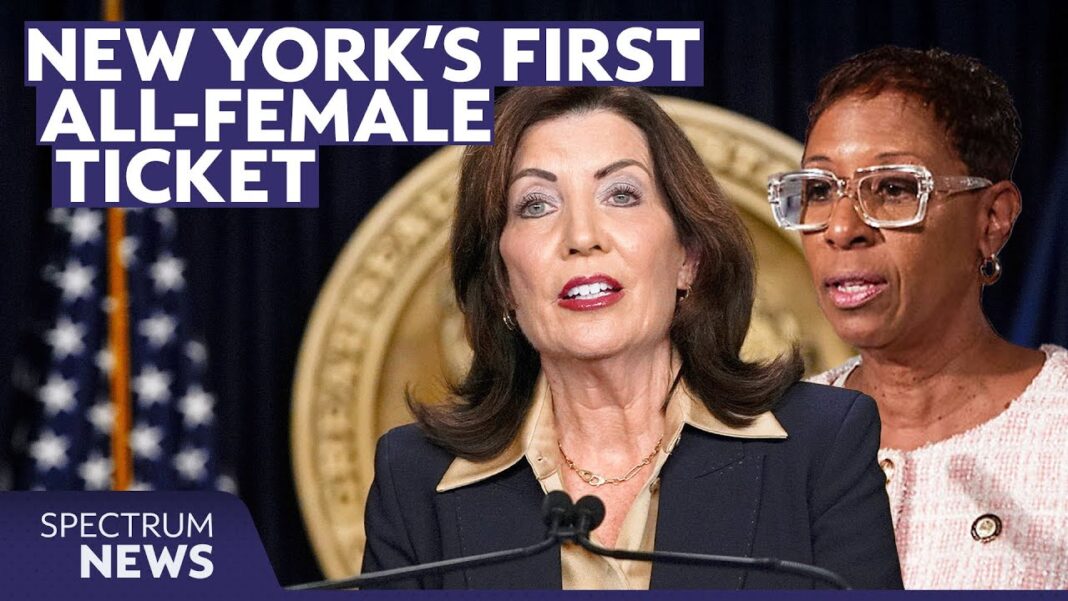
The broader field underscores the stakes. Delgado’s running mate is India Walton, a socialist and failed Buffalo mayoral candidate whose presence on the ticket is likely to energize the progressive base. The Republican contender, Nassau County Executive Bruce Blakeman, has yet to announce his own running mate, leaving the contours of the general election ticket unsettled. Hochul and Adams, meanwhile, will make history as the first all-female major-party ticket for New York’s top two statewide offices. The New York Post notes that this milestone has been highlighted by some supporters as a symbolic achievement, though critics caution that representation alone cannot substitute for strategic cohesion and broad-based appeal.
Within the Democratic caucus, reactions remain divided. Assemblyman Simcha Eichenstein, who represents heavily Jewish neighborhoods in Brooklyn, told The New York Post that he will support both Hochul and Adams. His endorsement was framed less as an affirmative embrace of the ticket than as a rejection of the alternative. “What’s the alternative, India Walton? Thanks but no thanks,” Eichenstein said. “I would take Kathy Hochul and Adrienne Adams over Antonio Delgado and India Walton any day.”
The remark calls attention to a recurring theme in The New York Post report: for many Democrats, the primary is shaping up less as a contest of compelling visions than as a referendum on relative risk.
What emerges from the early reaction is a portrait of a ticket assembled under duress, navigating a minefield of competing constituencies with limited room for error. The New York Post report suggested that Hochul’s choice of Adams has not quieted the anxieties roiling her coalition but has instead surfaced them in sharper relief. Jewish leaders wary of Adams’ posture on Israel, unions resentful of her progressive record, and party operatives unimpressed by her electoral track record converge in a chorus of caution that threatens to sap momentum at a critical juncture.
The challenge for Hochul now is not merely to defend her choice but to recalibrate the narrative around it. The governor must persuade skeptical constituencies that Adams can be both a loyal partner and an effective bridge to voters whose trust she has yet to secure. Whether the historic symbolism of an all-female ticket can counterbalance the substantive doubts articulated by critics remains uncertain. As The New York Post has chronicled, the immediate blowback spotlights a central paradox of political selection: in seeking to minimize risk, leaders often expose themselves to new vulnerabilities. Hochul’s gamble on Adrienne Adams may yet yield dividends in Queens, but the early tremors suggest that the wager has already unsettled the coalition she must hold together to prevail.
