




|
Getting your Trinity Audio player ready...
|
By: Fern Sidman
As New York’s political establishment braces for another bruising statewide contest, the race for attorney general is rapidly crystallizing into a referendum on law, order, and the perceived politicization of justice. The New York Post reported in December that Saritha Komatireddy, a former federal prosecutor with a formidable résumé forged in the crucible of national security, cybercrime, and international narcotics cases, is preparing to seek the Republican nomination to challenge Democratic Attorney General Letitia James. Her entry into the race injects a new level of intensity into an already volatile contest, one shaped by partisan rancor, public anxiety over crime, and a broader ideological struggle over the mission of the state’s top law enforcement office.
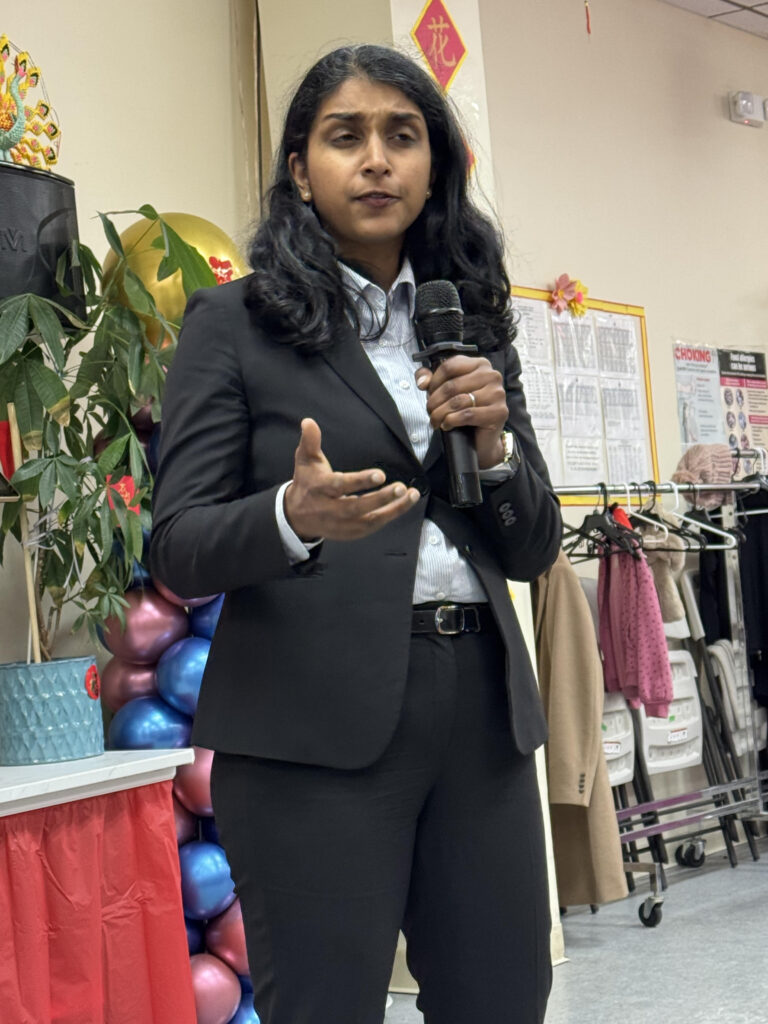
According to information provided in The New York Post report, Komatireddy, 41, is poised to frame her candidacy as a stark repudiation of what she describes as the present administration’s drift from the core responsibilities of the attorney general’s office. In her telling, the office has become ensnared in political vendettas, losing sight of the quotidian but essential work of protecting New Yorkers from violent crime, organized criminal networks, and sophisticated financial and cyber offenses. The New York Post quoted Komatireddy as saying that after more than a decade prosecuting terrorists, murderers, fraudsters, and hackers, she is now determined to “get the attorney general’s office back to basics.” It is a phrase freighted with rhetorical potency, signaling an appeal to voters who feel that governance has become performative and ideological rather than practical and protective.
Komatireddy’s professional biography reads like a compendium of modern federal law enforcement challenges. As The New York Post report detailed, she spent years in the U.S. Attorney’s Office for the Eastern District of New York, rising through a succession of demanding roles that included Chief of International Narcotics and Money Laundering, Deputy Chief of Appeals, and Deputy Chief of General Crimes. Her docket encompassed cases involving some of the world’s most notorious criminal enterprises, including al Qaeda, ISIS, and the Sinaloa cartel. These were not abstract encounters with criminality, but high-stakes prosecutions at the intersection of terrorism, transnational organized crime, and financial subterfuge—arenas where the line between domestic safety and global instability blurs.
Komatireddy has also served as the Computer Hacking and Intellectual Property Coordinator and as an Assistant U.S. Attorney in the National Security and Cybercrime Section. Her courtroom experience includes eight federal criminal trials and more than a dozen arguments before the U.S. Court of Appeals for the Second Circuit, a record that positions her as a litigator accustomed to both the adversarial intensity of trial work and the refined jurisprudential demands of appellate advocacy. Such credentials are central to her campaign narrative: that she is not merely a political aspirant, but a practitioner of law whose career has been defined by the pursuit of public safety.
Her résumé extends beyond the courtroom. Komatireddy served from 2023 to 2024 as Chief of Staff of the Drug Enforcement Administration, a role that placed her at the nexus of federal drug policy, interagency coordination, and the evolving landscape of narcotics enforcement. Before her prosecutorial career, she practiced at the Washington, D.C.-based firm Kellogg, Huber, Hansen, Todd, Evans & Figel, and served as counsel to the National Commission on the BP Deepwater Horizon Oil Spill and Offshore Drilling.
She also clerked for Brett Kavanaugh during his tenure on the U.S. Court of Appeals for the D.C. Circuit, an experience that situates her within the elite corridors of the federal judiciary. The New York Post portrays these formative chapters as evidence of a legal mind shaped by both public service and private-sector rigor.
Komatireddy’s campaign rhetoric, as reported by The New York Post, is calibrated to resonate with a broad swath of voters who perceive a deterioration of public safety in New York. Her insistence that “if New York isn’t safe, nothing else matters” functions as both a moral axiom and a political thesis. In this formulation, economic development, social services, and civic harmony are contingent upon the foundational guarantee of security. She has pledged that, if elected, she will devote her energies to safeguarding communities from Bethpage to Buffalo, from Staten Island to Saratoga Springs, invoking a geographic sweep that underscores her claim to represent the entire state rather than a narrow political constituency.
The contest, however, will not be fought in a vacuum. The New York Post report noted that Komatireddy will likely have to navigate a Republican primary before facing Letitia James in the general election. The GOP field already includes figures such as Michael Henry, the party’s 2022 candidate for attorney general, and Khurram Dara, a lawyer with expertise in cryptocurrency and digital assets. This intraparty competition introduces an additional layer of complexity, compelling Komatireddy to differentiate herself not only from the Democratic incumbent but also from fellow Republicans. Her strategy appears to hinge on presenting herself as uniquely qualified by virtue of her prosecutorial pedigree and her emphasis on law-and-order principles.
Letitia James, for her part, looms as a formidable adversary. As The New York Post reported, James is a polarizing figure, celebrated by her supporters for her aggressive posture toward powerful interests and excoriated by critics who view her actions as ideologically driven. Komatireddy’s campaign seeks to harness this polarization, casting James as emblematic of an attorney general’s office that has strayed into the realm of partisan combat. The New York Post report framed Komatireddy’s critique as an attempt to reposition the office as a neutral guardian of public safety rather than a stage for political theater.
The broader political context amplifies the stakes of the race. The attorney general’s office in New York wields significant authority, encompassing not only criminal prosecutions but also civil enforcement, consumer protection, and oversight of powerful corporate and governmental actors. In recent years, the office has been at the center of high-profile investigations and lawsuits that have reverberated far beyond the state’s borders. The New York Post report situated Komatireddy’s candidacy within this charged environment, suggesting that the election will serve as a proxy battle over the proper boundaries of prosecutorial power in a polarized age.
Komatireddy’s personal narrative adds another dimension to her campaign. She is a married mother of four, a detail she has invoked to underscore her stake in the future of the state’s communities. This biographical element is deployed not merely as a token of relatability, but as a testament to her investment in the quotidian realities of safety, education, and neighborhood stability. Her academic pedigree—Harvard College, Harvard Law School, and a decade of lecturing at Columbia Law School—further buttresses her image as a jurist-scholar capable of navigating both the theoretical and practical dimensions of law.
Komatireddy’s challenge will be to transform her career in the federal justice system into a persuasive case for stewardship of a state-level office that operates under different legal, political, and institutional constraints.
On one side stands an incumbent whose tenure has been marked by confrontations with powerful figures and institutions; on the other, a challenger who promises to recalibrate the office toward what she characterizes as its foundational mission of public safety. The electorate, meanwhile, is left to adjudicate not only between personalities, but between competing conceptions of justice itself—whether the attorney general should serve primarily as a crusading political actor or as a prosecutorial steward devoted to the quotidian work of protecting citizens from harm.
In that sense, Komatireddy’s entry into the race is more than a personal career pivot. It is, as The New York Post report suggested, a bellwether for the broader currents shaping New York’s political future: the reassertion of law-and-order rhetoric, the contestation of prosecutorial power, and the enduring question of how justice should be administered in an era defined by both insecurity and ideological division.
According to information provided in The New York Post report, Komatireddy, 41, is poised to frame her candidacy as a stark repudiation of what she describes as the present administration’s drift from the core responsibilities of the attorney general’s office. In her telling, the office has become ensnared in political vendettas, losing sight of the quotidian but essential work of protecting New Yorkers from violent crime, organized criminal networks, and sophisticated financial and cyber offenses. The New York Post quoted Komatireddy as saying that after more than a decade prosecuting terrorists, murderers, fraudsters, and hackers, she is now determined to “get the attorney general’s office back to basics.” It is a phrase freighted with rhetorical potency, signaling an appeal to voters who feel that governance has become performative and ideological rather than practical and protective.
Komatireddy’s professional biography reads like a compendium of modern federal law enforcement challenges. As The New York Post report detailed, she spent years in the U.S. Attorney’s Office for the Eastern District of New York, rising through a succession of demanding roles that included Chief of International Narcotics and Money Laundering, Deputy Chief of Appeals, and Deputy Chief of General Crimes. Her docket encompassed cases involving some of the world’s most notorious criminal enterprises, including al Qaeda, ISIS, and the Sinaloa cartel. These were not abstract encounters with criminality, but high-stakes prosecutions at the intersection of terrorism, transnational organized crime, and financial subterfuge—arenas where the line between domestic safety and global instability blurs.
Komatireddy has also served as the Computer Hacking and Intellectual Property Coordinator and as an Assistant U.S. Attorney in the National Security and Cybercrime Section. Her courtroom experience includes eight federal criminal trials and more than a dozen arguments before the U.S. Court of Appeals for the Second Circuit, a record that positions her as a litigator accustomed to both the adversarial intensity of trial work and the refined jurisprudential demands of appellate advocacy. Such credentials are central to her campaign narrative: that she is not merely a political aspirant, but a practitioner of law whose career has been defined by the pursuit of public safety.
Her résumé extends beyond the courtroom. Komatireddy served from 2023 to 2024 as Chief of Staff of the Drug Enforcement Administration, a role that placed her at the nexus of federal drug policy, interagency coordination, and the evolving landscape of narcotics enforcement. Before her prosecutorial career, she practiced at the Washington, D.C.-based firm Kellogg, Huber, Hansen, Todd, Evans & Figel, and served as counsel to the National Commission on the BP Deepwater Horizon Oil Spill and Offshore Drilling.
She also clerked for Brett Kavanaugh during his tenure on the U.S. Court of Appeals for the D.C. Circuit, an experience that situates her within the elite corridors of the federal judiciary. The New York Post portrays these formative chapters as evidence of a legal mind shaped by both public service and private-sector rigor.
Komatireddy’s campaign rhetoric, as reported by The New York Post, is calibrated to resonate with a broad swath of voters who perceive a deterioration of public safety in New York. Her insistence that “if New York isn’t safe, nothing else matters” functions as both a moral axiom and a political thesis. In this formulation, economic development, social services, and civic harmony are contingent upon the foundational guarantee of security. She has pledged that, if elected, she will devote her energies to safeguarding communities from Bethpage to Buffalo, from Staten Island to Saratoga Springs, invoking a geographic sweep that underscores her claim to represent the entire state rather than a narrow political constituency.
The contest, however, will not be fought in a vacuum. The New York Post report noted that Komatireddy will likely have to navigate a Republican primary before facing Letitia James in the general election. The GOP field already includes figures such as Michael Henry, the party’s 2022 candidate for attorney general, and Khurram Dara, a lawyer with expertise in cryptocurrency and digital assets. This intraparty competition introduces an additional layer of complexity, compelling Komatireddy to differentiate herself not only from the Democratic incumbent but also from fellow Republicans. Her strategy appears to hinge on presenting herself as uniquely qualified by virtue of her prosecutorial pedigree and her emphasis on law-and-order principles.
Letitia James, for her part, looms as a formidable adversary. As The New York Post reported, James is a polarizing figure, celebrated by her supporters for her aggressive posture toward powerful interests and excoriated by critics who view her actions as ideologically driven. Komatireddy’s campaign seeks to harness this polarization, casting James as emblematic of an attorney general’s office that has strayed into the realm of partisan combat. The New York Post report framed Komatireddy’s critique as an attempt to reposition the office as a neutral guardian of public safety rather than a stage for political theater.
The broader political context amplifies the stakes of the race. The attorney general’s office in New York wields significant authority, encompassing not only criminal prosecutions but also civil enforcement, consumer protection, and oversight of powerful corporate and governmental actors. In recent years, the office has been at the center of high-profile investigations and lawsuits that have reverberated far beyond the state’s borders. The New York Post report situated Komatireddy’s candidacy within this charged environment, suggesting that the election will serve as a proxy battle over the proper boundaries of prosecutorial power in a polarized age.
Komatireddy’s personal narrative adds another dimension to her campaign. She is a married mother of four, a detail she has invoked to underscore her stake in the future of the state’s communities. This biographical element is deployed not merely as a token of relatability, but as a testament to her investment in the quotidian realities of safety, education, and neighborhood stability. Her academic pedigree—Harvard College, Harvard Law School, and a decade of lecturing at Columbia Law School—further buttresses her image as a jurist-scholar capable of navigating both the theoretical and practical dimensions of law.
Komatireddy’s challenge will be to transform her career in the federal justice system into a persuasive case for stewardship of a state-level office that operates under different legal, political, and institutional constraints.
On one side stands an incumbent whose tenure has been marked by confrontations with powerful figures and institutions; on the other, a challenger who promises to recalibrate the office toward what she characterizes as its foundational mission of public safety. The electorate, meanwhile, is left to adjudicate not only between personalities, but between competing conceptions of justice itself—whether the attorney general should serve primarily as a crusading political actor or as a prosecutorial steward devoted to the quotidian work of protecting citizens from harm.
In that sense, Komatireddy’s entry into the race is more than a personal career pivot. It is, as The New York Post report suggested, a bellwether for the broader currents shaping New York’s political future: the reassertion of law-and-order rhetoric, the contestation of prosecutorial power, and the enduring question of how justice should be administered in an era defined by both insecurity and ideological division.
