



|
Getting your Trinity Audio player ready...
|
FBI Opens Hate Crime Investigation Into Brutal Antisemitic Assault at Queens Kosher Restaurant
By: Fern Sidman
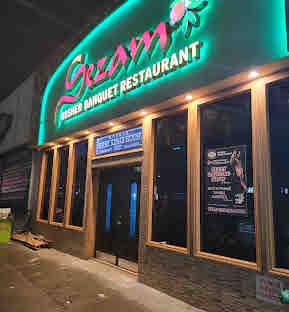
The Federal Bureau of Investigation (FBI) has launched a hate crime investigation into a violent assault targeting Jewish diners at a kosher restaurant in Queens, New York. As was first reported by The Algemeiner on Thursday, the incident, which took place on July 20 at the Sezam restaurant, has shaken the city’s Jewish community and drawn national attention amid a documented surge in antisemitic attacks. According to a report that appeared on Israel National News, the FBI’s involvement marks a significant escalation after local authorities initially declined to classify the assault as a hate crime.
According to eyewitness accounts, what began as a routine evening meal quickly devolved into chaos and violence. Bita Golbari, 51, was dining with her husband and friends when two women entered the restaurant and joined a group of men seated nearby. Quoting from The Algemeiner report, Israel National News detailed that the altercation began when one of the women took the purse of Golbari’s friend, 45-year-old Elham Sharga.
When Sharga confronted the woman, she was dragged to the ground, beaten, and repeatedly struck by multiple assailants. “They started hitting me on my head, my belly, my back, my neck,” Sharga later recounted. “Then the men joined in. I was screaming for help. I thought I was dying.”
Sharga’s husband tried to defend her but was also attacked, leaving him with a bloodied face and serious injuries, including a concussion and a fracture. Sharga herself was hospitalized with broken ribs. Her husband has since returned to the hospital multiple times due to ongoing complications from his injuries, Israel National News reported.
The victims emphasized that the violence was motivated by open antisemitism. Sharga recalled hearing her attackers shout: “You guys are Jewish, we wanna kill you all tonight.”
Golbari recounted a separate terrifying episode after she fled the restaurant. One of the women pursued her outside, shouting: “Are you trying to call the police on us? We are going to kill all of you Jews.” Golbari said she was punched so hard in the face that she believed she might die. She escaped only after a passerby intervened.
“These people weren’t just angry,” Golbari later told investigators. “They wanted to kill us — all because we are Jewish.”
The Israel National News report emphasized the victims’ insistence that the attack was not a misunderstanding or drunken brawl, but a targeted act of hate.
Despite explicit threats and serious injuries, the NYPD initially declined to treat the assault as a hate crime. Restaurant management characterized the incident as a “drunken altercation,” and police reports reflected this classification.
This response has been sharply criticized by Jewish community leaders and activists. Quoting from The Algemeiner, Israel National News reported that Israeli writer and activist Hen Mazzig expressed frustration on social media: “How many Jews do you have to hospitalize while yelling antisemitic slurs before the police take it seriously as an antisemitic crime?”
The reluctance of local authorities to acknowledge antisemitic motivation has become a recurring source of tension. Community organizations argue that such reluctance not only minimizes the gravity of these incidents but also leaves victims feeling abandoned by the very institutions tasked with protecting them.
The turning point came when the FBI contacted Golbari and other victims to discuss the attack in detail, indicating that federal investigators had opened a hate crime probe. The Israel National News report confirmed that the Bureau’s involvement elevates the case beyond the local level, ensuring that the explicit antisemitic threats and physical violence are examined under federal statutes.
Under U.S. law, hate crimes motivated by religion fall squarely within the FBI’s jurisdiction. Federal prosecutions carry stiffer penalties and are often pursued when state or local authorities are perceived as unwilling or unable to adequately enforce protections.
The July 20 incident is not isolated. Antisemitism in New York City has surged in recent years, a trend documented extensively by both local officials and Jewish advocacy groups.
According to the information provided in the Israel National News report, antisemitic crimes represented 55% of all hate crimes reported in New York City in 2024 — up from 44% in 2023. By early 2025, the NYPD’s Hate Crimes Task Force reported that 62% of hate crimes in the city targeted Jews.
Deputy Inspector Gary Marcus, who leads the Task Force, acknowledged earlier this year that antisemitic incidents “jump off the page as the single largest category of hate.” He noted that “well over half of all hate crimes in New York City are perpetrated against Jews,” underscoring the community’s disproportionate vulnerability.
The October 7 Hamas massacre in Israel further exacerbated the situation. Following that event, Jewish neighborhoods in New York reported a spike in threats, vandalism, and assaults. Israel National News has repeatedly highlighted that the climate of hostility has created a heightened sense of insecurity among Jewish residents.
Federal investigations into antisemitic violence in New York are not without precedent. In past years, the FBI has stepped in to investigate synagogue vandalism, threats against Jewish schools, and violent assaults.
For example, in 2019, the FBI supported state prosecutions following the fatal stabbing attack at a Hanukkah celebration in Monsey, New York. Federal prosecutors charged the attacker under hate crime statutes, ensuring a life sentence.
By invoking federal jurisdiction, the Bureau sends a strong message that antisemitic crimes are not merely local disturbances but violations of national civil rights protections. As the report at Israel National News noted, this broader framework ensures accountability when local enforcement appears inconsistent.
Leaders of Jewish organizations have expressed relief that the FBI is now involved. For many, the attack at Sezam exemplifies the dangers of minimizing antisemitism.
“This was not just a bar fight,” one community leader told Israel National News. “These were Jews being beaten and threatened with death, explicitly because of who they are. When local authorities dismiss such cases, it deepens the trauma for the victims and emboldens the perpetrators.”
Local rabbis have echoed these concerns, urging Jewish residents to remain vigilant and calling for increased police protection around kosher restaurants, synagogues, and Jewish schools.
For the victims themselves, the attack has left both physical and psychological scars. Sharga, still recovering from broken ribs, described the trauma of hearing her attackers threaten mass killing. Her husband continues to grapple with the aftereffects of his concussion. Golbari, meanwhile, admitted she has been unable to sleep since the assault, haunted by the moment she thought she would be killed on the street.
“These attacks are not just bruises and broken bones,” Golbari told The Algemeiner, and cited in the Israel National News report. “They take away our sense of safety, our peace of mind. And that is exactly what hate crimes are meant to do.”
The FBI’s decision to investigate the Queens assault as a hate crime underscores the seriousness of the incident and the broader crisis of antisemitism in New York. With victims describing brutal violence accompanied by explicit death threats against Jews, the case has become emblematic of a troubling trend that shows no signs of slowing.
As Israel National News has reported, the July 20 attack reflects both the resilience of New York’s Jewish community and the urgent need for stronger protections against antisemitic violence. Whether the federal investigation results in prosecutions remains to be seen, but for many in the community, the message is clear: antisemitism must be recognized, confronted, and prosecuted to the fullest extent of the law.

Since the identity of the assailants is not being explained, I will have to guess as to who would oppose a call for help with ‘you ain’t callin no police on us!’. They say there is ‘fatigue’… yes , there is.