



|
Getting your Trinity Audio player ready...
|
By: Fern Sidman
In a fiery rebuke that cut to the heart of New York City’s most contentious political and public safety debate, Independent mayoral candidate Andrew Cuomo on Wednesday denounced Assemblyman Zohran Mamdani’s plan to close Rikers Island, calling it a “reckless ideological experiment” that would “unleash chaos, jeopardize public safety, and abandon the city’s most vulnerable communities to lawlessness.”
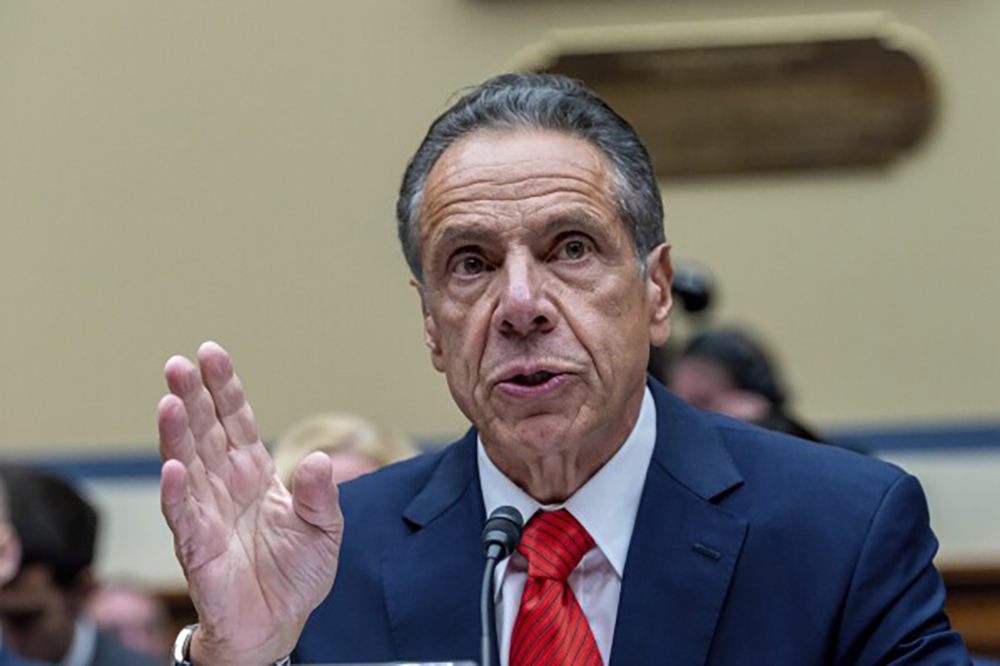
Cuomo’s remarks, delivered in a sharply worded statement and amplified in a press appearance on the steps of City Hall, framed the Rikers debate not as a question of reform, but of responsibility — and positioned him as the only candidate willing to confront what he termed “the dangerous consequences of DSA extremism.”
“Mamdani’s plan to close Rikers without any workable alternative is nothing short of reckless,” Cuomo said. “It follows the Democratic Socialists of America’s dangerous blueprint to abolish jails outright — unleashing chaos, jeopardizing public safety, and putting our neighborhoods at risk. Once Rikers closes under Mamdani’s plan, there will be nowhere to house over half of the city’s inmate population. This isn’t reform — it’s an experiment in lawlessness.”
At the center of the dispute lies the de Blasio-era “four-borough jail plan,” an ambitious but deeply flawed effort to replace the Rikers Island complex with smaller, community-based jails in Manhattan, Brooklyn, Queens, and the Bronx. When introduced in 2019, the plan projected a construction budget of roughly $8 billion and envisioned a total capacity of 3,300 beds — less than half the number of inmates currently held at Rikers, which topped 7,000 as of March 2025.
As Cuomo pointed out, the plan is now billions over budget and years behind schedule. Current cost estimates, according to the City’s Budget Office, have ballooned to between $15 and $16 billion, while environmental reviews, zoning disputes, and fierce neighborhood opposition have slowed progress to a crawl.
“This plan was broken from the start,” Cuomo said. “You cannot replace Rikers with four jails that don’t exist, that are half the size needed, and that no one in the affected neighborhoods wants. What Mamdani is proposing isn’t a solution — it’s surrender.”
Even senior City officials have begun to acknowledge the plan’s unsustainability. The Budget Director admitted publicly that the city will not meet the August 31, 2027 deadline to close Rikers, which is codified in local law but increasingly viewed as politically symbolic rather than practical.
Cuomo’s team emphasized that under Mamdani’s leadership, the city would face the very real possibility of emptying inmates onto the streets, given that there are no viable facilities ready to house the current Rikers population. “This is what happens when ideology overtakes governance,” a senior Cuomo campaign strategist told reporters. “You get chaos disguised as compassion.”
Assemblyman Zohran Mamdani, a Democratic Socialist representing Queens’ Astoria district, has long been aligned with the Democratic Socialists of America (DSA) and its “decarceral” platform — a sweeping agenda that calls for cutting incarceration rates, defunding police departments, and opposing the construction of new correctional facilities nationwide.
When Mamdani first ran for the State Assembly in 2020, he explicitly pledged to close Rikers Island and oppose any new jail construction — a position he has since reaffirmed in multiple public statements. His mayoral campaign website describes Rikers as “a moral abomination” and promises to “end New York’s reliance on mass incarceration.”
Cuomo, however, argues that Mamdani’s policies amount to systemic neglect disguised as reform. “Mamdani isn’t fixing the criminal justice system — he’s dismantling it,” Cuomo said. “He’s fulfilling a DSA fantasy that sees jails not as tools of justice, but as symbols to be erased. The problem is, when you erase without replacing, you don’t create equity. You create anarchy.”
According to policy documents reviewed by Cuomo’s campaign, the DSA’s official criminal justice plank requires its endorsed candidates to support legislation aimed at “decarceration” — or the deliberate reduction of prison populations through legal reform, budget cuts, and decriminalization measures. The platform further mandates members to “reject any expansion to police budgets or scope of enforcement while cutting budgets annually toward zero.”
Cuomo contends that such policies would leave New York City “effectively unprotected,” noting the sharp rise in assaults, thefts, and quality-of-life crimes in areas where police staffing has already been reduced. “The DSA’s approach to public safety has been tried in miniature — and it’s failed spectacularly,” he said. “What Mamdani wants to do is take that failure citywide.”
Media reports indicated that Rikers remains plagued by overcrowding, staff shortages, and violence — yet remains the only facility currently capable of holding the city’s full inmate population. While reform advocates have long argued for its closure, they have struggled to present a viable replacement that balances security, logistics, and fiscal reality.
The four-borough plan, as originally designed, called for compact, vertical jails with modernized facilities and better access to courthouses. But opposition from neighborhood coalitions, local legislators, and public defenders has effectively frozen progress. In Queens, community boards have filed multiple lawsuits to block construction, while in the Bronx, contractors have withdrawn bids amid safety and cost concerns.
Mamdani, however, has remained steadfast, insisting that the city “must not delay justice.” His opponents interpret that phrase differently. “Justice for whom?” Cuomo asked. “For the victims who will see violent offenders back on the street? For the families terrorized by repeat criminals who no longer face detention? This isn’t justice — it’s ideology run amok.”
Cuomo’s campaign released a detailed position paper outlining his alternative: a comprehensive modernization of Rikers Island rather than its closure. Under his proposal, Rikers would be redeveloped into a secure, rehabilitative complex that integrates mental health treatment, workforce development, and addiction recovery programs. Cuomo described it as “a reform rooted in reality, not rhetoric.”
“Closing Rikers without a plan is not progress,” Cuomo said. “Modernizing it into a humane, effective facility that prioritizes rehabilitation over retribution — that’s progress.”
Financial analysts have also questioned the viability of the Mamdani–de Blasio plan, which they say has become a sinkhole for taxpayer dollars. City Comptroller data shows that design, zoning, and procurement delays have inflated the projected cost by nearly 100 percent, even before a single facility is operational.
“By the time the first borough jail opens, it may already be obsolete,” said a former Deputy Mayor. “We’re spending billions to build four jails that won’t meet the city’s capacity needs, while letting the one functioning facility fall into disrepair.”
Cuomo seized on those figures to paint Mamdani as fiscally irresponsible. “He’s inherited the worst of de Blasio — a penchant for grand gestures with no plan to pay for them,” Cuomo said. “We can’t afford another ideologue in Gracie Mansion.”
The clash between Cuomo and Mamdani represents more than a dispute over criminal justice policy; it embodies a deeper philosophical divide about the role of government in maintaining order. Cuomo, a three-term former governor with decades of executive experience, casts himself as the sober realist in a field of dreamers. Mamdani, the insurgent socialist, champions a vision of systemic transformation that critics see as dangerously naïve.
“Cuomo is the only candidate with both the experience and the credibility to stand up to the ideological left,” said one political strategist. “Sliwa might make noise, but Cuomo can actually govern — and he understands how to navigate the bureaucracy, unions, and law enforcement agencies that keep this city functioning.”
In the coming weeks, Cuomo is expected to intensify his focus on public safety, using Rikers as a symbol of what he calls “New York’s crossroads moment.” His campaign slogan — “Competence over chaos” — is already appearing on billboards across the city.
With the October 16 mayoral debate approaching, the Rikers issue is poised to dominate the discussion. For Cuomo, it offers a chance to contrast his pragmatism against Mamdani’s radicalism. For voters, it crystallizes the larger question: Will New York choose stability or ideological experimentation?
As Cuomo put it in his closing remarks Wednesday: “You can’t fix what you refuse to face. Rikers needs reform, not abolition. Law and order aren’t outdated ideas — they’re the foundation of civilization. And under my administration, they’ll be the foundation of this city once again.”
In a race already defined by sharp ideological contrasts, Cuomo’s warning was unmistakable: New York’s future depends on whether its next mayor governs with principle — or gambles with chaos.
