



|
Getting your Trinity Audio player ready...
|
By: Fern Sidman
In the small hours of the night, when most of Brooklyn retreats into the vulnerable privacy of sleep, the streets of the Gravesend section have recently become the stage for an anxious contest between vigilance and predation. A spate of home invasions earlier this week, compounded by a string of car thefts along East 4th Street between the T–U and U–V blocks, jolted a neighborhood accustomed to regarding itself as among the safest enclaves in the city.
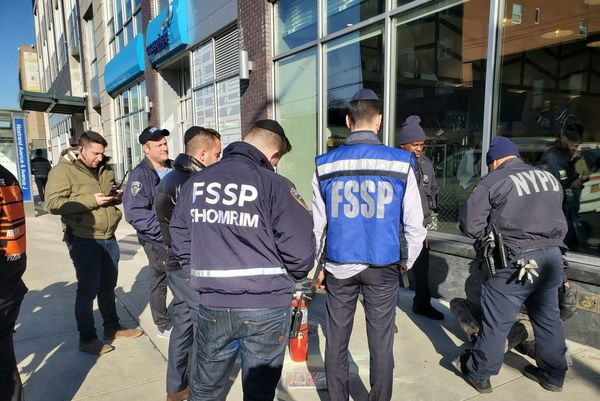
In response, Flatbush Shomrim, in close coordination with the New York Police Department, mounted an extraordinary series of overnight operations that unfolded across four consecutive nights, transforming the nocturnal stillness into a theatre of coordinated security presence.
At the center of these efforts has been David Assis, president of Community Security Alliance and member of the Flatbush Shomrim, whose steady voice has served as both an authoritative account of events and a rallying point for a community unsettled by the sudden proximity of crime. Mr. Assis described the operations as an emphatic demonstration of collective resolve: more than fifteen Shomrim vehicles deployed nightly, moving in visible concert with six NYPD patrol cars, saturating the affected corridors with a level of scrutiny rarely witnessed even in neighborhoods renowned for their safety.
The choreography of marked vehicles threading through residential streets sent an unmistakable message, both to residents seeking reassurance and to would-be perpetrators accustomed to exploiting moments of inattention.
The operational tempo was unrelenting. According to Mr. Assis, every suspicious vehicle encountered during the overnight patrols was stopped by the NYPD, an approach calibrated to interrupt patterns of reconnaissance that often precede organized thefts. The nights were not without incident. Two high-speed pursuits erupted when suspects attempted to flee, pursuits that, in the judgment of the responding officers, had to be terminated for reasons of public safety.
The decision to disengage, though frustrating to those eager for immediate apprehensions, underscored the delicate balance that law enforcement must strike between assertive intervention and the imperative to avoid endangering bystanders. Mr. Assis acknowledged the bitter calculus of such moments: the knowledge that suspects escaped, coupled with the conviction that restraint prevented potential tragedy on residential streets.
Beyond the visible patrols, a sting operation was conducted as part of the broader effort to disrupt the networks behind the recent thefts. While details of the sting remain appropriately guarded, Mr. Assis emphasized that such tactics reflect an evolution in community security strategies, blending grassroots vigilance with sophisticated law-enforcement methodologies. The aim is not merely to chase individual offenders, but to unravel the logistical chains that render these crimes so efficient and, for perpetrators, so profitable.
The unsettling efficiency of those chains is among the most sobering aspects of the current crime wave. Mr. Assis warned that the recent car thefts are not isolated to Flatbush. Similar incidents have been reported across Queens, New Jersey, and other jurisdictions, pointing to a coordinated enterprise rather than opportunistic crime. The perpetrators, he explained, operate with chilling precision: stolen vehicles are transported to ports in New Jersey, loaded into shipping containers, and dispatched overseas, often within a window of ten minutes from the moment of theft. The speed of this pipeline, as described by Mr. Assis, renders traditional reactive policing insufficient; by the time a vehicle is reported missing, it may already be en route to an international destination.
These thefts are part of a larger ring being currently investigated by the FBI.
In this context, the emphasis on prevention assumes heightened urgency. Mr. Assis has repeatedly urged residents to recalibrate their everyday habits in light of the evolving threat. Vigilance, he insists, is not a sporadic posture adopted after an incident, but a continuous discipline, practiced day and night. The admonition to keep home alarms operational at all times and never to disable them reflects a recognition that the smallest lapses can invite intrusion. Similarly, the caution against leaving car or home keys in clear view from the outside is rooted in the knowledge that contemporary theft operations often exploit visual reconnaissance to facilitate rapid access.
Mr. Assis has also stressed the importance of maintaining active surveillance cameras, transforming private homes into nodes within a broader lattice of deterrence.
These exhortations are not abstract. They arise from the granular realities of recent incidents, in which perpetrators demonstrated both audacity and familiarity with the vulnerabilities of residential life. Mr. Assis framed the community’s response as a collective undertaking: a recognition that no patrol, however robust, can substitute for the distributed vigilance of thousands of residents who take seriously their role in the ecology of neighborhood safety.
The goal is not to foster paranoia, but to cultivate a shared attentiveness that deprives criminal networks of the anonymity and complacency on which they thrive.
The collaboration between Flatbush Shomrim and the NYPD has emerged as a central pillar of this response. One responding officer, reflecting on the recent operations, remarked that these blocks rank among the safest in the city—a testament, he suggested, to the depth of cooperation between community volunteers and law enforcement. Mr. Assis has echoed this sentiment, expressing profound gratitude to the 61st Precinct and the NYPD for what he characterized as unwavering support and partnership. The language of partnership is not incidental. In a city where relations between police and communities are often strained by mistrust, the Flatbush model offers a counter-narrative: a demonstration of how mutual respect and shared purpose can produce tangible security dividends.
Yet the sense of safety, however well-earned, is not taken for granted. Mr. Assis has announced that patrols will continue, with four marked Shomrim vehicles scheduled to maintain a presence from Friday evening into Shabbat morning in the affected area. The timing is deliberate. The rhythms of the neighborhood shift with the onset of Shabbat, and the assurance of visible patrols during this period carries symbolic as well as practical weight. It signals to residents that their vulnerability during moments of communal gathering and spiritual repose has been acknowledged and addressed.
The broader significance of these operations lies in what they reveal about contemporary urban security. The Flatbush experience, as articulated by David Assis underscores the reality that crime in the twenty-first century is rarely parochial. It is networked, transjurisdictional, and technologically facilitated.
The response, therefore, must be equally networked, drawing on the capacities of community organizations, municipal police, and interagency cooperation to interrupt flows that extend from residential streets to international ports. In this sense, the overnight patrols are not merely reactive measures; they are the visible edge of a deeper strategic recalibration.
For the residents of East 4th Street and the surrounding blocks, the presence of Shomrim vehicles threading through the night has offered a measure of reassurance amid lingering unease. Mr. Assis described the atmosphere during these nights as one of quiet determination: volunteers and officers exchanging nods in the glow of streetlights, residents peering from windows with a renewed awareness of the fragile social contract that binds safety to vigilance. The memory of home invasions and stolen cars lingers, but so too does the conviction that collective action can reassert a sense of control.
In the final analysis, the events of the past week have reframed the meaning of security in Flatbush. Safety is no longer an assumed backdrop; it is an achievement, continually renewed through cooperation, alertness, and the willingness to adapt to evolving threats. Mr. Assis has emerged as a central voice in this recalibration, articulating both the gravity of the challenge and the resilience of the response. The quiet war for the neighborhood’s safety continues, fought not with sirens alone but with the steady, disciplined presence of those who refuse to cede the night to those who would exploit it.
