



|
Getting your Trinity Audio player ready...
|
By: Jerome Brookshire
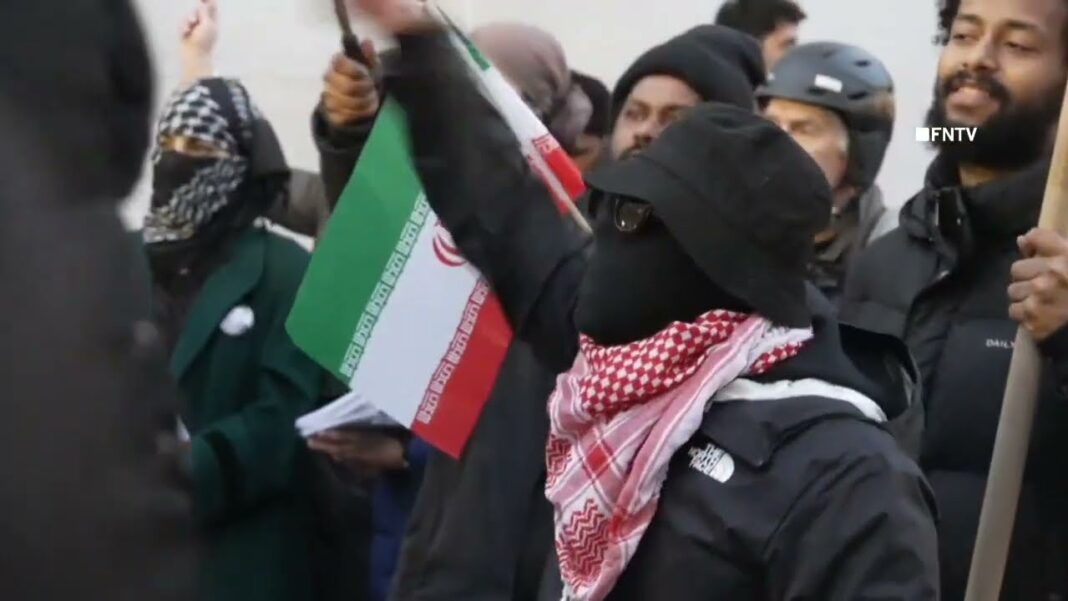
Tensions surrounding the escalating conflict between the United States, Israel, and Iran spilled onto the streets of New York City on Friday afternoon when rival groups of demonstrators clashed in Washington Square Park, prompting multiple arrests and an intensive police response. The confrontation unfolded beneath the iconic Washington Square Arch, where a group of pro-Iranian regime activists erected a makeshift shrine honoring the late Ayatollah Ali Hosseini Khamenei, the former supreme leader of Iran who was killed earlier this year in an Israeli airstrike.
The demonstration quickly drew an opposing group of protesters who arrived carrying American and Israeli flags and chanting slogans celebrating Khamenei’s death. The resulting standoff produced a volatile atmosphere that culminated in several physical altercations, police intervention, and arrests, according to authorities and witnesses cited in a report by The New York Daily News.
At the center of the dispute was the symbolic memorial constructed by approximately 50 pro-Khamenei demonstrators who assembled beneath the arch on Friday afternoon. As The New York Daily News reported, the agitators displayed Iranian flags and arranged tables bearing portraits of Khamenei along with images of other historical and political figures associated with revolutionary movements. Among the figures featured were Malcolm X and Congolese independence leader Patrice Lumumba, as well as civil rights icon George Floyd.
The display reflected an ideological framework that sought to portray the Iranian regime’s struggle against Western powers as part of a broader global movement opposing colonialism and racial injustice. Participants described the memorial as an act of resistance against what they characterized as foreign intervention in Iran.
“People cannot change regimes by assassination,” said one demonstrator who identified himself as Shahid Comrade, a 70-year-old Brooklyn resident. Speaking to reporters, Comrade warned that the killing of Khamenei risked escalating tensions across the world.
“This war only makes the world unsafe,” he said. “This is a step toward World War Three.”
Khamenei’s death came on Feb. 28 when Israeli forces carried out a precision airstrike at the outset of a joint U.S.-Israeli military campaign targeting Iran’s ruling establishment. The operation was designed to dismantle key elements of the Iranian government and weaken the network of militant proxies that Tehran had cultivated throughout the Middle East. The assassination of the longtime Iranian leader marked a dramatic escalation in the confrontation between Iran and its adversaries.
While the memorial ceremony unfolded beneath the arch, an equally vocal group of anti-Khamenei demonstrators gathered nearby on the northern side of Washington Square Park. According to the information provided in The New York Daily News report, the counter-protesters waved American and Israeli flags while chanting jubilant slogans celebrating the demise of the Iranian cleric.
Several participants in the anti-Khamenei demonstration argued that honoring the late Iranian leader in the heart of Manhattan represented a profound insult to American values. They also expressed concern that the event reflected growing ideological divisions within the city.
“They have the woke mind virus,” said Shan Singh, a 35-year-old resident of Queens who attended the counterprotest. In remarks quoted by The New York Daily News, Singh criticized the decision to hold the memorial beneath the arch dedicated to George Washington.
“They hold this memorial under Washington’s arch,” Singh said. “It is a spit in the face.”
Singh also framed the demonstration within the context of broader political debates surrounding religion and governance. “Iran is a theocratic state and we’re for the separation of church and state,” he said. “Islam is not compatible with the U.S.”
The gathering reflected the increasingly globalized nature of political activism in New York City, where international conflicts often inspire passionate demonstrations among diaspora communities and ideological movements alike.
The situation escalated when tensions between the two groups erupted into a physical confrontation. Witnesses told The New York Daily News that one anti-Khamenei protester attempted to breach a barrier separating the demonstrators in an effort to seize a sign from the pro-Iranian activists.
According to those accounts, the man was quickly surrounded by members of the opposing group and assaulted before police intervened. Officers from the New York Police Department moved in to restore order and took the individual into custody.
Authorities confirmed that multiple arrests were made during the clashes, although an NYPD spokesperson told The New York Daily News that officials were still determining the exact number of individuals detained and the charges they would face.
The chaotic scene drew additional attention when a controversial figure from the far-right political fringe made a brief appearance at the park. Jake Lang, a self-described influencer who had previously been convicted for his role in the Jan. 6, 2021, attack on the U.S. Capitol before later receiving a presidential pardon, reportedly arrived in a van near the demonstration.
As The New York Daily News reported, Lang performed a lewd act directed toward the pro-Iranian demonstrators before leaving the area. The episode further inflamed tensions at an already volatile gathering.
Observers noted that the Washington Square Park confrontation illustrated how the ongoing conflict in the Middle East has reverberated deeply within American political discourse. Demonstrations related to the war between Iran and the United States and Israel have taken place in several major cities, reflecting starkly divergent views about the legitimacy of the military campaign.
For supporters of the U.S.-Israeli operation, the removal of Khamenei represents a decisive blow against a regime long accused of sponsoring terrorism and threatening regional stability. Critics, however, argue that the assassination of a foreign leader risks destabilizing the international order and provoking a broader conflict.
The political ramifications of the war continue to unfold as President Donald Trump intensifies pressure on Tehran. On Friday, the president issued a stark ultimatum demanding the “unconditional surrender” of Iran and the installation of leadership acceptable to the United States as conditions for ending the conflict.
According to the information contained in The New York Daily News report, Trump’s remarks underscored the administration’s determination to force a dramatic transformation of Iran’s political structure. The weeklong war has already spread across several countries in the Middle East, raising concerns among analysts that the conflict could escalate into a wider regional confrontation.
Back in Washington Square Park, the clashes eventually subsided as police increased their presence and separated the rival groups. Officers remained stationed around the arch to prevent further violence while demonstrators continued to exchange chants and accusations.
Although the confrontation ended without serious injuries, the events of the afternoon left many observers reflecting on the growing polarization of political discourse in the United States. The scene in Manhattan—where memorials, protests, and ideological symbolism collided beneath a historic monument—offered a vivid illustration of how international conflicts can quickly ignite passions thousands of miles from the battlefield.
For residents and visitors who passed through Washington Square Park on Friday, the demonstration served as a reminder that the reverberations of global geopolitics are often felt most intensely at the local level. As The New York Daily News report noted, the clash between rival demonstrators was not merely about the legacy of one foreign leader but about the broader ideological struggles shaping the contemporary political landscape.
Whether similar confrontations will occur in the future remains uncertain. But as long as the war in the Middle East continues to dominate headlines and influence global politics, cities such as New York are likely to remain arenas where those conflicts play out in the form of protest, debate, and sometimes confrontation.
