



|
Getting your Trinity Audio player ready...
|
By: Fern Sidman
In a dramatic demonstration that blended political messaging with public spectacle, a pro-Israel activist organization brought a mobile billboard truck to the gates of Gracie Mansion on Wednesday, accusing New York City’s leadership of allowing extremist rhetoric and pro-terror sympathies to flourish within the nation’s largest metropolis. The protest, organized by the advocacy group DiploAct, has ignited a fresh round of debate about the intersection of foreign policy conflicts, domestic political leadership, and the growing tensions surrounding the Israel-Iran war that now reverberates across communities worldwide.
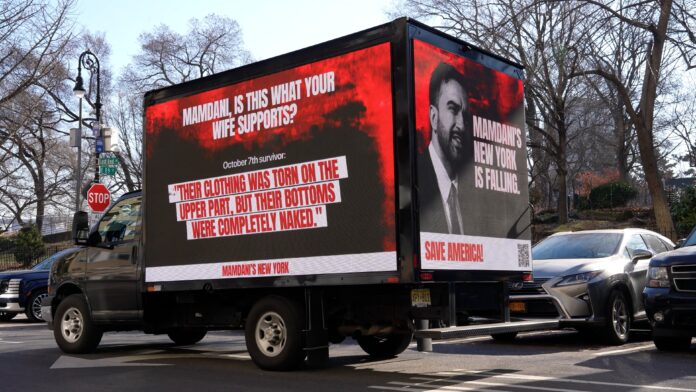
According to a report on Wednesday at VIN News, the billboard truck drove through the streets surrounding the mayoral residence on Manhattan’s Upper East Side displaying messages sharply critical of Mayor Zohran Mamdani. The vehicle, designed to capture the attention of pedestrians, motorists, and the media, carried large visual displays accusing the mayor of presiding over a city climate in which anti-Semitic rhetoric and pro-terror propaganda have allegedly been allowed to take root.
Today, we brought a billboard truck to Gracie Mansion. Under Mamdani, New York is becoming a hotbed for jihadists and extremist propaganda — while City Hall looks the other way.
While the West fights Iranian-backed terror, his New York hosts chants of “Death to America,” vigils… pic.twitter.com/A5cliVk7dS
— DiploAct (@diploact) March 11, 2026
The protest represents the latest development in a growing series of controversies surrounding Mamdani’s leadership, particularly in the context of the ongoing Middle East conflict and the surge of political activism it has inspired in New York City.
The protest was carefully staged to maximize visibility.
Gracie Mansion, the official residence of New York City’s mayor, has long served as both a symbolic and practical focal point for public demonstrations. Situated within Carl Schurz Park overlooking the East River, the residence has frequently been used by activists seeking to send messages directly to city leadership.
DiploAct’s decision to deploy a mobile billboard truck allowed the group to bring its message directly to the neighborhood surrounding the mansion.
According to coverage cited by VIN News, the truck displayed slogans criticizing what the organization describes as a pattern of tolerance toward extremist rhetoric in New York.
In a social media statement accompanying the demonstration, DiploAct said the protest was intended to highlight what it believes is a troubling disconnect between global security concerns and the political climate within the city.
“While the West fights Iranian-backed terror,” the group wrote, “his New York hosts chants of ‘Death to America,’ vigils for Khamenei, and activists who praise Hamas.”
The statement reflects broader anxieties among pro-Israel advocates who argue that demonstrations sympathetic to terrorist groups have increasingly appeared in Western cities since the outbreak of the Israel-Hamas war and the subsequent escalation involving Iran.
Central to DiploAct’s criticism is the lingering trauma of the October 7, 2023 Hamas attacks on southern Israel, an event that dramatically reshaped global discourse surrounding terrorism and Middle Eastern geopolitics.
Those attacks resulted in the brutal murder of more than 1,200 people and the abduction of hundreds of hostages into Gaza, triggering a devastating regional war and sparking intense political debate across Europe and North America.
DiploAct’s protest also referenced a controversy involving Rama Dawaji, the mayor’s wife, who was reported to have “liked” social media posts that critics claim celebrated the Hamas attacks.
According to reports cited by VIN News, the billboard truck included references to the alleged social media activity as part of its broader critique of the mayor’s leadership. The issue has generated considerable political attention in recent days, with critics arguing that such social media behavior raises serious questions about the values and perspectives influencing City Hall.
New York City has long served as a stage upon which global political conflicts are echoed and debated. Home to one of the world’s largest Jewish populations outside Israel, as well as large Muslim, Arab, and international communities, the city frequently becomes a focal point for demonstrations tied to Middle Eastern politics.
The current war involving Israel, Iran, and allied forces has intensified those dynamics. Protests, vigils, and rallies have become increasingly common across Manhattan and other boroughs, sometimes drawing thousands of participants representing a wide range of perspectives.
Supporters of Israel have organized rallies calling for the release of hostages and the defeat of Iranian-backed militant groups, while pro-Hamas activists have staged demonstrations criticizing Israeli military actions and Western support for the Jewish state.
According to the VIN News report, tensions surrounding these demonstrations have occasionally led to confrontations between opposing groups.
DiploAct’s protest specifically targeted what it described as the city’s failure to address extremist rhetoric appearing in certain demonstrations. The organization alleges that some rallies have included chants or slogans sympathetic to militant organizations or hostile to the United States.
Critics of the mayor argue that stronger condemnation of such rhetoric is necessary to prevent the normalization of extremist views. Supporters of Mamdani, however, contend that political speech—even controversial speech—falls within the protections of the First Amendment and that city officials must tread carefully when responding to protests.
The debate reflects a broader national conversation about how democratic societies should respond to controversial or inflammatory political expression during times of international conflict.
Despite the intensity of the demonstration and the publicity it generated, City Hall had not issued an immediate response to the protest as of Wednesday evening. According to reports cited by VIN News, requests for comment from the mayor’s office had not yet received a reply.
The absence of an official response has only fueled further discussion among observers, some of whom argue that the controversy underscores the need for clearer messaging from city leadership.
Political analysts note that demonstrations such as the DiploAct billboard protest represent a form of modern political theater. Mobile billboards, social media campaigns, and highly visible demonstrations are increasingly used by advocacy organizations to shape public narratives and attract media attention.
By bringing its message directly to Gracie Mansion, DiploAct sought to connect local leadership with the broader geopolitical struggle unfolding in the Middle East.
Whether the protest will influence city policy remains uncertain.
What is clear, however, is that the controversy reflects deeper tensions within New York City’s political landscape. The city’s role as a global hub ensures that international conflicts often resonate locally, creating debates that extend far beyond municipal governance.
For DiploAct and its supporters, the billboard truck represented an urgent warning about what they perceive as a dangerous trend. For critics of the protest, it represents another chapter in the ongoing politicization of foreign policy within domestic politics.
As the war abroad continues to shape conversations at home, the streets surrounding Gracie Mansion have once again become a stage where global struggles intersect with local leadership—and where the battle for public opinion unfolds in full view of the city t
