



|
Getting your Trinity Audio player ready...
|
By: James Carlisle
In a decision that has ignited debate over policing, prosecutorial discretion and public disorder, Manhattan prosecutors declined Thursday night to pursue an assault charge against a man arrested in connection with a viral snowball fight in Washington Square Park earlier this week. Instead, the defendant, 27-year-old Gusmane Coulibaly, was arraigned on lesser misdemeanor counts, a move that has drawn both criticism and defense from competing quarters of the city’s civic life.
According to a report on Thursday in the Gothamist, Coulibaly appeared in Manhattan Criminal Court facing charges of obstructing governmental administration and a harassment violation. The more serious allegation of assault—initially publicized by police following the incident—was notably absent from the complaint. Prosecutors indicated they could not establish that a police officer sustained a physical injury directly attributable to Coulibaly’s actions, a legal threshold required to sustain an assault charge under New York law.
The case stems from a large and chaotic snowball fight that unfolded Monday in Washington Square Park, in the aftermath of a powerful blizzard that blanketed New York City. Gothamist reported that what began as an exuberant display of post-storm revelry escalated when police officers entered the scene, reportedly responding to complaints about disorderly conduct and snow being hurled from elevated structures. The encounter, captured on video and widely circulated on social media, showed officers surrounded by a crowd as snow and ice were thrown in multiple directions.
Earlier in the week, police officials stated that two officers had been treated for minor injuries, including a bruised eye and a headache. Law enforcement representatives initially characterized the episode as an assault on uniformed officers, framing it as an affront not merely to individual officers but to the authority of the NYPD itself. Gothamist noted that such characterizations quickly reverberated beyond the park, fueling commentary from police unions and city leaders alike.
Yet when Coulibaly was formally arraigned Thursday evening, prosecutors took a narrower view of the available evidence. As reported by Gothamist, the Manhattan District Attorney’s office concluded that it could not prove beyond a reasonable doubt that Coulibaly’s conduct caused a specific officer’s injury. While the broader investigation remains ongoing, the immediate legal action reflects the evidentiary standards governing criminal charges in New York courts.
Coulibaly was released under supervised release conditions, a common practice for nonviolent misdemeanor charges. The decision to forgo an assault charge prompted a conspicuous display of solidarity from law enforcement. Approximately a dozen uniformed officers attended the arraignment, joined by leadership from the Police Benevolent Association (PBA). Gothamist reported that PBA President Patrick Hendry sharply criticized prosecutors’ decision, describing the snowball fight as “a blatant attack on the uniform.”
Hendry’s remarks underscored the ongoing friction between police unions and Manhattan prosecutors, particularly in cases involving allegations of assaults against officers. The union’s presence in court signaled its broader concern about what it views as insufficient accountability for actions targeting law enforcement. In framing the snowball fight as a direct challenge to police authority, union officials sought to elevate the incident beyond youthful exuberance or momentary chaos.
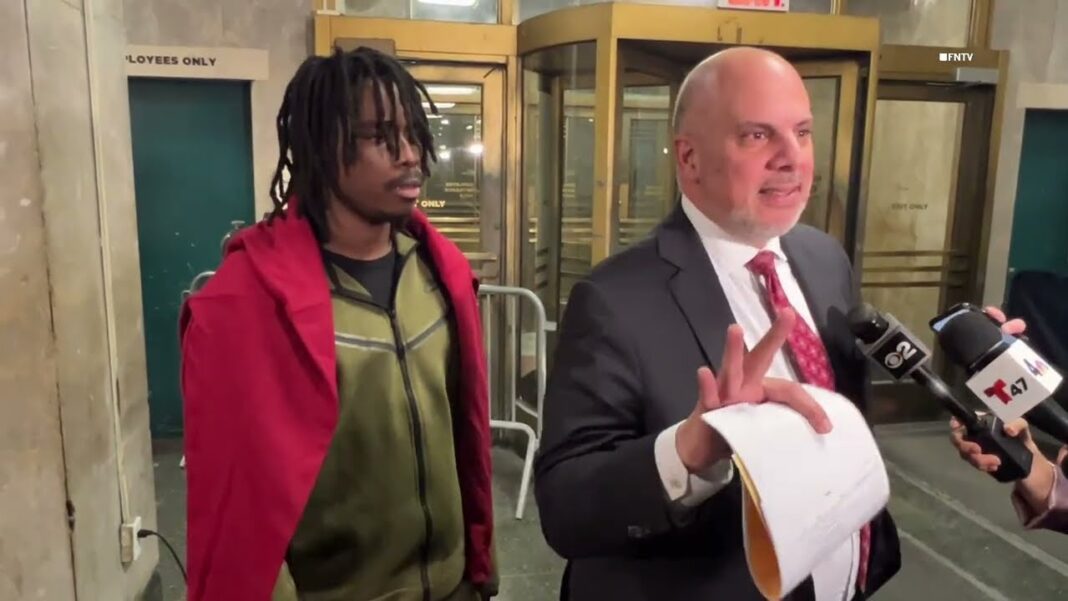
Defense attorney George Vomvolakis offered a sharply contrasting interpretation. Vomvolakis told reporters outside the courtroom that video footage of the encounter did not substantiate claims of a deliberate assault. In court, he argued that the case amounted, at most, to a summons-level offense—hardly the violent confrontation suggested in initial public statements. His argument focused on the absence of clear causation between Coulibaly’s alleged actions and the officers’ injuries.
The divergence in narratives illustrates the broader tensions surrounding public demonstrations and police response in New York City. Washington Square Park, long a locus of spontaneous gatherings and civic expression, has in recent years become a flashpoint for debates about public order and enforcement priorities. Gothamist’s coverage contextualized Monday’s snowball fight within that tradition, noting the intersection of celebratory chaos and law enforcement intervention.
Prosecutors’ decision to limit the charges may reflect both legal prudence and sensitivity to evidentiary clarity. Under New York Penal Law, a charge of assault in the third degree requires proof of physical injury caused intentionally or recklessly by the defendant. Without conclusive evidence tying Coulibaly’s conduct to the specific injuries sustained, prosecutors appear to have opted for charges that align more directly with the provable facts.
Still, the political ramifications are unlikely to dissipate quickly. The investigation remains active, leaving open the possibility of additional charges or defendants if further evidence emerges. Meanwhile, the case has reignited discussion about the line between disorderly conduct and criminal assault, particularly in the emotionally charged context of confrontations with police.
Public reaction has been predictably divided. Some New Yorkers view the snowball fight as an overblown episode of winter exuberance, arguing that minor injuries sustained in such circumstances do not merit felony-level prosecution. Others contend that any act resulting in harm to officers should be met with decisive legal consequences, lest the city signal tolerance for attacks on public servants.
The incident also highlights the power of viral video in shaping public perception. The Gothamist report emphasized that the rapid dissemination of footage from Washington Square Park amplified scrutiny on both police conduct and prosecutorial decisions. In the digital age, the evidentiary record often extends beyond official reports, encompassing amateur recordings that can complicate or contradict initial narratives.
For Coulibaly, the immediate legal outcome is a release under supervision and the prospect of defending against misdemeanor charges. For the city, the case serves as a microcosm of ongoing debates about accountability, proportionality and the role of prosecutorial discretion. The Gothamist report illuminated not only the specifics of this case but also the broader dynamics that frame interactions between citizens and law enforcement in a densely populated urban environment.
As winter recedes and the snow in Washington Square Park melts away, the legal and political reverberations of Monday’s gathering are likely to endure. Whether viewed as an instance of reckless misconduct or an overcriminalized moment of communal exuberance, the episode underscores the delicate balance between maintaining public order and calibrating justice to the weight of the evidence.
