



|
Getting your Trinity Audio player ready...
|
Edited by: Fern Sidman
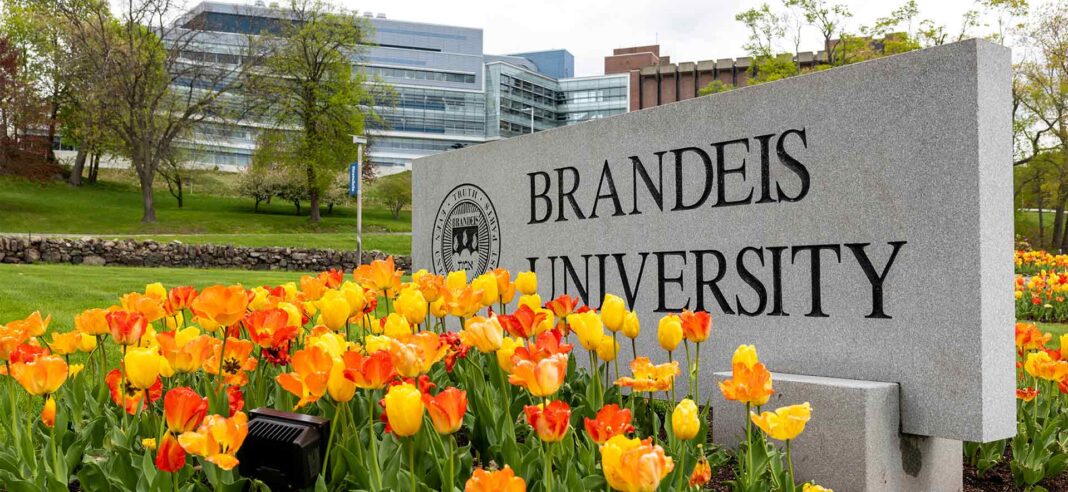
Brandeis University, a prestigious institution of higher learning located just west of Boston, has a rich history deeply intertwined with the Jewish community. Founded in 1948 and named after the first Jewish justice on the U.S. Supreme Court, Louis Brandeis, the university has a significant Jewish student population, making it a unique and culturally diverse place of learning. However, recent events have exposed divisions within the student body, with a resolution igniting passionate responses from students and reflecting the broader debate around the condemnation of Hamas terror and Israel’s objective of defending herself after the October 7th brutal massacre that left over 1400 dead in southern Israel.
For pro-Israel students at Brandeis, the past two weeks had offered a semblance of relief. Shockwaves were felt around the world in the immediate aftermath of the heinous atrocities committed by Hamas against Israeli civilians. While other campuses around the world grappled with heightened anti-Israel sentiments and protests, Brandeis University had largely avoided this tumultuous wave, as was reported by the JTA. However, this period of calm was disrupted when the student government faced a resolution condemning the Iranian backed Hamas terror group while demanding the immediate release of the 220 hostages that they captured during their sadistic rampage.
The resolution, introduced by senior Yoni Kahn, aimed to condemn terrorism and, in his words, show support for “Jewish, Israeli, Palestinian, and Muslim students,” the JTA reported. The resolution specifically targeted Hamas, seeking to address a pressing issue that had ignited global debates. Yet, the outcome of the vote left a bitter taste for many, as only six members of the Student Union Senate voted in favor, while ten voted against it, and five abstained, according to the JTA report. This split decision was met with great consternation throughout the Brandeis community.
The aftermath of the vote revealed a campus divided. Pro-Israel students were left feeling frustrated and disappointed. The JTA report indicated that Stephen Gaughan, a Jewish sophomore who had served in the student government, was so incensed by the decision that he resigned from his position. Gaughan believed the vote had undermined the legitimacy of the Student Union as a representative body, as he saw a strong sense of unity among students who felt let down by the decision, as was reported by the JTA. Gaughan’s outrage was shared by many, illustrating the deep emotional response generated by the vote.
Ella Messler, a junior and the social media manager of the advocacy group Jewish on Campus, expressed her disappointment with the outcome. As was indicated in the JTA report, she pointed to Brandeis’ history and its founding principles of inclusion, social justice, and close ties to the American Jewish community as the foundation for her frustration. Many students felt that the university had strayed from its core values by failing to condemn terrorism.
Brandeis University’s president, Ronald Liebowitz, had previously issued a statement expressing concern for students and staff with Israeli friends and relatives during the attack on Israel. According to the JTA report, unlike some other college leaders, Liebowitz unambiguously supported Israel’s right to defend itself, condemning terrorism and emphasizing the importance of protecting innocent civilians.
Additionally, the resolution urged campus groups to engage with the conflict and promote “empathy, tolerance, and informed discussion.” Importantly, it did not take a stance on the Israeli government or the Israeli-Palestinian conflict as a whole, according to Yoni Kahn, the student who introduced it, according to the JTA report.
Kahn, who expressed solidarity with the Palestinian cause, emphasized that the resolution’s purpose was to condemn an extremist organization rather than delve into the complexities of the broader conflict.
Despite the resolution’s relatively narrow scope, it faced a wide margin of rejection by student senators. The JTA also reported that Allison Weiner, a member of the senate, criticized the resolution, labeling it “ridiculous” to call on an internationally recognized terrorist organization to take any action.
Eamonn Golden, the senator who had initiated the resolution, clarified that its primary goal was to show students that the university was in solidarity with them during these challenging times, the JTA report said. The resolution had garnered significant support, with more than 160 signatures from fellow students, prior to the vote.
Brandeis University enrolls a diverse group of international students, including Palestinians. This diversity has given rise to ongoing activism, notably by a chapter of Students for Justice in Palestine (SJP). However, the JTA reported that these vehement ant-Israel displays of pure hatred have also generated controversy, as dozens of Jewish groups across the nation have called for defunding SJP chapters due to their celebration or defense of the recent Hamas terror attack.
Ella Messler, a student who expressed her disappointment following the vote, saw Brandeis University’s situation as part of a broader pattern of dismaying responses on college campuses to the reprehensible Hamas attack on Israel This pattern, according to Messler, includes protests, harassment of students, and Jewish students being targeted for their real or perceived connections to Israel, the JTA reported.
Messler and Gaughan referenced a notable example from Harvard University, where various student groups signed a letter holding the Israeli government entirely responsible for the unfolding violence, the JTA report said.
In response to the vote and the heightened campus temperature, Brandeis University’s president, Ronald Liebowitz, issued a second statement reaffirming the institution’s support for Israel’s right to defend itself. The JTA report said that he also expressed sympathy for innocent civilians in Israel and Gaza and urged compassion and civility in discussions related to the issue. Liebowitz emphasized the university’s commitment to free speech and the prohibition of threats or harassment directed at members of the community.
Gaughan praised the university’s administration for its unwavering support, finding comfort in the president’s statements, especially in light of the student senate’s divisive vote.
On Thursday, the JTA reported that two statements published on Wednesday serve as a collective response to the recent divisive vote, illustrating that the student government’s stance does not represent the majority view at Brandeis. These statements emphasize the importance of condemning Hamas terrorism without reservation and demonstrate that the university’s commitment to unity remains unwavering.
One of the statements, an open letter authored and circulated by Eitan Marks, a senior and the president of Brandeis Hillel, has rapidly gained support from various segments of the Brandeis community, the JTA reported. By Thursday morning, the letter had garnered over 1,000 signatures from current students, their families, university faculty and staff, and alumni dating back to 1960. Notably, Brandeis Hillel, an important organization on campus, has also endorsed this statement.
“We, the undersigned, strongly condemn the atrocious and barbaric Hamas terror attacks against the people of Israel this month, including many connected to the Brandeis community,” the letter begins. It adds, “Failure to denounce these atrocities without reservation is a moral stain.”
Speaking to the Jewish Telegraphic Agency, Rabbi Seth Winberg, the executive director of Brandeis Hillel, said, “I’m really proud of our students for mobilizing so quickly.” He also signed the letter.
The second statement, from the Brandeis Undergraduate Student Union, reinforces the denunciation of Hamas terrorism. This statement was emailed to all undergraduate students and posted on social media, the JTA reported.
Marks praised the Student Union’s letter, viewing it as an essential correction at a challenging time. As was reported by the JTA, he expressed his relief that the student government corrected its stance and unequivocally condemned terrorism. Marks also emphasized that Brandeis University remains dedicated to being the best university for Jewish students in the United States.
While the Student Union’s statement has received widespread support, not all members of the Brandeis community view it as an adequate response. As was reported by the JTA, Gaughan mentioned that he has heard from students on campus who consider the Student Union’s letter to be “too little too late.” Gaughan also expressed concern over the lack of individual signatories on the student government’s statement, underlining the need for transparency.
Despite the senate vote, Gaughan pointed out that the campus response to the terror attack has been largely in support of Israel and Brandeis’ Jewish community, the JTA report said. Isolated incidents of anti-Israel graffiti have been reported on campus, but there have been no demonstrations in support of Hamas terrorism.
Pro-Israel student groups, such as the Brandeis Israel Public Affairs Committee (BIPAC), also weighed in on the matter. The JTA reported that BIPAC expressed disappointment and concern regarding the Student Union’s decision, emphasizing the need for students to be vocal about their commitment to human rights.
The recent events at Brandeis are not isolated incidents but are part of a broader trend of campus reactions to the conflict in Israel. Several campuses have faced challenges regarding their response to the Israel-Gaza conflict, including donor funding concerns.
SJP has initiated its own open letter, which strongly denounces “the Israeli genocide” and calls on Brandeis University to acknowledge the suffering of Palestinians, as was reported by the JTA. It also requests special resources for Palestinian and Muslim students on campus, including an Arab social worker at the university counseling center.
