



|
Getting your Trinity Audio player ready...
|
By: Fern Sidman
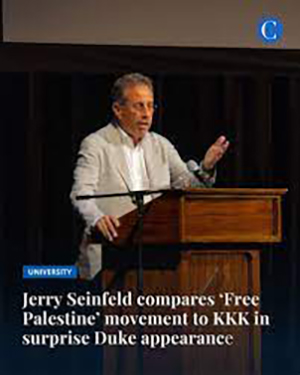
Comedian Jerry Seinfeld, one of America’s most recognizable entertainers and long a vocal supporter of Israel, ignited controversy on Wednesday after equating the “Free Palestine” slogan with the rhetoric of the Ku Klux Klan during a surprise appearance at Duke University in Durham, North Carolina. His remarks, delivered before a packed audience of students and faculty, have since triggered a cascade of debate over the intersection of celebrity activism, antisemitism, and free expression on American campuses.
According to a report that appeared on Thursday in The Jerusalem Post, Seinfeld bluntly told attendees that he views the slogan “Free Palestine” not as a call for liberation or justice, but as a thinly veiled rejection of Jews and their right to self-determination. “Free Palestine is, to me, just, you’re free to say you don’t like Jews. Just say you don’t like Jews,” Seinfeld remarked. He continued by drawing an analogy to one of America’s most notorious hate groups: “By saying Free Palestine, you’re not admitting what you really think. So, it’s actually, compared to the Ku Klux Klan, I’m actually thinking the Klan is actually a little better here because they can come right out and say, ‘We don’t like blacks; we don’t like Jews.’ Okay, that’s honest.”
The Jerusalem Post report highlighted that Seinfeld’s choice of words was a deliberate choice, intended to call attention to the disingenuous language of anti-Israel activism. Slogans such as “Free Palestine” function as euphemisms masking raw antisemitism. His comments struck a nerve in a country where tensions around the Israeli-Palestinian conflict have increasingly spilled over into academic and cultural spaces, with universities often serving as flashpoints.
Seinfeld’s appearance was arranged quietly by Duke’s Chabad organization, working in tandem with other student groups. According to NBC News and confirmed in The Jerusalem Post report, the comedian requested that his participation not be announced beforehand to preserve the focus on the evening’s central guest: Omer Shem Tov, a former Israeli hostage who spent 505 days in captivity in Gaza following Hamas’s October 7, 2023, terrorist onslaught.
The evening was designed to raise awareness about the hostages still held in Gaza, as well as to give Shem Tov the opportunity to share his story of survival, spirituality, and resilience under harrowing conditions. Mason Herman, president of Duke Chabad, explained that the goal was twofold: “To one, raise awareness of that fact, and two, to share their plight while in captivity. And to share Omer’s story.”
The Jerusalem Post report noted that the hostage crisis continues to weigh heavily on Israel’s national psyche, with over 40 individuals still unaccounted for in Gaza. Seinfeld’s participation at the Duke event linked this ongoing humanitarian issue to his longstanding advocacy for Israel.
The Duke Chronicle, the university’s student newspaper, reported that Seinfeld’s comments immediately sparked debate across campus. Duke University issued a statement clarifying its position. In an email from the university spokesperson, the administration emphasized that Duke does not preview remarks made by speakers nor endorse their content. The institution further underscored that Seinfeld’s presence was organized by independent student groups, including Chabad, rather than by the university itself.
This measured distancing reflects the precarious balance universities attempt to maintain: allowing space for student-driven programming and high-profile speakers, while managing the political firestorms that often follow.

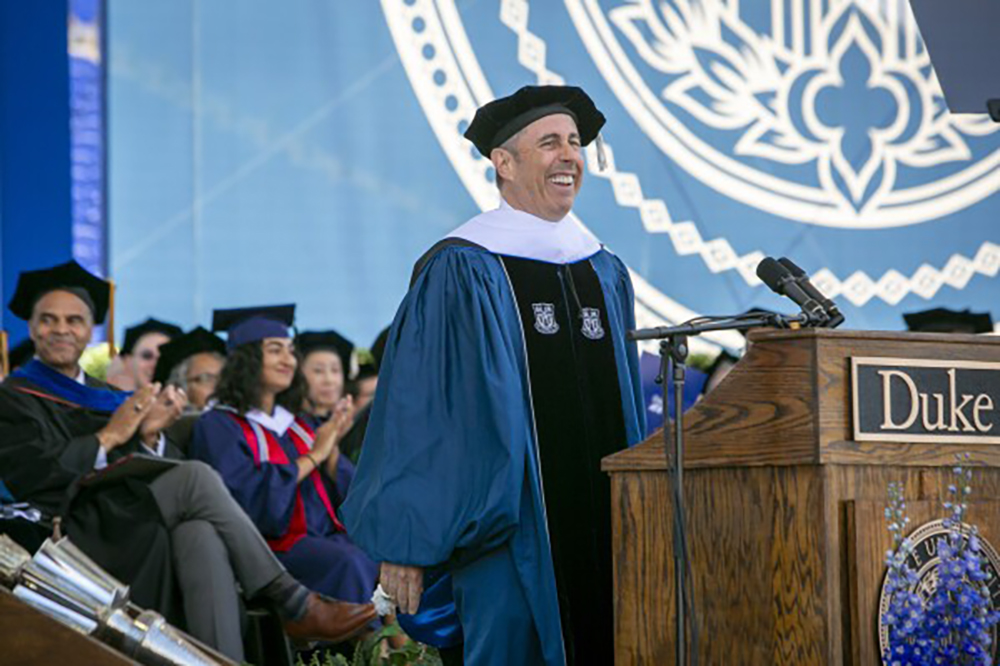
The Jerusalem Post report recalled that this was not Seinfeld’s first appearance at Duke. In 2023, the comedian was awarded an honorary degree during commencement. That ceremony was marred by dozens of students walking out in protest over his pro-Israel views, with some chanting “Free Palestine” as they exited. The echoes of that moment loomed over his Wednesday appearance, particularly as his latest remarks directly targeted the slogan that animated the protest against him two years ago.
Seinfeld’s analogy to the Ku Klux Klan struck many as deliberately provocative. By framing the KKK—historically responsible for brutal violence against Jews, African Americans, and other minorities—as “more honest” than pro-Palestinian activists, Seinfeld sought to spotlight the overt and egregious hypocrisy of modern antisemitism that is cloaked in political rhetoric.
As The Jerusalem Post reported, his remarks aligned with a broader argument advanced by Jewish organizations: that slogans such as “Free Palestine” often fail to distinguish between legitimate criticism of Israeli government policies and the outright rejection of Israel’s right to exist, veering into antisemitic territory.
As of Thursday, reactions to Seinfeld’s speech were sharply divided. Pro-Israel advocates praised the comedian for his candor in boldly calling out widespread antisemitism in campus activism. Groups sympathetic to the Palestinian cause condemned his words as inflammatory and dismissive of Palestinian suffering.
According to the information provided in the The Jerusalem Post report, Jewish organizations have frequently criticized NGOs, media outlets, and academic institutions for minimizing or excusing antisemitic rhetoric cloaked in pro-Palestinian slogans. Seinfeld’s intervention, they argued, amplifies this critique in a cultural setting where celebrity voices can cut through the noise in ways that politicians or policy experts often cannot.
Meanwhile, Palestinian advocacy groups issued statements rejecting the comparison outright. They contended that “Free Palestine” is not an antisemitic slogan but a call to end what they describe as decades of occupation and oppression. For them, Seinfeld’s analogy to the KKK was an offensive mischaracterization.
The Jerusalem Post emphasized that Seinfeld’s speech should be seen in the broader context of American Jewish anxieties in the aftermath of October 7 and the subsequent war in Gaza. Rising antisemitic incidents in the United States, combined with increasingly aggressive anti-Israel demonstrations on campuses, have fueled a climate in which prominent Jewish voices feel compelled to speak out forcefully.
By linking the “Free Palestine” slogan to America’s most infamous hate group, Seinfeld crystallized a sense of Jewish vulnerability: that calls to erase Israel are, in essence, calls to erase Jewish identity itself.
Whether one agrees with his analogy or not, it spotlights the depth of fear and frustration felt in many Jewish communities.
Seinfeld’s foray into political commentary is also notable for the risks it entails. As The Jerusalem Post report pointed out, the comedian has generally avoided overt political activism throughout his career, preferring instead to cultivate an image centered on observational humor and cultural critique. But in recent years, he has become more vocal about his support for Israel, especially as antisemitism has surged globally.
Jerry Seinfeld’s remarks at Duke University have ignited a fierce debate that extends well beyond Durham. By likening the “Free Palestine” movement to the Ku Klux Klan, he delivered an absolutely honest critique of the plague of virulent antisemitism being intentionally masked by spurious political language. The Jerusalem Post report has framed his comments as a pointed intervention at a time when Jewish communities worldwide feel besieged by rising hostility and when the plight of Israeli hostages in Gaza remains unresolved.
The speech, made on behalf of those still held captive, also highlights how deeply the October 7 attacks continue to reverberate in American public life. Whether Seinfeld’s analogy is remembered as a necessary truth-telling or as a damaging oversimplification, it reflects the broader struggle to articulate the boundaries between free expression, political advocacy, and antisemitism in a polarized era.
