



|
Getting your Trinity Audio player ready...
|
Israeli Artist Immortalizes Charlie Kirk in Ashdod Mural Following Assassination
By: Justin Winograd
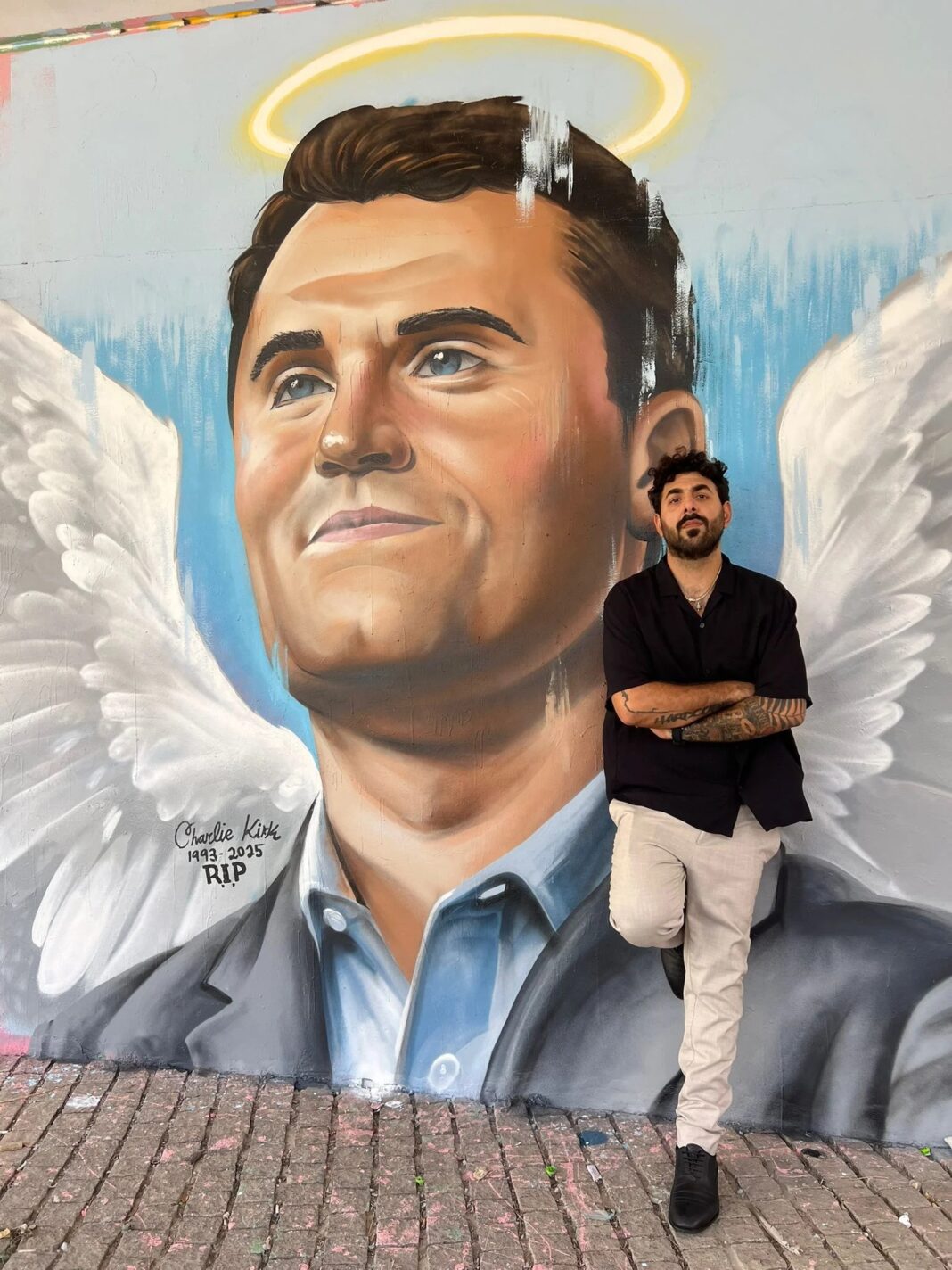
The shockwaves of Charlie Kirk’s assassination continue to reverberate far beyond American shores. In Israel, where Kirk was deeply admired for his outspoken defense of the Jewish state, tributes have taken many forms—none more poignant than the striking mural painted in Ashdod by renowned street artist Dudi Shoval. As reported by Israel National News on Friday, Shoval unveiled his work on Thursday at Ilan Ramon Square, less than 24 hours after news of Kirk’s brutal murder stunned the world.
The mural, completed in record time, portrays the conservative American activist with a glowing halo above his head and a pair of angelic wings stretching wide behind him. To Shoval, this was not merely a work of art but an act of mourning, defiance, and remembrance for a man he described as “one of the world’s most brilliant and unique people.”
Shoval, who has gained prominence for using public spaces in Israel to deliver cultural and political messages through his vivid murals, explained his motivation with heartfelt candor. “Rest in peace, Charlie Kirk,” he said in a statement published by Israel National News. “Yesterday, humanity lost one of the world’s most brilliant and unique people. Not just because he was a supporter of Israel, but because he was sharp, smart, articulate, and fierce. A man of family and faith.”
For Shoval, Kirk’s murder during a campus event in Utah was not only an attack on an individual but also an attack on the values of free expression and truth-telling that Kirk embodied. “Charlie was murdered during a speech, while he held on to the truth, honestly and bravely, while others were too stupid or afraid to contend with it,” Shoval lamented.
The Ashdod mural is as much an expression of grief as it is a declaration of gratitude. “On behalf of the people of Israel, thank us for all your work—watch over us from above,” Shoval added, his words echoing sentiments widely shared in pro-Israel communities.
Charlie Kirk, co-founder of Turning Point USA, was known internationally as a polarizing but highly influential conservative voice. Yet, as Israel National News has frequently documented, he enjoyed an especially strong following in Israel and among Jewish communities worldwide. His uncompromising defense of Israel’s right to self-defense, his outspoken criticism of antisemitism on American campuses, and his willingness to confront hostile audiences endeared him to Israelis who saw him as an ally in the global battle of ideas.
Kirk’s last public appearance, during which he was assassinated, was consistent with his mission: an open forum at a university, answering questions, engaging critics, and defending his convictions without hesitation. That he died while doing so only deepened the resonance of his legacy in Israel, where courage in the face of adversity is deeply cherished.
As Shoval explained in his tribute, “If the world is divided into good and evil, we lost a very important man on the side of good. I still can’t believe that they managed to silence you.”
The choice of Ilan Ramon Square as the mural’s location is rich with symbolism. Named after Israel’s first astronaut, who perished aboard the space shuttle Columbia in 2003, the square has become a place of civic pride and remembrance in Ashdod. By situating Kirk’s mural in such a space, Shoval implicitly linked the American activist’s memory to Israel’s broader narrative of sacrifice, resilience, and perseverance in the face of tragedy.
Residents of Ashdod gathered quickly after the mural’s completion, laying flowers and lighting candles beneath the image. As the report on Israel National News described, passersby paused in silence before the mural, some reciting prayers, others simply reflecting on the cruel silencing of a man they saw as a fighter for truth and justice.
Dudi Shoval is no stranger to using his art as a weapon against forgetfulness. Known for murals commemorating Israeli heroes, Holocaust victims, and fallen soldiers, he views public art as a means of both preserving memory and galvanizing communities.
In Kirk’s case, Shoval saw not only a duty to honor the man but also a responsibility to signal continuity of his mission. “May we continue in Charlie’s path and never give in to the crazy anarchists who use violence to silence us and make us disappear,” Shoval said in remarks highlighted in the Israel National News report.
His closing words, “May his memory be a blessing,” reflect a Jewish tradition of sanctifying remembrance, placing Kirk in a continuum of figures whose influence transcends their lives.
The assassination of Charlie Kirk, a husband and father of two, has been widely condemned across the political spectrum in the United States. Yet, as Israel National News reported, the reaction in Israel has carried a unique intensity, given Kirk’s reputation as an unwavering friend of the Jewish state.
Israeli officials, commentators, and ordinary citizens alike have expressed outrage and grief, seeing in Kirk’s murder both an act of political violence and a tragic loss of a rare ally. His assassination is being framed in Israel not merely as an American domestic event but as part of a broader struggle in which Israel itself is a frontline target.
The Ashdod mural, therefore, is not an isolated act of tribute. It is emblematic of a wider Israeli recognition of Kirk’s role as a defender of Jewish rights, an amplifier of Israel’s narrative abroad, and a man willing to take personal risks for his convictions.
As Israel National News has frequently observed, Israel is intimately familiar with the phenomenon of silencing voices through violence. From terrorist attacks to international campaigns of delegitimization, Israelis live in the shadow of efforts to stifle their existence and narrative.
In this sense, Kirk’s assassination resonated deeply. His killing on a university campus—an environment that should epitomize free debate—underscored how intolerance and ideological extremism can metastasize into deadly violence.
Shoval’s mural can thus be read as both a lament and a rallying cry: lamenting the silencing of a friend, while rallying against the forces that seek to muzzle voices of truth through intimidation.
The question now, as Israelis and Americans alike grapple with the tragedy, is how to ensure that Kirk’s mission is not extinguished alongside his life. For Shoval, the answer lies in emulation: “We really need you to continue watching over us from above,” he said, directing his words heavenward.
But for those still on earth, the mural is a reminder of the responsibility to carry forward Kirk’s commitment to truth, family, faith, and the defense of Israel.
As the Israel National News report indicated, Kirk’s life and death illustrate the enduring need for courage in confronting hatred and defending freedom. His mural in Ashdod will now stand as a visible symbol of that courage, a daily reminder to passersby of the cost of speaking truth and the imperative of ensuring that such voices are never forgotten.
The assassination of Charlie Kirk has left a void that art alone cannot fill. Yet, in Ashdod, Dudi Shoval has transformed grief into an enduring tribute, capturing both the pain of loss and the resolve to carry forward Kirk’s legacy.
In the bright halo and angelic wings painted above Ilan Ramon Square, Israelis now see not only the likeness of a slain friend but also a reflection of their own struggle against hatred and violence.
As the Israel National News report observed, Kirk’s legacy, like the mural itself, is a call to remembrance and resistance: a promise that truth will not be silenced, even when its messengers fall.

I suggest The Jewish Voice post a daily tribute to an Israeli hero for a courageous sacrifice for the Jewish people. Here is the first one for today from X for an Israeli teenager soldier on October 7: Miss Ravit Assayag, 19:
𝐓𝐡𝐢𝐬 𝐈𝐬𝐫𝐚𝐞𝐥𝐢 𝐡𝐞𝐫𝐨 𝐰𝐚𝐬 𝐬𝐡𝐨𝐭 𝐢𝐧 𝐭𝐡𝐞 𝐦𝐨𝐮𝐭𝐡 𝐛𝐲 𝐇𝐚𝐦𝐚𝐬.
“𝐈𝐟 𝐬𝐡𝐞 𝐝𝐢𝐝𝐧’𝐭 𝐠𝐨 𝐢𝐧, 𝐭𝐡𝐞 𝐞𝐧𝐭𝐢𝐫𝐞 𝐮𝐧𝐢𝐭 𝐰𝐨𝐮𝐥𝐝 𝐛𝐞 𝐝𝐞𝐚𝐝”
Miss Ravit Assayag, 19, was an Israeli teenager that ignited a revolution when she defended her fellow Jews on October 7th.
She saved the village of Yakini.
The night before, Ravit was in NYC and as soon she got off the red-eye flight to Israel, Ravit she went straight onto the field to protect her people.
Her commander told funeralgoers:
“Ravit insisted on going in first. She was killed but she saved the unit, she saved the operation.
We were in an olive grove and had been fighting for several hours. We shot eight of them. Ravit killed three.
We thought they were all dead. We did a sweep of the area and Ravit went to check a shed in the olive grove.
She insisted on going in first. She asked me to cover her. She was shot. But if she had not gone in there, he would have wiped us all out. She saved the unit.”
Just 72 hours earlier Ravit posed for a picture in NYC where she was celebrating the Jewish festival of Sukkot — also known as the Feast of the Tabernacle — with her father.
Every Sukkot they travelled to the United States to sell ritual fruits known as ‘etrog’ — called citron in English — to the NYC Jewish community.
Two parents and 8 siblings, and a family business, she leaves behind.
RIP RAVIT, born July 23, 2004, fell in battle October 7th, 2023. She was only 19.”
pic.x.com/OmRi9DkFl0
Post by Mazelit Toni Airaksinen 🇮🇱🎗(מזלית ) on X.
(You can open the link to her photo,
above):
pic.x.com/OmRi9DkFl0