














UN Rapporteur Francesca Albanese Faces Renewed Scrutiny After Mocking Mother of Oct. 7 Victim
By: Fern Sidman
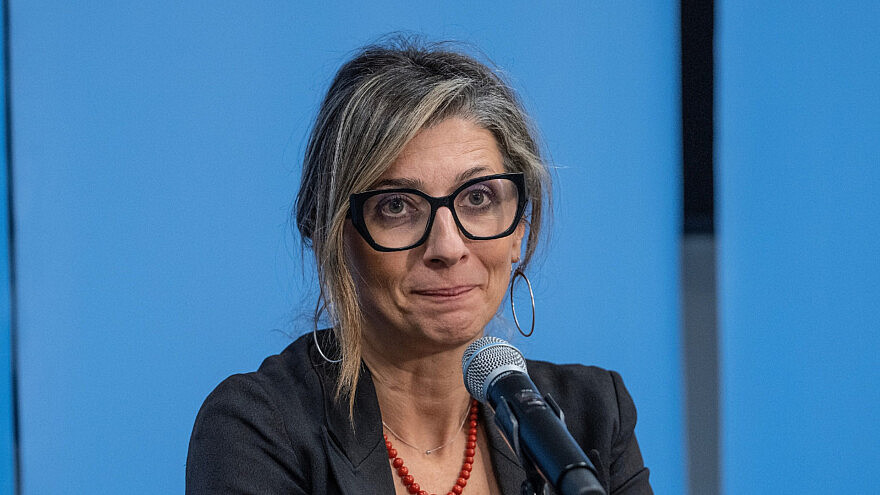
Francesca Albanese, the United Nations special rapporteur on the human rights situation in the Palestinian territories, has once again become the focus of international controversy following a social media exchange involving the mother of a young woman who was murdered during the Hamas-led terrorist attacks in southern Israel on Oct. 7, 2023. The episode has reignited a long-running debate over Albanese’s public rhetoric, her interpretation of the Israeli-Palestinian conflict, and whether her conduct is compatible with the responsibilities of a senior United Nations mandate holder.
According to a report on Thursday in The Algemeiner, criticism intensified after Albanese appeared to respond dismissively to remarks made by Sonja Bohl-Dencker, whose daughter, Carolin Bohl, was among those killed during the Hamas assault that devastated communities across southern Israel.
The controversy emerged after Bohl-Dencker gave an interview to the German newspaper *Die Welt*, in which she recounted attending a film premiere in Berlin in March where Albanese was present as a guest of honor and later participated in a public discussion.
Reflecting on the atmosphere she encountered at the event, Bohl-Dencker described it in stark terms. “I have never been in a room where I felt so much hatred,” she told *Die Welt*. “Everywhere I looked, there were keffiyehs, hostile slogans, and an overwhelming hatred directed at anything connected with Israel.”
According to reports cited by The Algemeiner, Albanese subsequently responded on social media to commentary concerning Bohl-Dencker’s account by posting the phrase “Change medication,” a remark that immediately triggered widespread condemnation from critics who viewed it as insensitive and inappropriate given the circumstances.
The exchange rapidly circulated across social media platforms and became the latest flashpoint in a tenure that has frequently generated diplomatic disputes and public controversy.
At the center of the controversy is the story of Carolin Bohl, a 22-year-old German fashion student and aspiring model who was killed during Hamas’s Oct. 7, 2023, attack on Kibbutz Nir Oz. The assault remains one of the deadliest terrorist attacks in modern Israeli history.
As widely reported, Hamas-led terrorists crossed into southern Israel from Gaza, attacking communities, military installations, and a music festival. Israeli authorities stated that approximately 1,200 people were brutally and sadistically murdered, while 251 hostages were abducted and taken into Gaza. Numerous reports and investigations also documented allegations of widespread sexual violence and other atrocities committed during the assault.
The attack profoundly affected families across multiple countries, including Germany, whose citizens were among the victims. For relatives such as Bohl-Dencker, the loss remains deeply personal and ongoing.
It was against this backdrop that Albanese’s social media response drew particular scrutiny. Critics argued that regardless of political disagreements regarding the Israeli-Palestinian conflict, the appearance of dismissing or mocking a grieving parent crossed a line inconsistent with the responsibilities of a United Nations official.
According to The Algemeiner report, Albanese subsequently elaborated on her views in another social media post, rejecting accusations that she had acted out of hostility toward victims of the Oct. 7 attacks. “I vividly remember the friend of a relative of a victim of the Oct 7 massacre taking the floor,” Albanese wrote. “I replied compassionately.”
She continued: “The audience showed zero sympathy toward Israel, because in the name of protecting Apartheid Israel, Germany is repressing its own citizens. But that’s not HATRED.”
The comments did little to quiet the controversy. Instead, they intensified debate regarding Albanese’s broader record of statements concerning Israel, Hamas, and the war in Gaza. Supporters of Albanese have frequently argued that she is fulfilling her mandate by highlighting alleged human rights violations and advocating for Palestinian rights. Her critics, however, contend that her language often exceeds the bounds of legitimate criticism of Israeli policy and veers into inflammatory rhetoric that undermines her credibility as an independent UN expert.
As The Algemeiner report noted, the latest dispute is far from the first involving Albanese. Since assuming her position as UN special rapporteur in 2022, she has become one of the most polarizing figures associated with the United Nations’ human rights system. The role of special rapporteur is designed to provide independent assessments and recommendations concerning specific countries, territories, or thematic issues.
Rapporteurs are not formal UN employees, but they operate under UN mandates and often carry considerable international influence. Albanese’s critics argue that she has repeatedly used that platform to advance highly controversial interpretations of the Israeli-Palestinian conflict.
Earlier this year, according to reports referenced by The Algemeiner, senior diplomats from Austria, Germany, Italy, France, and the Czech Republic publicly called for her resignation following remarks she made during an event organized by Al Jazeera in Doha. During that appearance, Albanese reportedly described Israel as “the common enemy of humanity” and accused the country of “planning and carrying out a genocide” in Gaza.
Israel has categorically rejected such accusations, arguing that its military operations are directed against Hamas and other terrorist organizations rather than the Palestinian population.
The genocide allegation remains the subject of intense international legal and political debate.
European criticism of Albanese has become increasingly notable because it extends beyond traditional supporters of Israel. Several governments that have sharply criticized Israeli policies in Gaza have nevertheless expressed concern regarding Albanese’s rhetoric. The objections center not only on the substance of her comments but also on the tone and language she has employed.
Diplomats have argued that the position of special rapporteur carries obligations of impartiality and professionalism. Critics contend that repeated use of provocative language risks undermining confidence in the broader UN human rights system. Those concerns have intensified following several controversial statements attributed to Albanese over the years.
According to The Algemeiner report, opponents have cited remarks in which she referred to a “Jewish lobby,” compared Israel to Nazi Germany, and argued that Hamas violence should be understood within a broader political context. Such statements have generated accusations of bias from numerous Jewish organizations, Israeli officials, and lawmakers in several Western countries.
The controversy surrounding Albanese highlights a broader international debate about the distinction between criticism of Israeli government policy and rhetoric that critics view as crossing into antisemitic territory. Supporters of Albanese maintain that she is addressing issues of occupation, military conflict, and human rights violations. They argue that robust criticism of governments and state policies is a legitimate component of international human rights advocacy.
Her detractors counter that some of her statements rely on themes and narratives that echo longstanding antisemitic tropes. The dispute has become particularly intense since the Oct. 7 attacks and the subsequent war in Gaza, which have generated unprecedented polarization across political, academic, and diplomatic circles worldwide.
The latest controversy has also renewed questions regarding oversight mechanisms for UN special rapporteurs. Unlike many traditional international officials, rapporteurs operate with considerable independence. The United Nations has repeatedly emphasized that special rapporteurs are independent experts rather than representatives of the organization itself. As a result, the UN has generally been reluctant to discipline or remove mandate holders solely because of controversial statements.
Critics argue that this framework creates insufficient accountability. Supporters respond that independence is essential for ensuring that rapporteurs can investigate sensitive issues without political interference. The debate intensified last year when pressure mounted on the UN Human Rights Council to block Albanese’s reappointment.
According to The Algemeiner report, several governments and nongovernmental organizations urged member states to oppose extending her mandate. Despite those objections, her appointment was renewed through 2028.
The scrutiny surrounding Albanese has not been limited to her public comments. The Algemeiner reported that the United Nations previously launched an inquiry into allegations involving travel to Australia that was reportedly funded by organizations accused by critics of supporting Hamas.
The circumstances surrounding that trip became another source of controversy and added to ongoing questions about Albanese’s relationships with activist groups. Separately, Albanese has voiced support for anti-Israel protest movements that emerged on university campuses following the Oct. 7 attacks and the Gaza war. According to previous statements cited by The Algemeiner, she characterized student protest movements as a “revolution” that gave her “hope.”
Supporters viewed those remarks as an endorsement of peaceful activism. Critics argued they demonstrated ideological alignment with movements that have often been accused of promoting hostility toward Israel and toward Jewish students.
The latest dispute involving Sonja Bohl-Dencker illustrates how deeply contested Albanese’s role has become within international discourse. For supporters, she remains a vocal advocate for Palestinian rights who is willing to challenge powerful governments and institutions. For critics, she has become a symbol of a growing problem within international organizations: the use of inflammatory rhetoric that they argue undermines both objectivity and constructive diplomacy.
The disagreement is unlikely to subside soon. As the war in Gaza continues to reverberate across international politics, questions surrounding the conduct, language, and influence of prominent figures such as Albanese are likely to remain at the forefront of diplomatic debate.
For the family of Carolin Bohl and other victims of the Oct. 7 massacre, however, the controversy extends beyond politics and diplomacy. It touches on deeply personal questions of memory, grief, and respect for those whose lives were irrevocably altered by one of the most traumatic events in modern Middle Eastern history.
As The Algemeiner has reported, the resulting backlash demonstrates once again how every statement made by prominent international figures in the context of the Israeli-Palestinian conflict is scrutinized intensely—and how the intersection of personal tragedy, political advocacy, and international diplomacy continues to generate fierce and often emotional debate around the worl



