



|
Getting your Trinity Audio player ready...
|
By: Fern Sidman
In the fraught arena of international conflict, where clarity of purpose and moral coherence are indispensable, the recent remarks by Thomas Friedman have ignited a firestorm of criticism that extends far beyond a single televised interview. What might have been framed as a nuanced reflection on geopolitical complexity has instead been widely interpreted as a revealing admission of deep-seated bias—one that critics argue undermines not only Friedman’s credibility but also the integrity of his long-standing commentary on Israel and global affairs.
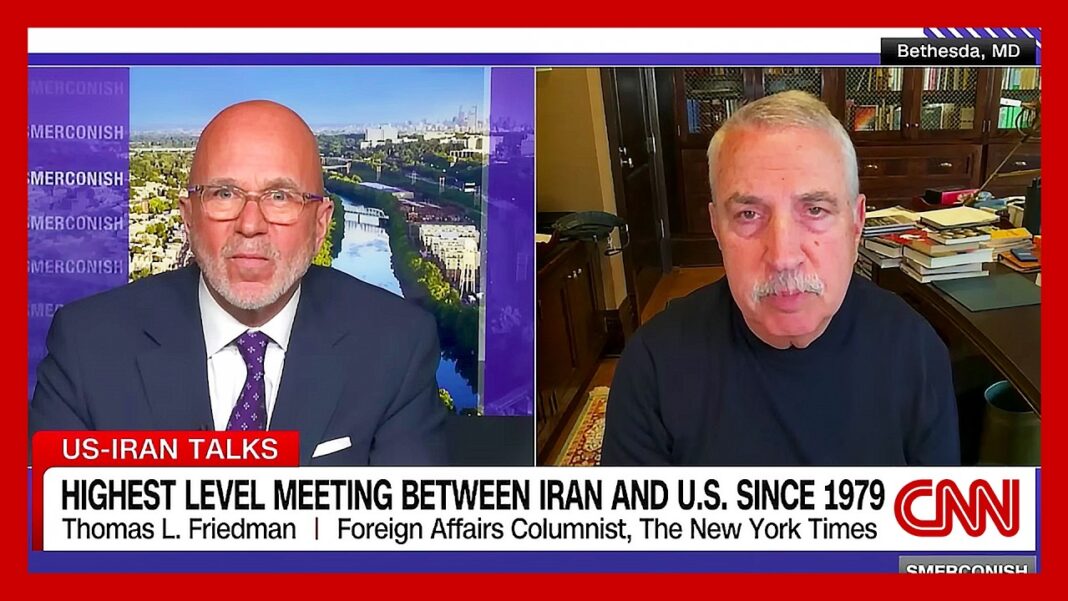
According to a report on Sunday by Israel National News, Friedman’s appearance on CNN with Michael Smerconish laid bare a striking contradiction: a professed desire to see the Iranian regime defeated, coupled with an equally fervent reluctance to see such a victory benefit the leaders currently prosecuting the war. For many observers, this dichotomy is not merely paradoxical—it is emblematic of a broader pattern of subjectivity that has long characterized Friedman’s approach to Israel and its leadership.
Friedman’s central assertion—that he supports the military defeat of Iran while opposing any political advantage accruing to President Donald Trump and Israeli Prime Minister Benjamin Netanyahu—has been interpreted by critics as an extraordinary conflation of personal animus with strategic analysis. As reported by Israel National News, Friedman did not merely express policy disagreements with these leaders; he resorted to sweeping and highly charged characterizations, labeling them in terms that are unbecoming of a seasoned commentator.
Israel National News reported that Friedman said he is troubled because those whom he sees as the “wrong people” are leading the fight against Iran. “I really don’t want to see Bibi Netanyahu or Donald Trump politically strengthened by this war because they are two awful human beings.”
According to Friedman, Netanyahu and Trump are “both engaged in anti-democratic projects in their own countries. They’re both alleged crooks. They are terrible, terrible people, doing terrible things to America’s standing in the world and Israel’s standing in the world.”
For that reason, he says, “I really find myself torn. I want to see Iran militarily defeated, but I do not want to see these two terrible people strengthened.”
This rhetorical posture has prompted a fundamental question: can an analyst who so openly prioritizes his disdain for particular political figures over the outcome of a major geopolitical conflict be regarded as an objective observer? For critics, the answer is unequivocal. They argue that Friedman’s remarks reveal a predisposition that compromises his ability to evaluate events on their merits.
To understand the intensity of the backlash, one must consider Friedman’s broader record. Over the years, he has been among the most persistent and vocal critics of Israeli policy, particularly under the leadership of Netanyahu. While criticism of any government is both legitimate and necessary in a democratic context, detractors contend that Friedman’s commentary has often crossed the line from rigorous analysis into habitual disparagement.
As Israel National News has noted in its reporting, Friedman’s critiques have frequently emphasized perceived failings in Israeli leadership while downplaying or contextualizing the security challenges that the country faces. This tendency, critics argue, has contributed to a narrative that is disproportionately focused on Israel’s shortcomings, even in the face of persistent external threats.
The latest episode, in which Friedman appears to subordinate the strategic imperative of countering Iran to his personal opposition to Netanyahu, is thus seen not as an isolated misstep but as a continuation of a broader pattern.
Friedman’s acknowledgment of the Iranian regime’s malign influence is, in itself, uncontroversial. As he himself noted, Iran’s activities across Lebanon, Syria, Iraq, and Yemen have had destabilizing effects throughout the Middle East. The prospect of a regime change that would prioritize domestic development and peaceful integration into the international community is one that many analysts would welcome.
Yet, as the Israel National News report emphasized, the gravity of this strategic objective makes Friedman’s ambivalence all the more perplexing. If the defeat of Iran is indeed a paramount goal—one with far-reaching implications for regional stability—then the question of who receives political credit for that outcome might reasonably be considered secondary.
By elevating his opposition to Trump and Netanyahu to a level that appears to rival, if not surpass, his concern about Iran, Friedman has invited accusations that he has lost sight of this hierarchy of priorities.
The reaction to Friedman’s remarks was both immediate and pointed. US Ambassador to Israel Mike Huckabee delivered one of the most forceful critiques, questioning the logic of a position that seemed to imply a preference for denying victory to one’s own country if it meant avoiding political gains for disliked leaders.
As recounted by Israel National News, Huckabee drew a stark contrast with his own experience, noting that he had been willing to commend actions taken by political opponents when those actions served the national interest. His remarks underscored a broader expectation that strategic considerations should transcend partisan or personal grievances.
Similarly, Foundation for Defense of Democracies CEO Mark Dubowitz interpreted Friedman’s comments as a candid, if troubling, admission of bias. By suggesting that Friedman’s antipathy toward Trump and Netanyahu had eclipsed his commitment to the strategic objective of defeating Iran, Dubowitz articulated a critique that resonated widely among observers.
The controversy has also reignited a longstanding debate about the role of objectivity in journalism and commentary. While no analyst can claim complete detachment from personal beliefs, there is a widely held expectation that those beliefs should not unduly distort the analysis of critical issues.
In Friedman’s case, critics argue that this line has been crossed. As the Israel National News report highlighted, the explicit nature of his remarks leaves little room for interpretation: he is not merely analyzing the conflict but openly grappling with a desire to see certain political figures denied success.
This admission, while perhaps intended as a display of candor, has instead been perceived as an erosion of the impartiality that is essential to credible commentary.
The broader implications of this episode extend beyond Friedman himself. In an era characterized by heightened polarization, the blending of personal animus with policy analysis risks further undermining the quality of public discourse.
As the Israel National News report suggested, the stakes of the conflict with Iran are too high to be filtered through the lens of individual grievances. The outcome of this war will have profound consequences for regional stability, global security, and the lives of millions. In such a context, clarity of purpose and analytical rigor are not merely desirable—they are indispensable.
Friedman’s remarks, by contrast, have been seen as introducing an element of subjectivity that detracts from these essential qualities. By framing the conflict in terms of his personal opposition to specific leaders, he has shifted the focus away from the substantive issues at hand.
Whether Friedman’s remarks will lead to a reassessment of his approach remains to be seen. What is clear, however, is that they have sparked a broader conversation about the responsibilities of commentators in times of crisis.
In the final analysis, the uproar surrounding Thomas Friedman’s comments serves as a cautionary tale about the dangers of allowing personal animus to overshadow strategic judgment. While his acknowledgment of the Iranian threat aligns with a widely shared assessment, his reluctance to see that threat decisively countered—if it means political gains for leaders he opposes—has raised serious questions about his priorities.
As Israel National News continues to report, the conflict with Iran remains a defining challenge of our time. It demands clear-eyed analysis, disciplined reasoning, and a willingness to place broader interests above individual preferences.
In this instance, critics argue, Friedman has fallen short of that standard—offering not a nuanced perspective, but a revealing glimpse into the perils of subjectivity in an arena where objectivity is paramount.
