












|
Getting your Trinity Audio player ready...
|
Foreign-Linked Machine Politics and the Rise of Zohran Mamdani: How a South Asian Activist Network May Have Tipped New York’s Mayoral Race
By: Fern Sidman – Jewish Voice News
In the crowded world of New York City politics—where every borough, ethnic bloc, and neighborhood power base carries weight—few stories are as startling or as troubling as the one emerging around Zohran Mamdani’s mayoral campaign. According to an in-depth investigation by The New York Post that appeared on Monday, the newly ascendant Democratic Socialist’s primary victory appears to have been fueled not just by local organizing, but by an intricate transnational political machine with ideological and personnel links to radical Marxist movements in Pakistan and other parts of South Asia.
The findings have sparked widespread concern among observers of American democracy. For years, Washington policymakers have sounded the alarm over foreign meddling in U.S. elections, usually imagined as shadowy online operations or disinformation farms. Yet, as The New York Post now reported, the interference many feared may have unfolded in plain sight—on the streets of New York City, under the banner of “immigrant empowerment,” and with foreign activists at the center of a meticulously engineered political operation.
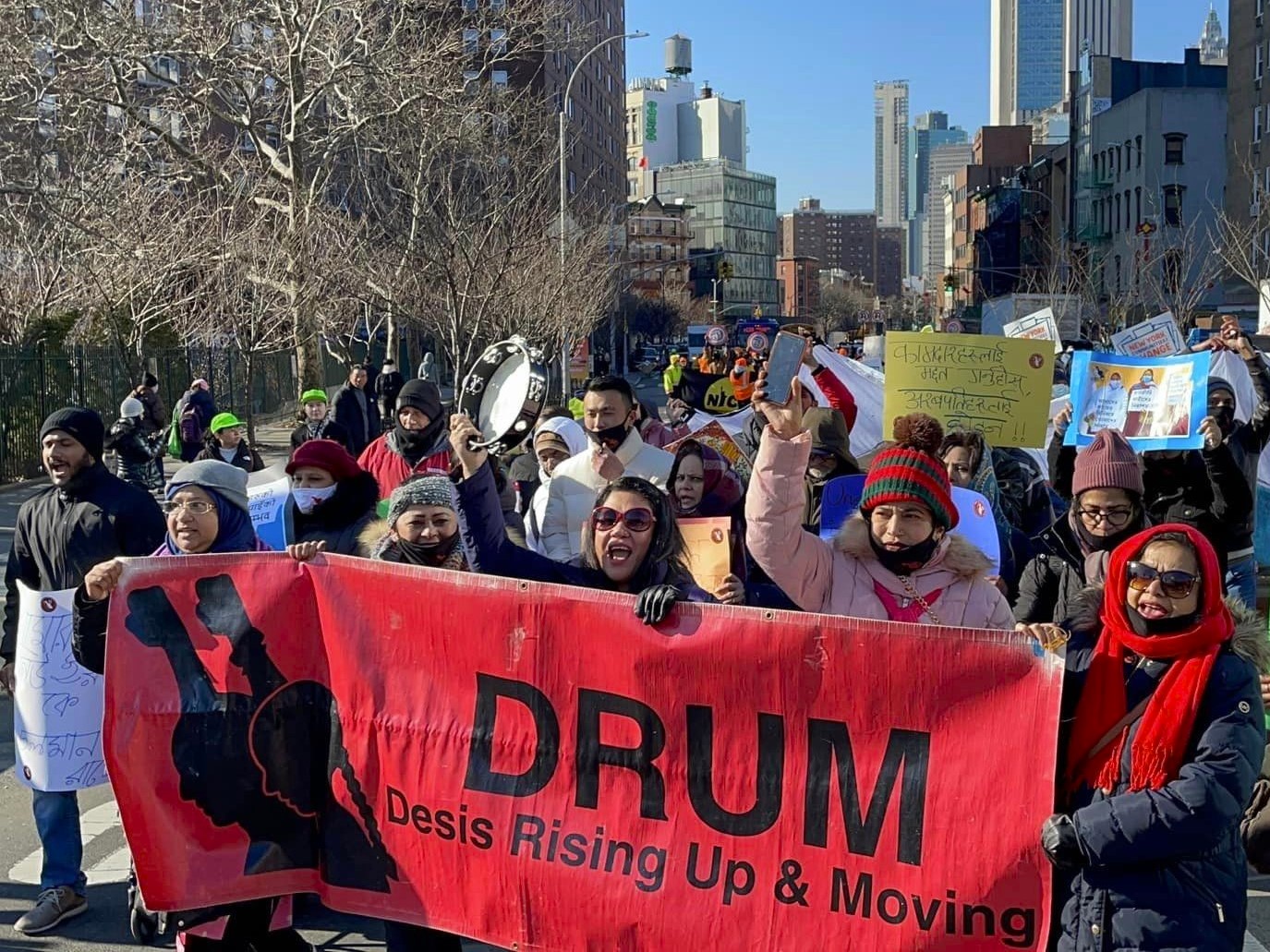
At the heart of the story lies Desis Rising Up and Moving (DRUM)—a Queens-based immigrant-rights nonprofit whose political arm, DRUM Beats, has quietly become one of the most effective field organizations in the city’s recent electoral history. The term “Desis” refers to people of Indian subcontinental origin living abroad—a broad category encompassing Pakistani, Indian, Bangladeshi, and Indo-Caribbean communities.
According to the information provided in The New York Post report, DRUM’s ground game in the 2025 Democratic primary was nothing short of astonishing. By the group’s own account, its volunteers and staff helped mobilize over 150,000 South Asian and Indo-Caribbean voters, resulting in an extraordinary surge in turnout across these demographics. Mamdani ultimately defeated former governor Andrew Cuomo by a margin of 573,169 to 443,229 votes in the third round of ranked-choice voting—a result that stunned city political veterans and redrew assumptions about where power lies in New York’s electoral map.
DRUM’s numbers tell a dramatic story: Bangladeshi turnout rose 13% compared to 2021, while Pakistani turnout rose 11%, with the group boasting that “almost half of all registered Bangladeshis came out to vote.” In a separate analysis, The New York Times—as cited by The New York Post —reported an overall 40% surge in South Asian participation compared to the last mayoral primary.
In an October Facebook post, Mamdani himself credited this tidal wave of organizing. “From the very days of the campaign, we worked closely with organizations like @drumbeatsnyc and @caaavvoice, who canvassed more than one-third of all South Asian residents by the time of the primary,” he wrote. “We made videos in Bangla and Urdu. We showed up everywhere, all the time.”
By all appearances, the strategy paid off. But as The New York Post report revealed, this unprecedented mobilization was far from organic. It was coordinated, disciplined, and—according to multiple reports—deeply intertwined with a network of activists and ideologues connected to Pakistan’s far-left political movements.
In 2022, Fahd Ahmed, DRUM’s executive director, proudly shared a Facebook post recounting his “opportunity to engage with” figures from Pakistan’s Haqooq-e-Khalq Party (HKP), a radical Marxist movement founded by Cambridge-educated historian Ammar Ali Jan and veteran socialist Farooq Tariq. Ahmed described the meeting as “encouraging and impressive.”
HKP—literally “the Party for the Rights of the People”—is not a mainstream political force in Pakistan but a revolutionary group advocating for the fusion of “nationalist movements of oppressed nationalities” with “the socialist movement.” As The New York Post report noted, its leaders operate within a global far-left network that overlaps with organizations such as Vijay Prashad’s Tricontinental Institute—an entity funded by billionaire Roy Singham, who has been accused of financing groups with Chinese Communist Party ties.
In recent years, Ammar Ali Jan has appeared at events hosted by The People’s Forum, a U.S.-based organization currently facing congressional scrutiny for alleged influence from Beijing. DRUM has co-hosted several events with The People’s Forum and participated in its “Shut It Down for Palestine” protests, which erupted in multiple American cities—including New York—after the October 7, 2023 Hamas attacks on Israel.
The overlap of personnel between these groups is significant. As The New York Post report indicated, Jan’s efforts to build “a solidarity network for Pakistani activists in the U.S.” included naming three individuals—Raza Gillani, Mohiba Ahmed, and Zahid Ali—all of whom later emerged as key DRUM organizers during Mamdani’s campaign.
Gillani, a Pakistani journalist and self-described socialist organizer, joined DRUM as a communications specialist while maintaining his public affiliation as an HKP co-founder. He was seen leading a campaign rally in Queens—with Mamdani standing directly behind him.
Mohiba Ahmed, an NYU graduate student and HKP activist, worked as a full-time DRUM organizer during the primary, only to reappear weeks later in Pakistan, delivering speeches at HKP rallies. Similarly, Zahid Ali, another HKP founder and now a doctoral student at Rice University, was publicly lauded in Urdu-language posts by HKP Secretary-General Jan as a “struggle partner who played a key role in Mamdani’s victory.”
In short, as The New York Post report concluded, DRUM’s organizational muscle in New York was reinforced by activists tied directly to an overseas revolutionary movement—a movement openly advocating for anti-capitalist revolution and hostile to Israel, the United States, and Western democratic institutions.
While the Pakistani flank operated quietly, the Bangladeshi arm of DRUM—led by Kazi Fouzia, the group’s director of organizing—wielded extraordinary influence at the local level.
Fouzia, who once described herself as an “undocumented” immigrant before receiving asylum, is widely credited by community figures for mobilizing entire South Asian neighborhoods in Queens and Brooklyn. In her own words to Politico, “We’re like a gang. When we go to any shop, people just move aside and say, ‘Oh my God, the DRUM leaders are here.’”
That confidence—and power—extended into Mamdani’s electoral infrastructure. Campaign filings reviewed by The New York Post show that Mamdani’s committee paid DRUM’s political arm, DRUM Beats, a total of $20,000 during the 2025 mayoral primary. Both entities list the same Jackson Heights address and share the same executive director, Fahd Ahmed.
Such overlap could carry serious legal implications, as 501(c)(3) organizations like DRUM are prohibited from direct political activity. Moreover, Fouzia’s dual role—working on campaign events while maintaining her post as DRUM’s organizing director—could raise questions about the use of charitable funds for partisan purposes.
Yet the network’s influence extended beyond door-to-door canvassing. The New York Post obtained analytics showing that between June 1 and July 1, Mamdani’s social media following exploded, with Instagram followers jumping from 213,000 to nearly 3 million—a 1,295% increase—while TikTok grew by over 1,000%.
Investigators found that engagement from accounts located in India, Pakistan, and Bangladesh far exceeded those in the United States. Repeated comments like “Let’s go bhai!” (“brother”) appeared in hundreds of nearly identical posts, a telltale sign of coordinated foreign engagement.
This digital surge coincided precisely with the final weeks of the Democratic primary—suggesting, as The New York Post report observed, that foreign-based social media activism may have artificially inflated Mamdani’s visibility and reach, helping drive turnout among sympathetic diaspora voters.
Mamdani’s success represents a case study in the fusion of identity politics and ideological activism. His campaign was not just about economic populism or progressive reform—it was about crafting a new ethnic and ideological coalition, one that redefined the city’s political fault lines.
“The entire South Asian vote turned out like never before,” a Queens community leader told The New York Post. “But it wasn’t spontaneous—it was a machine. Every mosque, every small business, every WhatsApp group was part of the push.”
That push—rooted in transnational activism and left-wing solidarity—provided Mamdani with the precise margins needed to overtake Cuomo. A 13% increase in Bangladeshi turnout and an 11% increase among Pakistani voters bridged the gap between the candidates, effectively securing Mamdani’s nomination.
What’s more troubling, analysts note, is that Mamdani’s victory was built atop a movement that explicitly challenges the values of American democracy. Both DRUM and its affiliates have endorsed the Boycott, Divestment, and Sanctions (BDS) campaign against Israel and participated in pro-Hamas demonstrations following the October 7 massacre. Mamdani himself has repeatedly referred to Israel as an “apartheid state” and accused its government of “genocide”—positions widely condemned by mainstream Jewish organizations.
As The New York Post editorialized, the implications for New York’s Jewish community—and for the city’s reputation as a bastion of tolerance—are deeply unsettling. A Mamdani administration could align the mayor’s office with movements hostile to America’s closest ally in the Middle East, embolden antisemitic rhetoric, and further radicalize the city’s already polarized political climate.
The story, as The New York Post report insisted, is not merely about one candidate or one campaign. It is a case study in how foreign political ideologies can infiltrate local American elections, exploiting ethnic identity networks and nonprofit loopholes to shape electoral outcomes.
In this sense, Mamdani’s campaign offers a cautionary tale about the fragility of the American political system in the age of globalization and digital mobilization. What once would have been dismissed as fringe radicalism from abroad has now, through clever organization and targeted outreach, entered the mainstream of urban politics.
Already, policymakers in Washington are reportedly examining whether groups like DRUM and its affiliates have violated federal campaign laws. As The New York Post report noted, the IRS and FEC could be prompted to investigate the use of charitable resources in partisan activity and whether foreign nationals were involved in shaping or funding U.S. electoral outcomes.
Meanwhile, the political establishment in New York remains divided—some praising the campaign as a triumph of diversity and inclusion, others warning it signals the creeping normalization of foreign-backed radicalism in American civic life.
In the wake of the election, The New York Post has continued to probe the network underpinning Mamdani’s ascent. The evidence, while circumstantial in some areas, paints a picture that is deeply disquieting: a convergence of foreign ideology, digital manipulation, and identity-based mobilization powerful enough to reshape the outcome of a major American city’s election.
Whether the scandal will result in legal consequences remains uncertain. But the political and moral implications are clear. If verified, the DRUM–HKP connection represents a direct pipeline between a radical Marxist movement in Pakistan and the mayoral campaign of America’s largest city.
For a metropolis that prides itself on being the capital of democracy and pluralism, that reality is both ironic and alarming. As The New York Post indicated in its editorial analysis, “This was not the hidden hand of interference, but an open one—organizing in daylight, mobilizing in foreign tongues, and reshaping New York politics in its own image.”



