



|
Getting your Trinity Audio player ready...
|
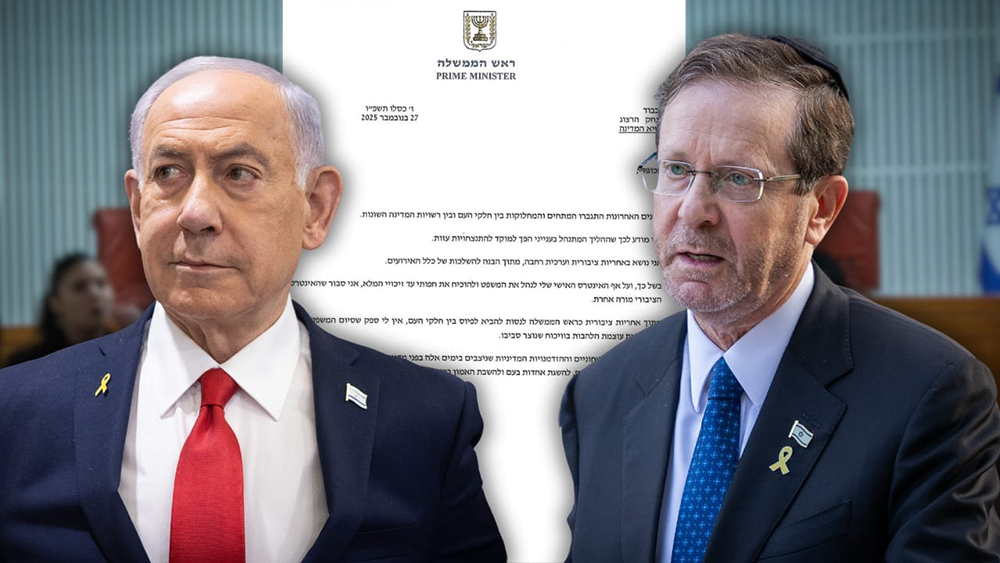
Herzog Temporarily Nixes Netanyahu’s Pardon Request; Urges Renewed Talks Toward Plea Agreement
By: Jeff Gorman
In a moment laden with constitutional gravity and political consequence, Israeli President Isaac Herzog has declined—at least for now—to grant a pardon to Israeli Prime Minister Benjamin Netanyahu, instead opting to pursue an ambitious and delicate effort to broker a negotiated resolution between the embattled premier and the state’s legal authorities. The decision, reported on Sunday by The Times of Israel, represents a pivotal juncture in one of the most consequential legal and political sagas in the nation’s modern history, with ramifications that extend far beyond the courtroom and into the very fabric of Israeli society.
At the heart of the matter lies Netanyahu’s ongoing trial, which began in 2020 and centers on allegations of bribery, fraud, and breach of trust. The proceedings have not only placed an incumbent prime minister in the unprecedented position of standing trial while in office but have also exacerbated longstanding fissures within Israel’s political landscape. The charges themselves—relating to claims that Netanyahu exchanged regulatory favors for gifts and favorable media coverage—have been vigorously contested by the prime minister, who has consistently maintained his innocence and characterized the prosecution as a politically motivated campaign designed to unseat him.
Herzog’s latest intervention, however, signals a determination to steer the crisis away from a zero-sum judicial outcome and toward a negotiated settlement that might mitigate the broader societal tensions the trial has inflamed. In a formal statement issued on Sunday, the president’s office confirmed that he would not be granting a pardon at this stage, emphasizing instead the necessity of exhausting all avenues for dialogue and compromise before considering such an extraordinary step.
“As he has said repeatedly,” the statement noted, “the president believes that reaching an agreement between the parties in the prime minister’s cases is both proper and constructive.” The language reflects a carefully calibrated approach, one that seeks to balance respect for the rule of law with a recognition of the broader national interest in stability and cohesion.
This emphasis on mediation aligns with Herzog’s longstanding view of the presidency as an institution uniquely positioned to bridge divides and foster consensus. According to the information provided in The Times of Israel report, Herzog has grown increasingly concerned that the prolonged legal battle surrounding Netanyahu is deepening political polarization at a time when the country faces a confluence of external and internal challenges. These include ongoing security tensions, the lingering effects of recent military engagements, and the approach of national elections scheduled to take place in approximately six months.
The president’s decision to prioritize negotiations over immediate clemency also reflects the complex legal considerations surrounding the use of the pardon power. In Israel, the authority to grant a pardon is enshrined in the Basic Law governing the presidency, but its application in cases involving ongoing legal proceedings—particularly those in which no conviction has yet been secured—remains a subject of considerable debate.
This issue was addressed directly in a position paper released last month by the Pardons Department of the Justice Ministry. The document, cited by The Times of Israel, concluded that granting a pardon under the current circumstances would be highly problematic. Among the concerns highlighted were the absence of a conviction, the lack of any admission of guilt by Netanyahu, and the broader implications for the integrity of the judicial process.
“Based on the factual and legal foundation currently before us,” the department stated, “it cannot be determined that the pardon authority applies in this case.” The paper further cautioned against taking what it described as a “far-reaching and exceptional step” that would effectively terminate ongoing legal proceedings, warning that such an action could undermine public confidence in the rule of law.
Netanyahu’s request for a pardon, formally submitted in November of 2025, was itself framed in terms of national unity rather than personal exoneration. In a video statement released at the time, the prime minister argued that the continuation of the trial was exacerbating divisions within Israeli society and diverting attention from pressing national priorities. “Israel faces immense challenges,” he said, “and to confront them effectively, unity is essential.”
Yet the request was notable for what it did not include: any acknowledgment of wrongdoing or expression of remorse. This omission has proven to be a central obstacle in the consideration of clemency, as traditional legal and ethical norms surrounding pardons often emphasize the importance of contrition as a prerequisite for forgiveness.
The political dimensions of the issue have further complicated matters. Netanyahu’s supporters, both within Israel and abroad, have mounted an energetic campaign urging Herzog to grant the pardon, arguing that the trial represents a form of judicial overreach that is destabilizing the country. Among the most vocal advocates has been President Donald Trump, who has publicly criticized Herzog’s reluctance to act and called for immediate clemency.
Conversely, Netanyahu’s critics have warned that granting a pardon under the current conditions would set a dangerous precedent, effectively placing political considerations above the rule of law. Many have insisted that any resolution must involve either a full judicial determination or a negotiated settlement in which the prime minister accepts responsibility and withdraws from political life.
It is within this fraught context that Herzog’s proposal for mediated talks assumes its significance. According to The Times of Israel, the envisioned negotiations would bring together Netanyahu’s legal representative, Amit Hadad, and Attorney General Gali Baharav-Miara, whose relationship with the prime minister’s government has been marked by profound ideological and institutional tensions.
Baharav-Miara has emerged as a central figure in the ongoing confrontation between the executive branch and the legal establishment. Her office has repeatedly challenged or declined to defend government initiatives that it deems inconsistent with the law, prompting calls from members of Netanyahu’s coalition for her dismissal. These disputes have become emblematic of a broader struggle over the balance of power within Israel’s democratic system, particularly in light of the government’s controversial efforts to implement sweeping judicial reforms.
Herzog’s belief that a negotiated agreement remains possible reflects a degree of optimism that may not be universally shared. The legal and political stakes are extraordinarily high, and the positions of the parties involved appear, at least on the surface, to be deeply entrenched. Yet the president has reportedly expressed confidence that the “legal landscape leaves room for creativity and innovation,” suggesting that a carefully crafted compromise might yet be within reach.
Not all observers, however, have welcomed this approach. Heritage Minister Amichay Eliyahu, who submitted a position paper supporting Netanyahu’s pardon request, has criticized Herzog’s decision to pursue mediation rather than immediate clemency. In a sharply worded statement, Eliyahu accused the president of opting for procedural caution over decisive leadership, arguing that the moment called for bold action to heal the nation’s divisions.
“It is unfortunate,” Eliyahu wrote, “that the president has chosen the path of legal procedure rather than the path of leadership.” His remarks underscore the extent to which even the mechanism for resolving the crisis has become a subject of political contention.
Beyond the immediate question of Netanyahu’s legal fate, the broader implications of Herzog’s decision are profound. The trial has become a focal point for debates over the nature of political accountability, the independence of the judiciary, and the resilience of democratic institutions in the face of sustained pressure. It has also served as a catalyst for mass protests, legislative battles, and a reexamination of the constitutional framework that governs the state.
In this context, the president’s effort to facilitate a negotiated settlement can be seen as an attempt to de-escalate a situation that threatens to spiral further out of control. By shifting the focus from adversarial litigation to collaborative dialogue, Herzog is seeking to create a space in which competing interests might be reconciled without resorting to outcomes that could exacerbate existing tensions.
Whether such an outcome is achievable remains an open question. The history of similar efforts, both in Israel and elsewhere, suggests that success will depend not only on the skill of the mediators but also on the willingness of the parties to engage in good faith and to make concessions that may be politically costly.
For Netanyahu, the stakes are existential. A negotiated plea agreement could potentially bring an end to the legal proceedings and allow him to claim a measure of vindication, but it might also require compromises that could curtail his political career. For the Attorney General and the broader legal establishment, any agreement must preserve the integrity of the judicial process and avoid the perception of capitulation to political pressure.
As the nation watches this high-stakes drama unfold, the role of the presidency as a stabilizing force will be tested as never before. Herzog’s decision to delay a pardon and pursue mediation reflects a belief that the long-term health of the state depends not on expedient solutions but on processes that command broad legitimacy and respect.
In the final analysis, the unfolding negotiations represent more than a legal maneuver; they are a microcosm of the challenges facing Israeli democracy at a moment of profound uncertainty. As reported by The Times of Israel, the coming weeks and months will determine not only the fate of one of the country’s most enduring political figures but also the trajectory of a nation grappling with the demands of justice, unity, and governance in an increasingly complex world.
