




















|
Getting your Trinity Audio player ready...
|
By: Fern Sidman – Jewish Voice News
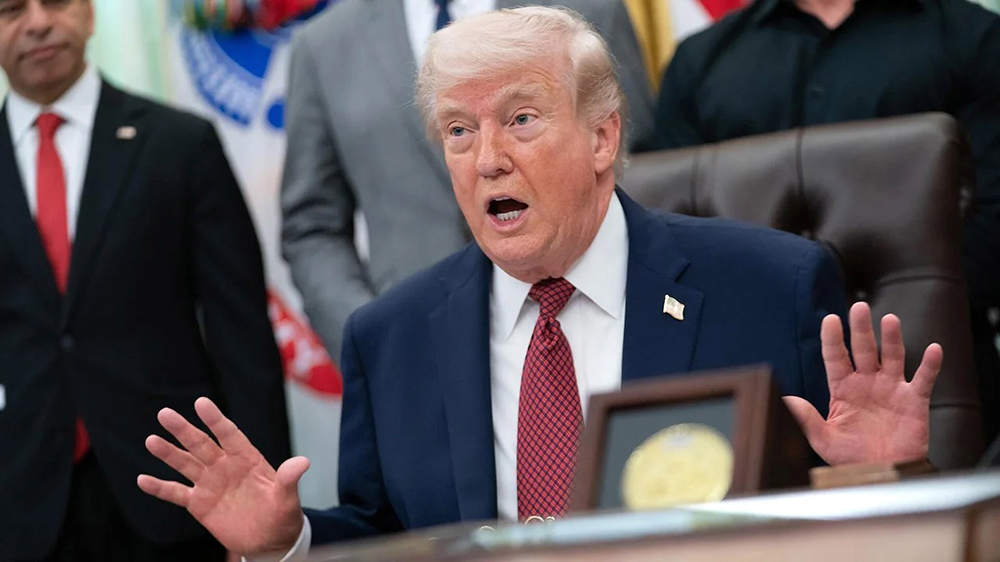
President Donald Trump has formally invited Israeli Prime Minister Benjamin Netanyahu to the White House “in the near future,” Netanyahu’s office announced Monday, setting the stage for another high-profile meeting between two leaders whose alliance has shaped the Middle East’s political and military landscape. According to a report that appeared on Monday in The Algemeiner, the invitation came shortly after Trump urged Israel to maintain a “strong and true dialogue” with Syria — an unexpected diplomatic overture that signals Washington’s evolving strategy in a region still reeling from conflict and political collapse.
If the visit proceeds, it will mark Netanyahu’s fifth White House visit since Trump returned to office in January, underscoring the intensity of their diplomatic engagement even as U.S. and Israeli officials privately acknowledge friction beneath the surface. As The Algemeiner has frequently noted, Trump’s personal rapport with Netanyahu often coexists with moments of impatience, particularly around the Gaza war, domestic Israeli politics, and the prime minister’s ongoing corruption trial.
According to the readout from Netanyahu’s office, the two leaders discussed disarming Hamas and securing a fully demilitarized Gaza — core components of Trump’s plan unveiled in September to end the war. That plan precipitated a ceasefire between Israel and Hamas that has now held since October, though its long-term durability remains uncertain.
Trump’s desire for a fresh meeting reflects what analysts cited by The Algemeiner describe as a turning point for U.S.–Israel coordination: Washington is increasingly focused not only on ending hostilities in Gaza but on shaping the “day after” governance structure. Demilitarization remains the non-negotiable prerequisite for both Trump and Netanyahu, yet the two diverge on how extensive the security overhaul must be and how external stakeholders — including Arab states and NATO-aligned forces — might participate.
Still, the prime minister’s office emphasized strategic continuity, portraying Trump’s invitation as evidence of “deep and ongoing U.S.–Israel coordination” on security threats and counterterrorism objectives across the region.
What most startled diplomatic observers was Trump’s public declaration, ahead of the invitation, that he expects Israel to maintain robust lines of communication with Syria. The president warned that “nothing should take place that will interfere with Syria’s evolution into a prosperous state” and predicted a “long and prosperous relationship” between Israel and Syria — a claim that startled many in Jerusalem and raised eyebrows across diplomatic circles.
Syria has not recognized Israel since the founding of the Jewish state, and relations have historically been defined by wars, proxy battles, and periodic escalations. Trump’s comments indicate that Washington is actively pursuing — and perhaps accelerating — efforts to broker a non-aggression pact between the two countries, a dramatic geopolitical project that would have been unthinkable for most of the past decade.
The U.S. has invested heavily in stabilizing the regime of Ahmed al-Sharaa, who assumed power following the collapse of Bashar al-Assad’s rule. While Trump has openly backed Sharaa, Israel remains deeply wary: intelligence officials in Jerusalem have repeatedly warned that Sharaa maintains dangerous historical ties to Islamist militancy. As The Algemeiner reported earlier this year, Israeli defense officials have cautioned Washington not to equate “post-Assad” with “benign,” especially given Syria’s record of facilitating Iranian entrenchment and anti-Israel operations.
Following Assad’s fall, Israel moved troops into strategic terrain along its northern frontier, reinforcing a military posture designed to prevent terrorist factions from exploiting the power vacuum. The buffer zone previously governed under the 1974 Disengagement of Forces Agreement — which demilitarized parts of the Golan Heights after the Yom Kippur War — effectively collapsed alongside the Syrian regime, leaving Israel to reassess its northern defensive doctrine.
Jerusalem considers the 1974 agreement void, and Israeli leaders have repeatedly warned that no diplomatic engagement with Syria can proceed without ironclad security guarantees. Trump’s vision of “prosperous” bilateral relations sits uneasily against a backdrop of near-daily skirmishes, Iranian proxy infiltration, and targeted Israeli airstrikes.
Indeed, just two days before Trump’s call with Netanyahu, Syrian state media reported that an Israeli operation in southern Syria killed 13 Syrians. The Israel Defense Forces said the strike targeted a Lebanese Islamist cell operating in the area — one of many recent incidents highlighting the volatility of the Syrian frontier. Israeli intelligence has intensified its surveillance of southern Syria, concerned that militant groups are attempting to reconstitute operational bases near the border.
Trump’s call came on the heels of a dramatic political development in Israel: Netanyahu’s submission of a formal request for a presidential pardon in his long-running corruption trial. The request, delivered to President Isaac Herzog on Sunday, has reignited political divisions and prompted fierce opposition calls for the prime minister’s resignation.
Trump, who publicly urged Herzog last month to grant the pardon, described the corruption charges as a “political, unjustified prosecution” in a letter reported widely by The Algemeiner. While the White House readout omitted any mention of the pardon, the topic looms over Netanyahu’s diplomatic standing as he navigates both a national security emergency and a personal legal battle.
Israeli opposition parties have condemned Netanyahu’s request as a cynical attempt to evade accountability, with several insisting that any pardon must be contingent on the prime minister’s permanent departure from political life. As The Algemeiner report noted, some opposition figures argue that Netanyahu’s leadership is now too compromised to effectively manage the Gaza crisis or the broader regional challenges Israel faces.
Nonetheless, Trump’s invitation may strengthen Netanyahu’s standing at home, signaling to Israelis that the prime minister retains strong international backing — particularly from Israel’s most consequential ally.
Trump’s outreach fits into a broader U.S. strategy that blends regional stabilization efforts with a renewed push for long-term diplomatic realignments. The Trump administration’s focus on disarming Hamas, demilitarizing Gaza, and pressuring regional actors to normalize relations with Israel echoes the logic of the Abraham Accords, which The Algemeiner report described as the most transformative diplomatic breakthrough in Middle Eastern politics in half a century.
The pursuit of an Israel–Syria non-aggression pact represents the next frontier of that project — a frontier fraught with complexity. Syria remains fractured, Iranian proxies remain entrenched, and Israel has little faith in Sharaa’s leadership. Yet Trump’s insistence that the two countries pursue dialogue reflects a belief that the geopolitical window opened by the Gaza ceasefire could support a broader shift.
For Netanyahu, the invitation offers both opportunity and risk. On one hand, closer coordination with the United States fortifies his diplomatic relevance at a moment of internal political turbulence. On the other hand, any public embrace of Trump’s Syria initiative poses potential backlash among Israeli defense officials, who remain deeply skeptical of Damascus.
The Middle East is entering a period of strategic realignment unlike anything seen since the Cold War. Trump’s push for Israeli-Syrian dialogue, coupled with his intervention in Netanyahu’s legal saga and his ongoing attempts to reshape the Gaza endgame, places Washington at the center of a volatile and rapidly shifting regional equation.
Netanyahu’s upcoming visit to the White House — if it proceeds — will likely be one of the most consequential diplomatic engagements of the post-October 7 era. It will test whether the United States and Israel can harmonize their visions for Gaza, Syria, and the wider region, even as political pressures intensify on both sides of the relationship.
For now, one certainty remains: as The Algemeiner report observed, the future of the region is being shaped not only by military realities on the ground, but by the evolving personal, political, and ideological interplay between the leaders who command its most powerful states.