



|
Getting your Trinity Audio player ready...
|
By: Fern Sidman
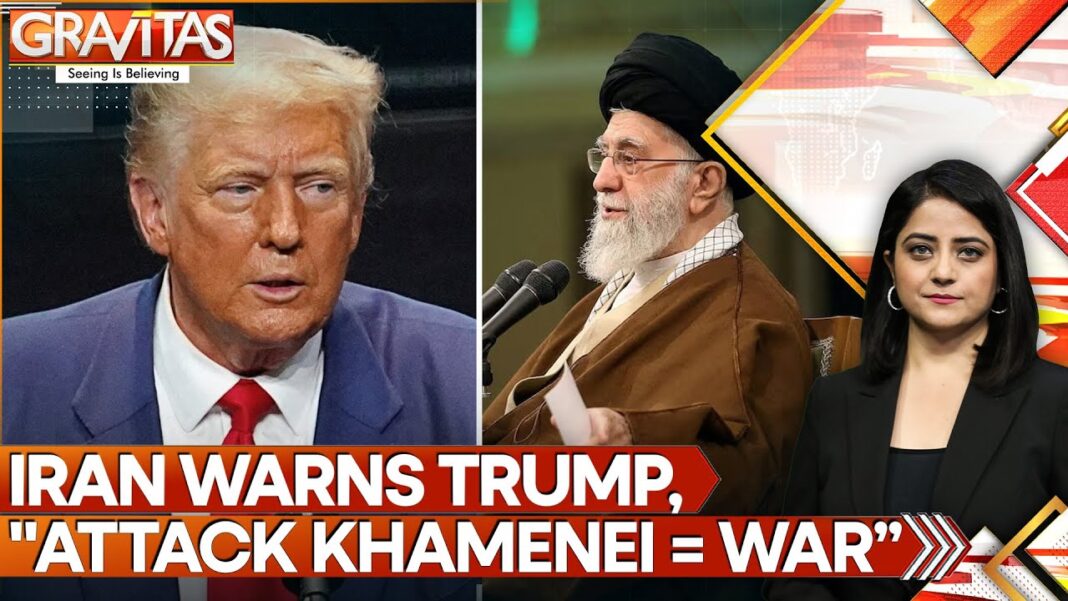
As Iran convulses under the weight of its most sustained and deadly internal uprising in decades, the country’s clerical leadership has reached for its most incendiary vocabulary. On Tuesday, senior Iranian lawmakers warned that any attack on the regime’s “supreme leader,” Ayatollah Ali Khamenei, would trigger a declaration of jihad—a holy war—with violent repercussions extending far beyond Iran’s borders.
The warning, reported by The Algemeiner on Tuesday and echoed across Iran’s state-aligned media ecosystem, marks a sharp escalation in rhetoric at a moment when the Islamic Republic is simultaneously battling mass domestic unrest and intensifying pressure from Washington. The message from Tehran was unambiguous: harm the apex of Iran’s theocratic hierarchy, and the regime claims it will unleash a global religious confrontation.
“Any attack on the supreme leader means declaring war on the entire Islamic world,” Iran’s semi-official ISNA news agency quoted the parliament’s National Security Committee as saying, according to The Algemeiner report. The committee went further, warning that such an act would lead to “the issuance of a jihad decree by Islamic scholars and the response of Islam’s soldiers in all parts of the world.”
The extraordinary threat comes amid mounting speculation that the United States may pursue coercive measures against Iran, including possible military action, if Tehran’s crackdown on protesters continues. President Trump has, in recent days, adopted increasingly confrontational language toward Iran’s leadership while openly signaling sympathy—and potential support—for demonstrators demanding systemic change.
As The Algemeiner report documented, protests that began on Dec. 28 over economic hardship rapidly morphed into nationwide demonstrations calling for the overthrow of Iran’s Islamist authoritarian system. Chants targeting Khamenei himself—long considered untouchable—have been widely reported, a symbolic rupture that underscores the depth of popular fury.
The Iranian government’s response has been swift and brutal.
According to the U.S.-based organization Human Rights Activists in Iran, at least 4,029 people have been confirmed killed during the protests, with an additional 9,049 deaths under review. The group reports at least 5,811 injuries and more than 26,000 arrests. Iranian officials, meanwhile, have acknowledged approximately 5,000 fatalities—figures that many independent observers believe are significantly understated.
The true scale of the bloodshed may be far worse. As The Algemeiner report noted, The Sunday Times recently obtained a report from medical professionals inside Iran suggesting that at least 16,500 protesters have been killed and as many as 330,000 injured. Verification is extraordinarily difficult, as the regime has imposed a sweeping internet blackout designed to obscure the scope of the repression.
Against this backdrop of internal collapse, the Iranian leadership’s fixation on protecting Khamenei takes on strategic clarity. For the Islamic Republic, the supreme leader is not merely a political figure but the theological linchpin of the entire system. To threaten him is to threaten the legitimacy of clerical rule itself.
Iranian President Masoud Pezeshkian reinforced that framing on Sunday, issuing his own stark warning. “Any aggression against the supreme leader of our country is tantamount to all-out war against the Iranian nation,” Pezeshkian wrote on social media, as cited in The Algemeiner report.
The language is telling. By equating Khamenei with the nation—and, by extension, with Islam itself—the regime seeks to transform any external pressure into a civilizational conflict. It is a familiar tactic: when domestic consent erodes, the leadership invokes existential threats from abroad to rally loyalty at home and intimidate adversaries overseas.
The escalation in Tehran has been met with unapologetic bluntness from President Trump. In recent statements, Trump has not only condemned the regime’s violence but openly questioned Khamenei’s right to rule after nearly four decades in power.
“It’s time to look for new leadership in Iran,” Trump told Politico in an interview published Saturday, according to The Algemeiner report. “The man is a sick man who should run his country properly and stop killing people. His country is the worst place to live anywhere in the world because of poor leadership.”
Earlier, Trump issued a fiery message directly addressing Iranian demonstrators, urging them to press their advantage. “Iranian Patriots, KEEP PROTESTING – TAKE OVER YOUR INSTITUTIONS!!!” he wrote on social media. “Save the names of the killers and abusers. They will pay a big price… HELP IS ON ITS WAY. MIGA [Make Iran Great Again]!!!”
Such rhetoric has electrified Iran’s opposition while infuriating its rulers. As The Algemeiner report observed, Trump’s language represents a dramatic departure from previous U.S. administrations, which often emphasized de-escalation and diplomatic caution even amid Iranian repression.
Iran’s invocation of jihad is not merely theological posturing. Historically, the regime has used religious edicts to mobilize proxy forces and inspire violence well beyond its borders—from Hezbollah in Lebanon to militias in Iraq, Syria, and Yemen.
By threatening a global religious response, Iranian lawmakers are signaling that any perceived attack on Khamenei would not be confined to conventional state-to-state conflict. Instead, it would activate a network of ideologically aligned actors capable of asymmetric warfare, terrorism, and regional destabilization.
As The Algemeiner report noted in its analysis, the threat is designed as deterrence—an attempt to raise the cost of external intervention to intolerable levels. But it also betrays anxiety. A regime confident in its domestic legitimacy would not need to warn of worldwide holy war to protect its leader.
Despite the regime’s threats, the protest movement shows few signs of abating. Demonstrations have continued even as security forces deploy lethal force, mass arrests, and communications blackouts.
The courage of ordinary Iranians—many of them young, many of them women—has drawn international attention and sympathy. Videos smuggled out before the internet shutdown show crowds chanting against clerical rule, tearing down regime symbols, and defying armed security personnel.
As The Algemeiner report emphasized, these protests are not merely about economic grievances. They represent a fundamental rejection of a system that fuses religion and authoritarianism, a system embodied in Khamenei’s 37-year reign.
The convergence of internal rebellion and external pressure has placed Iran on a knife’s edge. On one side stands a regime willing to deploy overwhelming violence and apocalyptic rhetoric to preserve itself. On the other stands a population increasingly unafraid of that violence—and a U.S. president openly questioning the regime’s survival.
The danger, analysts cited by The Algemeiner warn, lies in miscalculation. Tehran’s threats of global jihad are meant to deter Washington, but they also raise the stakes dramatically. Meanwhile, Trump’s encouragement of protesters and condemnation of Khamenei may embolden opposition forces while hardening the regime’s resolve.
For now, the international community watches uneasily as Iran’s leaders brandish the language of holy war while their streets run red. European governments have issued cautious statements, human rights organizations continue to tally casualties, and global media struggle to pierce the regime’s information blackout.
What is clear is that Iran has entered a new and perilous phase. The regime’s willingness to invoke jihad in defense of a single man reveals both its ideological extremism and its profound insecurity.
Whether this confrontation ends in reform, revolution, or wider conflict remains uncertain. But one reality is now undeniable: the Islamic Republic has staked its survival not on the consent of its people, but on the threat of global religious war.

If ‘any attack on the regime’s “supreme leader,” Ayatollah Ali Khamenei, would trigger a declaration of jihad,’ maybe the USA and Israel should accept the ‘invitation.’ If Iran attacks, that gives the USA and Israel the ‘excuse’ to eliminate the regime for good. That would be great.