



|
Getting your Trinity Audio player ready...
|
By: Fern Sidman
In a military operation of extraordinary audacity and complexity, United States forces executed a high-risk rescue deep within Iranian territory, retrieving a missing F-15E weapons officer who had been stranded behind enemy lines on Friday in what officials described as a race against time. As detailed in a report on Sunday in The New York Post, the mission combined precision airpower, elite special operations forces, and sophisticated intelligence deception in a manner rarely seen even in modern warfare.
❗️U.S. Conducted a Daring Rescue Operation Deep Inside Iran
📍U.S. forces rescued a seriously wounded weapons systems officer from an F-15E fighter jet that had been shot down over Iran. The airman hid in the mountains near Isfahan and managed to climb to a ridge about 7,000… pic.twitter.com/ffcZwFTE8d
— The Jewish Voice (@TJVNEWS) April 5, 2026
The operation, which unfolded over the course of two tense days, culminated in the successful extraction of a severely injured airman from mountainous terrain near Isfahan—an area widely regarded as one of Iran’s most strategically sensitive regions.
The crisis began when an F-15E Strike Eagle crew member—identified only as a senior Air Force officer—was separated from his aircraft during combat operations over Iran. According to accounts cited by The New York Post, the officer found himself isolated, injured, and pursued by Iranian forces and affiliated militias determined to capture him.
In a striking display of endurance and survival instinct, the officer reportedly evaded capture by navigating treacherous mountainous terrain, ultimately climbing a ridge rising approximately 7,000 feet above the surrounding landscape. This maneuver, described by sources as both grueling and essential, provided him with a temporary tactical advantage against pursuing forces.
🚨 BREAKING : Two Israeli commando units — Sayeret Matkal and Unit 5101 “Shaldag” — participated in the rescue of the American pilot near Isfahan, according to the latest reports.
•Sayeret Matkal is the IDF’s elite general‑purpose commando unit with deep‑penetration and… pic.twitter.com/aJuCxqizqr
— Mossad Commentary (@MOSSADil) April 5, 2026
Even as he struggled to remain hidden, Iranian authorities reportedly placed a bounty on his capture, intensifying the urgency of the rescue mission. The sum—estimated at $60,000—represented a significant incentive in the region, underscoring the strategic and symbolic value of apprehending an American officer.
The response from Washington was swift and decisive. As The New York Post reported, the rescue operation drew upon multiple branches of the U.S. military, including the deployment of SEAL Team 6, widely regarded as one of the most elite special operations units in the world.
Complementing this ground force was a robust aerial component. MQ-9 Reaper drones provided continuous surveillance and, when necessary, delivered precision strikes against Iranian forces that ventured too close to the officer’s position. These drone strikes played a critical role in maintaining a protective perimeter, effectively deterring enemy advances and buying time for the extraction team.
Simultaneously, American aircraft maintained a constant presence in the skies, offering both reconnaissance and cover for the unfolding mission. The coordination required to sustain such an operation—spanning air, ground, and intelligence assets—reflects a level of operational sophistication that few militaries can match.
One of the most intriguing aspects of the mission, as highlighted by The New York Post, was the use of a calculated deception orchestrated by the Central Intelligence Agency. In an effort to mislead Iranian forces, intelligence operatives disseminated false information suggesting that the stranded airman had already been rescued and was being transported out of the country.
This ruse appears to have successfully diverted Iranian attention, reducing the intensity of the search in the immediate vicinity of the officer’s actual location. Such psychological and informational tactics, while less visible than kinetic operations, are often decisive in shaping the outcome of complex missions.
Perhaps the most audacious element of the operation was the establishment of a forward airstrip within Iranian territory itself. According to The New York Post report, U.S. forces constructed a temporary landing zone approximately 200 miles inside Iran, near Isfahan.
This location is of particular strategic significance, housing key elements of Iran’s military infrastructure, including missile installations, air bases, and nuclear-related facilities. Conducting an operation in such proximity to these assets dramatically increased both the risk and the potential consequences of the mission.
Multiple transport aircraft, believed to include advanced MC-130J Commando II platforms, were deployed to this forward position. These specialized aircraft are designed for clandestine operations in hostile environments, capable of landing on short and improvised runways.
However, the mission was not without complications. Two of the aircraft became immobilized at the airstrip, necessitating the dispatch of additional planes to evacuate personnel. In a stark illustration of the stakes involved, the stranded aircraft—each valued at approximately $100 million—were deliberately destroyed to prevent them from falling into enemy hands.
As the extraction unfolded, U.S. forces encountered resistance from local militias and Iranian units converging on the area. According to accounts referenced by The New York Post, a firefight ensued as American commandos secured the perimeter and completed the evacuation.
Air support played a decisive role in repelling these forces. U.S. aircraft and drones targeted approaching vehicles, including those operated by the Islamic Revolutionary Guard Corps, effectively neutralizing threats before they could reach the landing zone.
Additional reports indicate that Iran succeeded in downing two MQ-9 Reaper drones during the operation, highlighting the intensity of the engagement and the capabilities of Iranian air defenses.
Despite these challenges, the mission achieved its primary objective without any American fatalities—a fact emphasized by senior military officials and noted in coverage by The New York Post.
According to reporting attributed to News18, the successful recovery of the downed American airman deep within Iranian territory was not solely the result of U.S. military prowess, but also the product of highly coordinated international intelligence collaboration—most notably from Israel.
While SEAL Team 6 and other elite American special operations forces undertook the perilous ground extraction, a senior Israeli security official, cited by Reuters and further detailed by News18, emphasized that Israel’s “crucial intelligence assistance” played an indispensable role in enabling the mission’s success. The airman, who had taken refuge in an isolated mountain crevice within the southern reaches of Isfahan province, was located with precision due in large part to this intelligence support.
Israeli contributions reportedly encompassed a broad spectrum of operational intelligence, including advanced surveillance capabilities, real-time tracking, and comprehensive situational awareness of Iranian troop movements. This intelligence framework allowed U.S. forces to accurately identify the airman’s location while simultaneously monitoring the movements of hostile elements in the surrounding terrain.
In a notable demonstration of strategic coordination, the Israeli Air Force temporarily suspended its own offensive operations in designated sectors of Iranian airspace. As outlined by News18, this deliberate pause was implemented to eliminate the risk of inadvertent engagement and to ensure that American rescue aircraft could maneuver freely and safely during the critical extraction window.
Further reports suggest that Israeli support may have extended beyond intelligence gathering to include the sharing of actionable targeting data. Such coordination would have enabled U.S. forces to suppress or deter approaching Iranian units, thereby securing the operational perimeter during the final and most vulnerable phase of the rescue.
The importance of this bilateral cooperation cannot be overstated. The mission unfolded deep within hostile Iranian territory, where local forces were actively engaged in a search for the stranded airman. In such an environment, timing, precision, and comprehensive situational awareness were paramount. Israeli intelligence inputs, combined with operational deconfliction measures, significantly reduced the risks associated with the mission and enhanced the likelihood of a successful outcome.
In essence, the operation stands as a compelling illustration of how intelligence sharing and strategic alignment between allies can decisively influence the success of high-stakes military endeavors conducted under extreme conditions.
The injured officer was successfully transported out of Iran and subsequently flown to Kuwait, where he is receiving medical treatment. While he sustained injuries during his ordeal, officials have expressed confidence in his recovery.
The successful extraction marks the second such rescue within a matter of days, following a separate operation to recover another downed pilot. Together, these missions represent a remarkable demonstration of U.S. military capability and resolve.
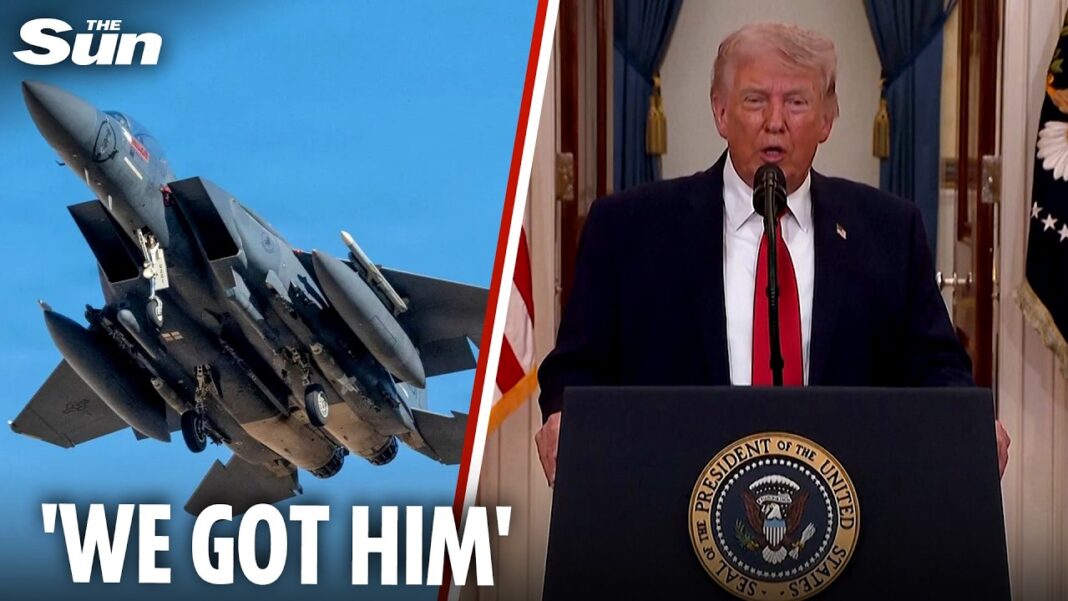
President Trump publicly confirmed the operation, declaring, “We got him,” in a statement that captured both the relief and the significance of the achievement. He later characterized the mission as the kind of operation that is “seldom attempted” due to the inherent risks to personnel and equipment.
Beyond its immediate tactical success, the operation carries broader strategic implications. The ability of U.S. forces to penetrate deep into Iranian territory, establish a temporary base of operations, and extract personnel under fire sends a powerful signal regarding American military reach and capability.
At the same time, the mission underscores the escalating tensions between the United States and Iran, highlighting the potential for further confrontations. The destruction of aircraft, the loss of drones, and the exchange of fire all point to a conflict environment that is becoming increasingly volatile.
For the United States, the operation reinforces a longstanding doctrine: that no American service member will be left behind. This principle, deeply embedded in military culture, serves both as a moral commitment and as a strategic imperative, bolstering morale and cohesion among troops.
As The New York Post report noted, operations of this scale and complexity are rarely disclosed in such detail. The combination of special operations forces, advanced airpower, and intelligence deception provides a rare window into the capabilities and methodologies of modern military engagements.
From the rugged mountains where a lone officer evaded capture, to the improvised airstrip carved out in hostile territory, to the coordinated strikes that cleared a path for extraction, every element of the mission reflects a level of precision and coordination that defines contemporary warfare.
In the final analysis, the rescue of the stranded F-15E airman stands as a testament to both individual resilience and institutional capability. It is a story of survival under extreme conditions, of strategic ingenuity, and of a military willing to undertake extraordinary risks to bring its personnel home.
As the full details continue to emerge, one conclusion remains clear: this was not merely a rescue mission, but a demonstration of resolve—an affirmation that, even in the most hostile environments, the commitment to leave no one behind endures.
