



|
Getting your Trinity Audio player ready...
|
By: Justin Winograd
As twilight descends across Israel and families gather around elaborately prepared Passover tables to recount the ancient story of liberation, a different kind of ritual unfolds far above the earth. In the cockpit of high-performance aircraft, Israeli pilots—tasked with long-range missions amid ongoing regional tensions—carry with them not only the burden of national defense but also the quiet yearning for tradition, memory, and spiritual continuity.
According to a report on Sunday at World Israel News, the Israel Air Force has undertaken a meticulous and highly coordinated effort to ensure that even those stationed far from home during the Passover holiday remain connected to its profound cultural and religious significance. The initiative, though logistical in nature, reflects a deeper ethos: that national service and spiritual identity are not mutually exclusive, even in the most demanding of circumstances.
Passover, a cornerstone of Jewish tradition, commemorates the exodus from bondage to freedom. It is a festival deeply rooted in ritual, symbolism, and communal experience. For soldiers—particularly those engaged in active operations—the challenge lies in reconciling the imperatives of duty with the desire to honor these traditions.
The Israel Air Force, operating under continuous operational demands, cannot suspend its missions for the sake of observance. Aircraft must be flown, targets monitored, and threats neutralized regardless of the calendar. Yet, as World Israel News reported, military planners have demonstrated an acute awareness of the psychological and cultural importance of maintaining a connection to the holiday.
This awareness has given rise to an innovative solution: a specially designed Passover menu tailored to the unique conditions of aerial combat and long-duration flight.
The creation of this menu represents a remarkable intersection of culinary tradition, nutritional science, and operational pragmatism. Developed in close collaboration with military dietitians and logistics experts, the offerings are carefully calibrated to meet the physiological demands of pilots while adhering strictly to Passover dietary laws.
Unlike conventional holiday meals, which often emphasize abundance and richness, the in-flight menu prioritizes efficiency, digestibility, and sustained energy release. As detailed in the World Israel News report, each component has been meticulously selected to ensure that it supports cognitive performance and physical endurance without compromising the symbolic essence of the holiday.
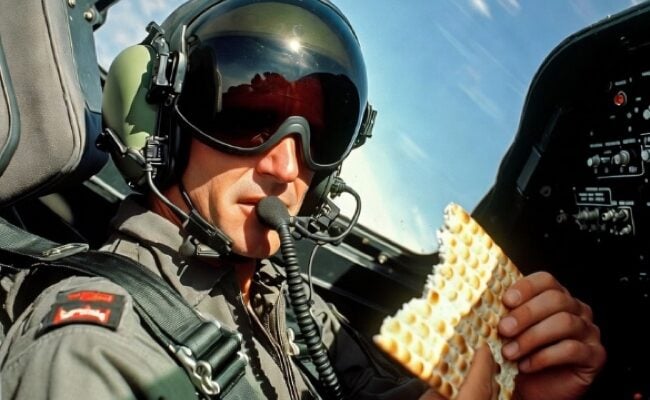
At the heart of the menu lies a matzah-based energy bar—a modern reinterpretation of the traditional unleavened bread that defines Passover. Enriched with dates, almonds, and a delicate honey glaze, the bar provides a balanced combination of carbohydrates and natural sugars designed for gradual energy release. Its compact form allows pilots to consume it quickly during pre-flight preparations, minimizing disruption while maximizing nutritional benefit.
The menu extends beyond this central element to include a selection of foods that collectively embody both practicality and tradition. A portion of grilled chicken breast, lightly seasoned with olive oil and herbs, serves as a primary source of lean protein. This choice reflects an understanding of the need for sustained mental acuity during extended missions, as protein plays a critical role in maintaining focus and reducing fatigue.
Complementing this is a crisp romaine salad, chosen for its hydrating properties and light texture. In the constrained environment of an aircraft cockpit, where comfort and mobility are paramount, such considerations are essential. Heavy or overly complex dishes would not only be impractical but could also impair performance.
Yet it is in the inclusion of symbolic elements that the menu truly distinguishes itself. A small serving of charoset—a mixture traditionally composed of fruits and nuts—has been adapted to meet operational requirements while preserving its cultural resonance. Made from apples, walnuts, and grape juice rather than wine, it offers a tangible connection to the Seder plate, evoking themes of endurance and redemption.
As the World Israel News report noted, the presence of such items, though modest in quantity, carries significant emotional weight. For pilots separated from their families and communities, these touches serve as reminders of shared heritage and collective identity.
In addition to solid foods, the menu addresses the critical issue of hydration—a factor of paramount importance in high-altitude operations. Pilots are provided with electrolyte-balanced water, carefully formulated to maintain optimal fluid levels without the adverse effects associated with sugary beverages.
This approach reflects a broader commitment to evidence-based nutrition, recognizing that even minor fluctuations in hydration or energy levels can have significant implications for performance and safety. The avoidance of rapid energy spikes and subsequent crashes is particularly important in the context of missions that may extend for several hours.
Dessert, too, has been reimagined to align with these principles. A coconut-based Passover cookie offers a light yet satisfying conclusion to the meal, providing a sense of festivity without introducing unnecessary heaviness.
The successful implementation of this initiative requires a level of logistical coordination that is itself noteworthy. From sourcing ingredients that meet strict dietary requirements to ensuring their safe transport and storage, every aspect of the process must be carefully managed.
As highlighted by World Israel News, the Israel Air Force’s logistics teams have risen to this challenge with remarkable efficiency. Their efforts extend beyond mere provisioning to encompass the broader goal of enhancing morale and reinforcing a sense of continuity amid disruption.
This dimension of military operations—often overlooked in public discourse—plays a crucial role in sustaining the effectiveness of personnel. By addressing not only physical needs but also emotional and cultural ones, the IAF demonstrates a holistic approach to readiness.
The significance of this initiative lies not only in its immediate impact but also in what it reveals about the evolving nature of military service. In an era characterized by advanced technology and complex geopolitical dynamics, the human element remains central.
Pilots operating far from home during a major religious holiday are not merely instruments of national policy; they are individuals with identities, traditions, and emotional ties. Recognizing and accommodating these dimensions is essential to maintaining both morale and cohesion.
The Passover menu serves as a tangible expression of this recognition. It acknowledges the sacrifices made by those in uniform while affirming the enduring relevance of cultural and spiritual practices.
Passover is, at its core, a narrative of resilience—a story of perseverance in the face of adversity. In many ways, the experience of these pilots mirrors that narrative. Operating in a challenging and often perilous environment, they embody the same spirit of determination and endurance that the holiday commemorates.
The effort to preserve elements of the holiday within this context can thus be seen as both symbolic and practical. It reinforces a sense of purpose and continuity, linking the present moment to a broader historical and cultural framework.
The initiative reflects a broader ethos within the Israel Air Force: that even in the midst of conflict, the preservation of identity and tradition remains a priority.
The image of a pilot consuming a matzah-based energy bar before embarking on a mission may seem, at first glance, a small and inconsequential detail. Yet it encapsulates a profound truth about the nature of service and identity.
In the skies above a region marked by tension and uncertainty, these pilots carry with them not only the tools of modern warfare but also the enduring legacy of their heritage. Through thoughtful planning and innovative adaptation, the Israel Air Force has ensured that the spirit of Passover—its themes of freedom, resilience, and remembrance—remains present even at 30,000 feet.
In doing so, it has demonstrated that tradition need not be confined to the home or the synagogue. It can be carried into the most demanding environments, providing comfort, connection, and meaning in the midst of duty.
