



|
Getting your Trinity Audio player ready...
|
By: Julie Herndon
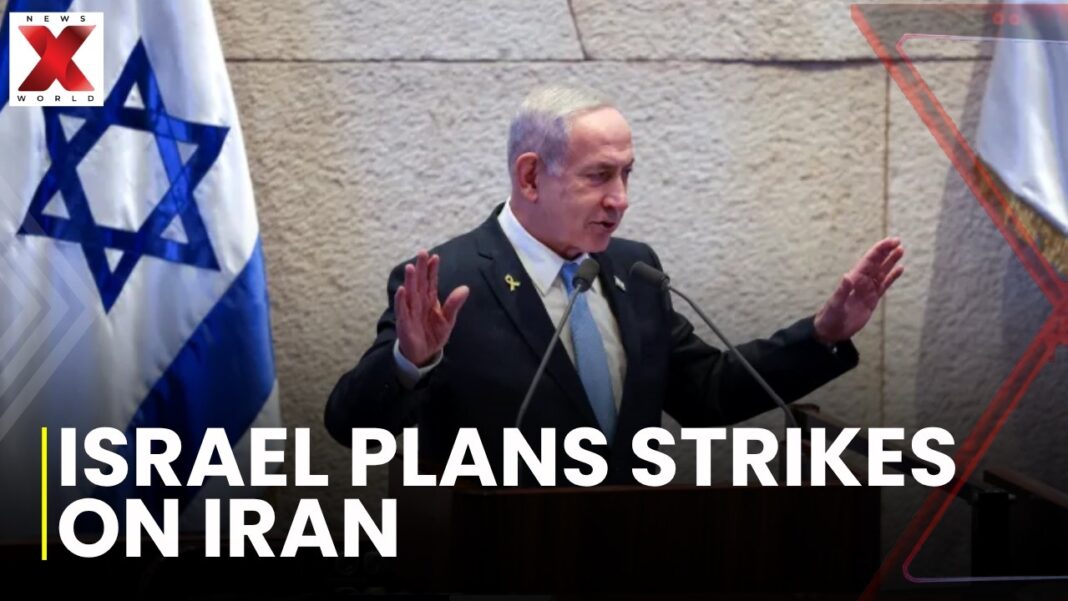
In a forceful and unequivocal address delivered from Israel’s central military command complex in Tel Aviv, Prime Minister Benjamin Netanyahu articulated what he described as a historic inflection point in the balance of power between Jerusalem and Tehran. Framed against the backdrop of ongoing military operations and intensifying regional volatility, Netanyahu’s message was as strategic as it was symbolic: Israel, he asserted, stands ascendant, while the Iranian regime is in a state of unprecedented weakness.
According to a report on Saturday by The Jewish News Syndicate, the Prime Minister’s remarks followed a high-level situational assessment at the Kirya military headquarters, where senior defense officials have been coordinating a multi-front campaign that spans Iran itself as well as proxy theaters such as Lebanon.
Netanyahu’s address emphasized the cumulative impact of Israel’s ongoing military campaign, conducted in close coordination with the United States. As detailed by The Jewish News Syndicate, the Prime Minister described a relentless series of operations targeting the Iranian regime’s strategic assets, including its command structure, transportation networks, and industrial base.
“Together with our American friends, we continue to pummel the terrorist regime in Iran,” Netanyahu declared, underscoring both the operational tempo and the depth of bilateral cooperation. The phrase itself—“pummel”—was indicative of a strategy designed not merely to contain but to systematically degrade Iran’s capacity to project power.
This campaign, he explained, has extended beyond conventional military targets to encompass critical infrastructure. Bridges, supply routes, and industrial facilities have all been subjected to sustained aerial assault, reflecting a doctrine aimed at crippling both the logistical and economic foundations of the Iranian state.
Among the most striking claims highlighted by The Jewish News Syndicate was the assertion that Israeli air operations have destroyed approximately 70 percent of Iran’s steel production capacity. While such figures are difficult to independently verify, their strategic implications are profound.
Steel production occupies a central role in modern military industry, underpinning the manufacture of weapons systems, vehicles, and infrastructure. By targeting this sector, Israel is effectively striking at the قلب of Iran’s industrial and military nexus. Netanyahu framed this achievement as a “tremendous” blow, one that simultaneously deprives the Islamic Revolutionary Guard Corps of financial resources and constrains its ability to produce armaments.
This approach reflects a broader evolution in military strategy, wherein economic targets are treated as integral components of the battlefield. By eroding the regime’s industrial base, Israel seeks to impose long-term limitations on Iran’s capacity to recover and rearm.
Central to Netanyahu’s narrative is the assertion of seamless coordination with the United States, particularly with President Donald Trump. According to The Jewish News Syndicate, the Prime Minister emphasized that the war effort is being conducted in full alignment at both the political and military levels.
This alignment extends beyond mere diplomatic support to encompass operational integration between the Israel Defense Forces and their American counterparts. Such coordination enhances both the effectiveness and the legitimacy of the campaign, signaling a unified front against what both nations characterize as a destabilizing regime.
The significance of this partnership cannot be overstated. It not only amplifies Israel’s military capabilities but also serves as a deterrent to potential escalation by other regional actors.
While much of the focus has been directed toward Iran, Netanyahu also addressed the situation in Lebanon, where Israeli forces continue to engage Hezbollah. As reported by The Jewish News Syndicate, the Prime Minister described an ongoing effort to expand and entrench a security zone designed to shield northern Israeli communities from cross-border attacks.
This operation, involving four IDF divisions, represents a significant escalation in Israel’s approach to the northern theater. By establishing a deeper presence within southern Lebanon, Israel aims to push Hezbollah’s operational capabilities further from its border, thereby reducing the threat of rocket fire and infiltration.
Netanyahu’s remarks suggest that this campaign is not merely defensive but transformative, seeking to reshape the strategic landscape in a manner that provides lasting security for Israeli civilians.
In addition to outlining military objectives, Netanyahu devoted a portion of his address to acknowledging the role of Israeli civilians in sustaining the national effort. As noted by The Jewish News Syndicate, he commended citizens for their steadfastness, particularly in adhering to Home Front Command directives during periods of heightened tension.
The reference to compliance even on the night of the Passover Seder carries symbolic weight, highlighting the intersection of national security and cultural life. In invoking this imagery, Netanyahu sought to reinforce a narrative of collective resilience, wherein the civilian population is both a beneficiary of and a participant in the broader defense effort.
The overarching theme of Netanyahu’s address, as captured by The Jewish News Syndicate, is one of momentum. The Prime Minister repeatedly emphasized that Israel is not only achieving its immediate objectives but also altering the strategic calculus of the region.
“We will continue to pummel Iran… and achieve all our objectives,” he declared, signaling an intent to sustain the current operational tempo. This language reflects a confidence rooted in recent successes, as well as a determination to capitalize on perceived vulnerabilities within the Iranian regime.
Despite the assertive tone of Netanyahu’s remarks, the situation remains fraught with uncertainty. The degradation of Iran’s capabilities, while significant, does not eliminate the potential for retaliation, either directly or through proxy forces. Moreover, the expansion of operations in Lebanon carries the risk of broader regional escalation.
Nevertheless, as The Jewish News Syndicate has reported, Israeli leadership appears committed to a strategy that prioritizes decisive action over incremental containment. The emphasis on industrial targets, territorial control, and sustained pressure suggests a long-term vision aimed at fundamentally reshaping the security environment.
Netanyahu’s address from the Kirya was more than a routine briefing; it was a declaration of intent at a moment of profound consequence. By asserting that Iran is weaker than ever and Israel stronger than ever, the Prime Minister has framed the current conflict as a turning point—one that may redefine the balance of power in the Middle East.
As The Jewish News Syndicate report indicated, the coming weeks will determine whether this narrative of ascendancy is sustained or challenged by unforeseen developments. For now, however, the message from Jerusalem is clear: Israel is pressing its advantage, and it intends to see the campaign through to its conclusion.
