



|
Getting your Trinity Audio player ready...
|
Israeli Supreme Court Ruling on Anti-War Demonstrations Sparks Debate After Shabbat Decision
By: Yisroel David
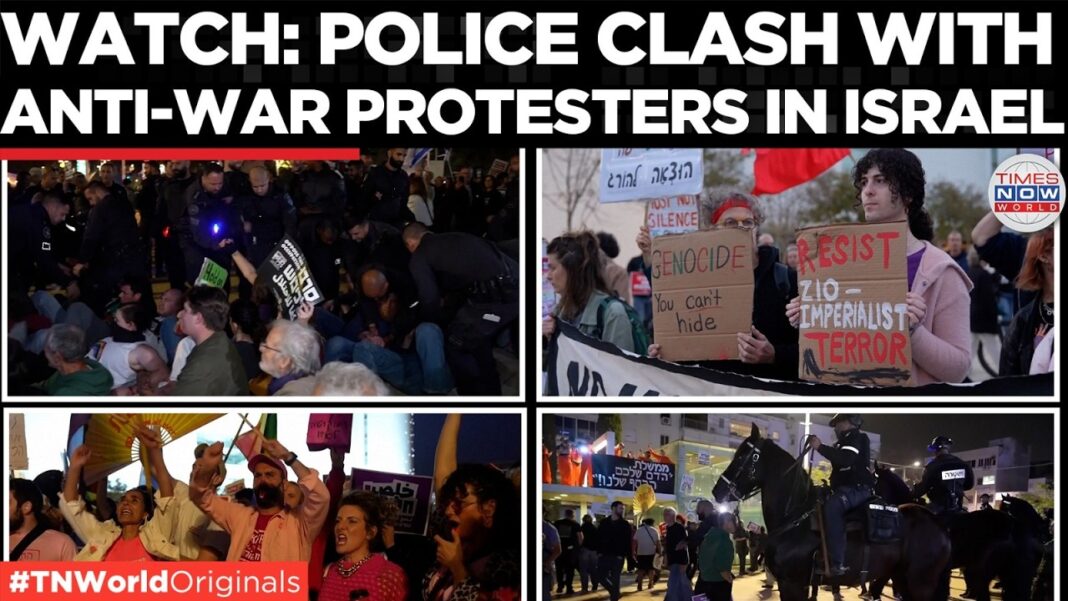
A contentious convergence of political dissent, judicial authority, and religious sensitivity unfolded in the heart of Tel Aviv, as a far-left protest against the ongoing war escalated into a police intervention at Habima Square, culminating in arrests, political recriminations, and a widening national debate over the limits of protest during wartime. The incident, reported on Saturday by Israel National News, has illuminated the fault lines within Israeli society at a moment of profound strain.
As evening descended upon Habima Square, a focal point for civic expression in Tel Aviv, demonstrators gathered to voice opposition to the war. The protest, characterized by its far-left orientation and vocal criticism of government policy, quickly drew the attention of law enforcement as attendance appeared to exceed the limits prescribed by a recent judicial ruling.
According to the Israel National News report, police officers on the scene issued repeated warnings, urging participants to disperse on the grounds that the gathering posed a risk to public safety. When these appeals went unheeded, authorities began dispersal operations, with one officer announcing that force would be employed if necessary.
The intervention resulted in the arrest of ten protesters, marking a decisive escalation in what had begun as a permitted demonstration. The images of police confronting demonstrators in a central public space quickly circulated, amplifying the controversy and drawing sharp reactions from across the political spectrum.
At the core of the unfolding controversy lies a ruling by Israel’s Supreme Court, issued during Shabbat, which authorized protests of up to 600 participants at Habima Square. The decision, as detailed by Israel National News, was accompanied by pointed criticism of what the court described as uneven enforcement of Home Front Command restrictions.
In its reasoning, the court noted that limitations imposed on public gatherings were being applied inconsistently, with protests subject to stricter scrutiny than other events and venues. “This situation is difficult to reconcile,” the ruling stated, highlighting a perceived disparity that, in the court’s view, undermined principles of fairness and equal treatment under the law.
The timing of the decision, however, proved as contentious as its substance. Issued during Shabbat, a day of profound religious significance in Israel, the ruling ignited a fierce backlash among religious and conservative leaders, who viewed it as both procedurally and symbolically problematic.
The reaction from political figures was swift and unequivocal. The Shas party, a prominent voice within Israel’s religious political landscape, condemned the ruling as a “trampling of the sanctity of Shabbat,” announcing its intention to file a formal complaint against the judges once the holiday concluded.
As reported by Israel National News, National Security Minister Itamar Ben-Gvir delivered a particularly forceful critique, questioning the judgment and priorities of the court. “Supreme Court judges making such decisions—whose side are you on?” he asked, framing the ruling as a potential threat to public safety.
Ben-Gvir also took issue with the procedural demands imposed by the court, arguing that requiring a governmental response within an hour during Shabbat was both unreasonable and detrimental to effective security management.
Deputy Communications Minister Yisrael Eichler echoed these sentiments, describing the ruling as “a declaration of war against the sanctity of Shabbat.” His remarks, cited by Israel National News, underscored a broader perception among religious leaders that the judiciary is increasingly detached from the values and traditions that underpin Israeli society.
Similarly, Moshe Gafni, chairman of the United Torah Judaism party, characterized the decision as both irresponsible and insensitive, suggesting that its timing was intended to assert judicial supremacy over public sentiment.
From the perspective of law enforcement, the decision to disperse the protest was rooted in concerns over public safety and adherence to legal guidelines. Police officials, as reported by Israel National News, maintained that the gathering had exceeded the permitted size and posed potential risks in a city already operating under heightened security conditions.
The invocation of Home Front Command restrictions reflects the broader context in which the protest occurred. Israel remains engaged in active conflict, with the potential for missile attacks and other threats necessitating strict controls on public gatherings.
In this environment, the balance between facilitating democratic expression and ensuring public safety becomes particularly delicate. The police response at Habima Square illustrates the challenges inherent in navigating this balance, especially when judicial directives and on-the-ground realities appear to diverge.
The events at Habima Square encapsulate a broader moment of tension within Israeli society. At one level, the controversy reflects a fundamental debate over the scope of protest during wartime and the extent to which dissent should be accommodated.
At another level, it highlights enduring divisions over the role of the judiciary, the sanctity of religious observance, and the priorities of governance in times of crisis. The convergence of these issues in a single incident has amplified their resonance, transforming a localized confrontation into a national conversation.
The Supreme Court’s intervention, while intended to address concerns of unequal enforcement, has itself become a focal point of controversy. Critics argue that the ruling undermines security considerations and disregards the cultural significance of Shabbat, while supporters contend that it upholds essential democratic principles.
As the Israel National News report noted, the court’s emphasis on consistency in enforcement reflects a broader commitment to the rule of law. Yet the backlash it has provoked underscores the complexities of applying abstract principles in a context marked by immediate and tangible risks.
In the aftermath of the Habima Square protest, the questions raised by the incident remain unresolved. How should a democratic society balance the right to protest with the imperatives of security? To what extent should judicial authority shape the parameters of public life during wartime? And how can deeply held religious values be reconciled with the demands of governance?
These are not questions with easy answers. As Israel National News continues to report, they will likely persist as points of contention in the weeks and months ahead.
What is clear, however, is that the events at Habima Square have laid bare the tensions that define this moment in Israel’s history. In the clash between protest and policing, law and tradition, dissent and security, a nation finds itself grappling with the very principles that underpin its identity.
