



|
Getting your Trinity Audio player ready...
|
By: Fern Sidman
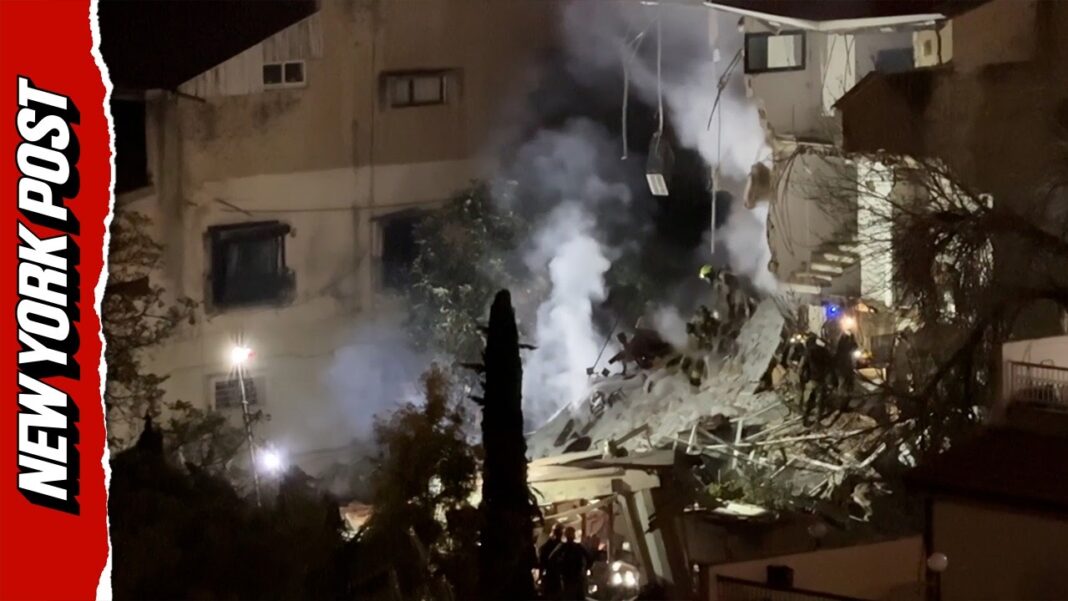
In a stark and harrowing escalation of hostilities, a heavy Iranian ballistic missile struck a seven-story residential building in the northern Israeli city of Haifa, unleashing widespread destruction and triggering an urgent, large-scale rescue operation. As reported on Sunday by Israel National News, the incident underscores both the evolving intensity of the conflict and the profound human toll exacted on civilian populations.
The missile, reportedly carrying an estimated 400 kilograms of explosives, evaded Israel’s advanced interception systems and struck its target with devastating precision. The resulting explosion tore through the residential structure, reducing significant portions of the building to rubble and sending shockwaves across the surrounding neighborhood.
According to the report at Israel National News, the direct hit inflicted catastrophic structural damage, collapsing sections of the building and scattering debris across adjacent streets. The sheer force of the detonation not only compromised the integrity of the seven-story complex but also endangered nearby structures, raising fears of secondary collapses.
Emergency services were dispatched immediately, converging on the scene amid sirens and plumes of dust. Firefighters, paramedics, and specialized units from the Home Front Command began a coordinated effort to locate survivors trapped beneath the debris.
The rescue effort, described by Israel National News as both urgent and painstaking, has involved the manual removal of heavy concrete slabs and twisted metal. Time, as always in such scenarios, is the most critical variable.
Magen David Adom personnel, among the first responders on the scene, recounted the chaotic and emotionally charged conditions they encountered upon arrival. Senior EMT Shevach Rothenshtrych provided a vivid account of the initial moments:
“When we arrived at the street, we saw a multi-story building that had been hit, with extensive destruction at the scene,” he said. “Residents who were there told us there were casualties trapped under the rubble on the lower floors.”
Rothenshtrych described the desperate efforts undertaken by rescue teams to extricate survivors. “We managed to move large pieces of concrete with our hands and rescued an 82-year-old man from the debris who was in serious condition but conscious,” he explained. The victim was stabilized at the scene before being transported to a hospital via a mobile intensive care unit.
The presence of such severe injuries, combined with the uncertainty surrounding the number of individuals still trapped, has lent a sense of urgency—and gravity—to the ongoing operation.
Medical officials, as cited by Israel National News, confirmed that multiple victims have been treated at the scene and in nearby hospitals. Among them is an elderly man in critical condition, whose survival remains uncertain, and an infant who sustained minor injuries but was successfully rescued from the wreckage.
In addition to physical injuries, a significant number of residents have been treated for acute psychological distress. The shock of the explosion, combined with the sudden destruction of homes and the fear of further attacks, has left many in a state of profound anxiety.
Paramedic Lamas Salameh elaborated on the scope of the medical response: “This is a seven-story building that sustained a direct hit, causing extensive damage,” she said. “We arrived at the scene with large MDA teams, including ambulances, mobile intensive care units, and medicycles, and began searching the scenes.”
Salameh noted that rescue teams located an elderly casualty in serious condition during their search efforts, in addition to several individuals with less severe injuries. “We are continuing to search the scenes to ensure there are no additional casualties,” she added, emphasizing the ongoing nature of the operation.
Perhaps most striking—and concerning—is the fact that the missile was not intercepted. Israel’s multilayered missile defense system, widely regarded as among the most sophisticated in the world, has historically succeeded in neutralizing the vast majority of incoming threats.
Yet, as Israel National News reported, this particular missile penetrated those defenses, raising questions about the evolving capabilities of Iran’s arsenal and the challenges posed by high-explosive payloads delivered with precision.
The 400-kilogram warhead represents a substantial destructive force, capable of inflicting severe damage even on reinforced structures. Its successful impact highlights the potential vulnerabilities inherent in any defensive system, particularly in the face of sustained or technologically advanced attacks.
The strike on Haifa is not merely an isolated incident but part of a broader pattern of escalation in the ongoing conflict between Israel and Iran. The targeting of a densely populated residential area underscores the increasingly direct nature of hostilities and the willingness of adversaries to inflict civilian casualties.
According to the Israel National News report, such attacks are likely intended not only to achieve tactical objectives but also to exert psychological pressure on the Israeli population. The disruption of daily life, the destruction of homes, and the pervasive sense of vulnerability all serve to amplify the impact of each strike.
Moreover, the incident has intensified calls for further military action, as Israeli officials weigh their response to a deliberate and indiscriminate attack on civilians.
Despite the devastation, scenes from Haifa also reveal a remarkable degree of resilience. Residents, many of whom had moments earlier been going about their daily routines, have joined rescue efforts, assisting emergency personnel and providing support to one another.
Neighbors have offered shelter to those displaced by the blast, while volunteers have mobilized to distribute food, clothing, and other essentials. This communal response, while born of necessity, reflects a broader pattern of solidarity that has characterized Israeli society in times of crisis.
As Israel National News has frequently noted, such resilience is both a strength and a testament to the enduring spirit of communities facing repeated threats.
As night falls over Haifa, rescue operations continue under floodlights, with teams working tirelessly to locate any remaining survivors. The uncertainty surrounding the number of individuals still trapped beneath the rubble adds a somber urgency to every movement of debris.
Authorities have not yet released a comprehensive account of casualties, and officials caution that the situation remains fluid. The possibility of additional victims being discovered underscores the magnitude of the disaster and the challenges faced by those on the ground.
The missile strike on Haifa serves as a stark reminder of the realities of modern warfare, where the front lines often extend into civilian neighborhoods and where the distinction between combatant and noncombatant becomes tragically blurred.
As documented by Israel National News, the incident encapsulates the human cost of geopolitical conflict—a cost measured not only in strategic calculations but in lives disrupted, families shattered, and communities forever altered.
In the coming days, as investigations continue and the broader implications of the attack are assessed, the focus will remain on the victims and the ongoing efforts to restore a semblance of normalcy. Yet the image of a shattered building in Haifa, and the stories of those pulled from its ruins, will endure as a powerful testament to both the destructive capacity of modern weaponry and the resilience of those who endure its consequences.
