



|
Getting your Trinity Audio player ready...
|
By: Fern Sidman
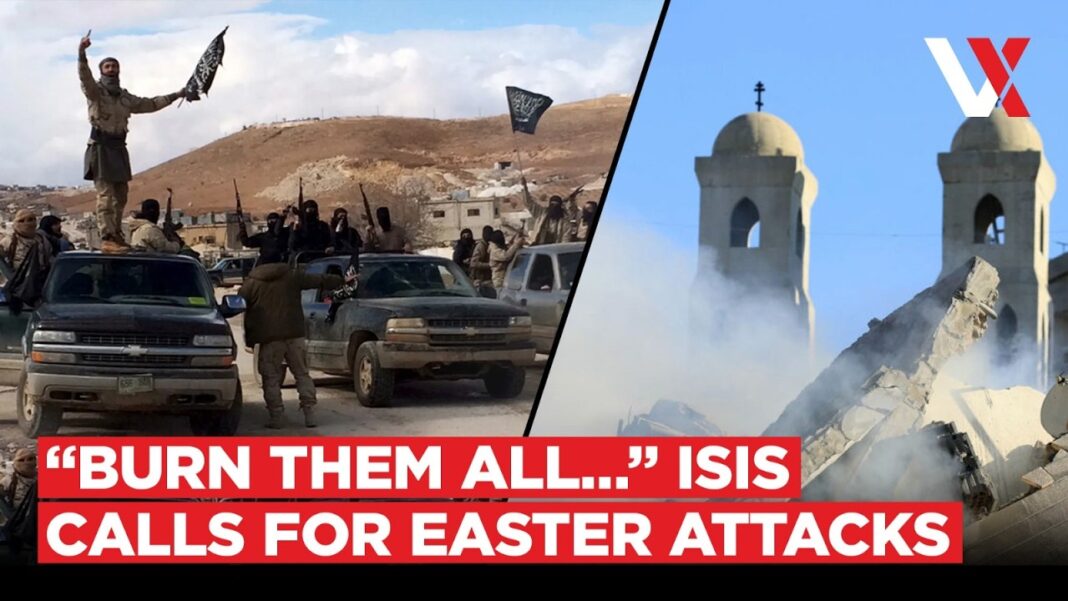
As the Christian world prepares to commemorate Easter and Jewish communities gather to celebrate Passover, a grim and deeply unsettling warning has emerged from the shadowy propaganda apparatus of the Islamic State. In a development that has sent tremors through security agencies on both sides of the Atlantic, the terror organization has issued an explicit call for coordinated arson attacks targeting churches and synagogues across the United States, Europe, and beyond.
According to a report on Thursday by The New York Post, the threat was disseminated through the latest edition of ISIS’s weekly propaganda publication, *al-Naba*, which has long served as a vehicle for incitement, recruitment, and ideological indoctrination. The timing—coinciding with major religious observances—appears deliberately calculated to maximize psychological impact and societal disruption.
The rhetoric contained within the publication is as incendiary as it is explicit. ISIS operatives urged adherents worldwide to “rise up and set fire” to Jewish synagogues and Christian churches, framing the attacks as a response to Israeli security measures at the al-Aqsa Mosque in Jerusalem. As The New York Post reported, the directive extended across continents, naming locations in North America, Europe, Russia, India, and the Middle East.
The language employed by the group is emblematic of its enduring strategy: to fuse geopolitical grievances with religious symbolism in order to mobilize lone actors and decentralized cells. By invoking al-Aqsa—one of the most revered sites in Islam—ISIS seeks to cloak its violent agenda in the guise of religious duty, thereby amplifying its appeal among susceptible individuals.
Security analysts cited by The New York Post note that such calls to action are not merely rhetorical flourishes but often precede attempts at real-world violence. The organization’s history demonstrates a consistent pattern of incitement followed by opportunistic attacks carried out by sympathizers acting independently but inspired by centralized messaging.
The explicit targeting of houses of worship represents a particularly pernicious dimension of the threat. Churches and synagogues, by their very nature, are spaces of communal gathering and spiritual reflection. Attacks against them are designed not only to inflict physical harm but to erode the sense of security and cohesion that underpins religious life.
As highlighted in The New York Post report, the directive also extends to “Jewish gatherings” more broadly, suggesting a willingness to target any setting in which religious communities assemble. The reference to prior attacks, including the so-called “Sydney Heroes” incident in Australia, underscores the group’s intent to glorify past violence while encouraging its replication.
This deliberate invocation of previous atrocities serves a dual purpose: it reinforces a narrative of continuity within the movement while providing a template for future attacks. By framing such acts as heroic, ISIS seeks to normalize and perpetuate a cycle of violence that transcends national boundaries.
The immediate pretext for the call to violence lies in the closure of the al-Aqsa Mosque by Israeli authorities, a decision taken in the context of heightened security concerns amid ongoing conflict involving Israel and Iran. The site, known to Muslims as the Noble Sanctuary and to Jews as the Temple Mount, occupies a uniquely sensitive position at the intersection of religion and politics.
According to The New York Post report, the closure has elicited strong reactions from Palestinian authorities and other stakeholders, further inflaming an already volatile situation. ISIS has seized upon this development to advance its narrative of religious persecution, portraying the restrictions as an affront that demands retribution.
It is important to note, however, that the organization’s appropriation of such events is opportunistic rather than principled. ISIS has historically demonstrated little regard for the sanctity of religious sites, including those within Islam, when such considerations conflict with its strategic objectives.
The latest threat is consistent with a broader pattern of ISIS propaganda that seeks to exploit moments of heightened tension to incite violence. As documented by The New York Post, the group also claimed responsibility for a series of recent attacks, boasting of dozens of casualties across multiple operations.
Such claims, while often difficult to independently verify, serve an important function within the organization’s information strategy. By projecting an image of continuation of activity and operational capability, ISIS aims to maintain its relevance in a crowded landscape of extremist movements.
The emphasis on decentralized action—encouraging individuals to act independently rather than as part of a coordinated network—further complicates efforts to counter the threat. This model reduces the regulation’s vulnerability to traditional counterterrorism measures while increasing the unpredictability of potential attacks.
In light of the threat, law enforcement and intelligence agencies across the United States and Europe have heightened their level of alertness. While no specific plots have been publicly confirmed, the explicit nature of the call to violence has prompted a proactive response aimed at safeguarding vulnerable communities.
As The New York Post report noted, authorities are particularly concerned about the possibility of lone actors inspired by the propaganda. Such individuals, often radicalized online, can be difficult to detect and may act with little warning.
Community leaders have also played a crucial role in disseminating information and encouraging vigilance. Religious institutions have been advised to review security protocols, increase coordination with local law enforcement, and remain alert to suspicious activity.
The timing of the ISIS threat coincides with broader policy developments in Israel, including the passage of a controversial law introducing the death penalty for certain acts of terrorism. While the legislation is intended to serve as a deterrent, critics argue that it may further inflame tensions and contribute to the narrative exploited by extremist groups.
As reported by The New York Post, the language of the law has drawn scrutiny for its potential implications, particularly with regard to its application in a complex and deeply contested environment. The interplay between policy decisions and extremist propaganda underscores the challenges inherent in navigating a landscape where actions taken for security purposes can be reframed as provocations.
Ultimately, the latest ISIS threat represents not only a security challenge but a test of societal resilience. The organization’s strategy relies on instilling fear, disrupting communal life, and exacerbating divisions. By targeting moments of religious significance, it seeks to undermine the very fabric of pluralistic societies.
Yet history suggests that such efforts, while capable of inflicting harm, often fail to achieve their broader objectives. Communities targeted by terrorism have repeatedly demonstrated an for solidarity and renewal, refusing to be defined by acts of violence.
As The New York Post report emphasized, the response to such threats must be both vigilant and measured. Overreaction can play into the hands of extremists, while complacency invites risk.
As Easter and Passover approach, the juxtaposition of celebration and threat serves as a stark reminder of the enduring challenges posed by extremist ideologies. The call issued by ISIS, as reported extensively by The New York Post, is a chilling testament to the organization’s continued attempt to project influence and incite violence.
In the face of such threats, the imperative is clear: to uphold the values of freedom and pluralism while ensuring the safety of all communities. This requires not only the efforts of governments and law enforcement but the collective vigilance of society as a whole.
The coming days will test the ability of institutions and individuals alike to navigate this precarious moment. Yet they will also affirm a deeper truth—that even in the shadow of fear, the enduring strength of faith and community remains a formidable counterweight to those who seek to divide and destroy.
