



|
Getting your Trinity Audio player ready...
|
By: Fern Rosenblatt
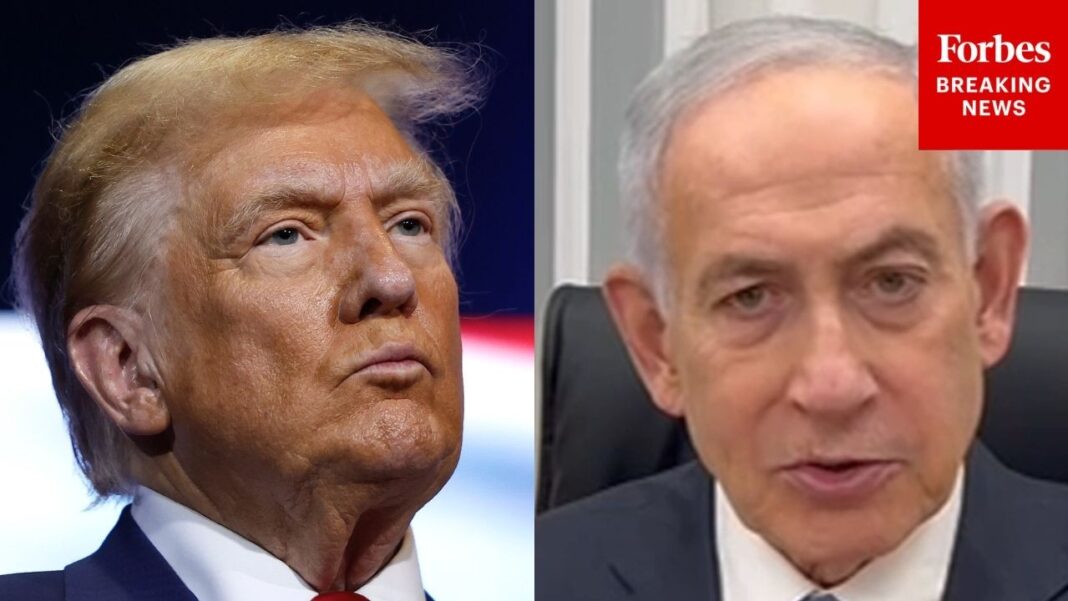
As the war between the United States, Israel, and Iran advances into a critical stage, a subtle yet consequential divergence has emerged at the highest levels of leadership. According to a report on Thursday by World Israel News, President Donald Trump and Israeli Prime Minister Benjamin Netanyahu are increasingly at odds over one of the most fundamental questions shaping the conflict: whether the ultimate objective should include regime change in Tehran.
This divergence—though not yet a rupture—signals a deeper strategic tension between two allies whose cooperation has defined the operational success of the campaign but whose visions for its conclusion may now be drifting apart.
At the core of the disagreement lies a philosophical and strategic divide over what constitutes victory. Early in the conflict, regime change in Iran was discussed in some circles as a conceivable outcome, particularly given the scale of military operations and the targeting of senior Iranian leadership figures. However, as the World Israel News report noted, President Trump has since recalibrated his position.
Rather than pursuing the collapse of Iran’s ruling system as an explicit objective, Trump appears increasingly inclined toward a more limited definition of success: the substantial degradation of Iran’s military capabilities, coupled with a negotiated ceasefire that stabilizes the region and mitigates economic disruption.
This approach reflects a pragmatic calculus. Prolonged conflict carries risks—not only of regional escalation but of domestic political repercussions, particularly in the context of economic volatility and voter fatigue. For Trump, the emphasis appears to have shifted toward securing tangible gains while avoiding the uncertainties associated with attempting to engineer political transformation within Iran.
Netanyahu, by contrast, has maintained a more expansive view of the war’s potential outcomes. While he has stopped short of explicitly declaring regime change as an official objective, his rhetoric and actions suggest that such an outcome remains a central aspiration.
The divergence between the two leaders became particularly evident in the context of appeals directed toward the Iranian public. According to the information provided in the World Israel News report, Netanyahu has increasingly framed the conflict not merely as a military confrontation but as an opportunity for the Iranian people to challenge their own government.
In a reported conversation between the two leaders, Netanyahu urged Trump to publicly encourage Iranians to take to the streets in mass protests against the regime. The proposal reflects a belief that internal pressure, combined with external military force, could create conditions conducive to systemic change.
Trump’s response, as recounted by World Israel News, was markedly cautious. Expressing concern for the potential consequences of such a call, he reportedly questioned the wisdom of encouraging civilian uprisings in a context where the regime’s response could be swift and brutal.
This exchange encapsulates the broader divergence: Netanyahu’s willingness to embrace the risks associated with transformative change, and Trump’s preference for a more controlled and predictable outcome.
Despite the absence of a coordinated call from Washington, Netanyahu has proceeded to address the Iranian populace directly. In a video message timed to coincide with Nowruz, the Persian New Year, he invoked themes of resilience and possibility, urging Iranians to seize the moment. “Our aircraft are striking terrorist operatives…this is meant to allow the brave Iranian people to celebrate,” he declared, in remarks cited by World Israel News. The message was carefully calibrated, blending assurances of military precision with an implicit invitation to act.
Such messaging reflects a longstanding Israeli strategy of distinguishing between the Iranian regime and the Iranian people. By emphasizing this distinction, Netanyahu seeks to position Israel not as an adversary of Iran’s population but as a potential ally in their liberation from authoritarian rule.
Yet, as the World Israel News report observed, these appeals have thus far failed to produce the desired effect.
Despite the intensity of the conflict and the disruption of the regime’s leadership, no significant mass protests have materialized within Iran. This absence has reportedly been a source of frustration for Israeli officials, including Netanyahu himself.
The lack of widespread unrest underscores the complexity of internal dynamics within Iran. While dissatisfaction with the regime undoubtedly exists, the capacity for organized resistance is constrained by a combination of factors, including state repression, communication limitations, and the absence of cohesive leadership.
The report at World Israel News explained that expectations of rapid internal upheaval may have been overly optimistic. The reality, as the current situation demonstrates, is that external military pressure does not automatically translate into domestic political transformation.
For Israel, the question of regime change is not merely ideological but existential. As World Israel News reported, Iran’s leadership has maintained a persistent hostility toward the Jewish state, including explicit calls for its destruction and sustained support for proxy groups such as Hezbollah.
From this perspective, the removal of the current regime would represent a fundamental shift in the strategic landscape, potentially eliminating a central source of regional instability. It is this logic that underpins Netanyahu’s apparent interest in fostering conditions that could lead to such an outcome.
However, the pursuit of regime change carries inherent risks. The collapse of an established government can lead to power vacuums, internal conflict, and unpredictable consequences that extend beyond national borders. These considerations appear to inform Trump’s more cautious stance.
Even as the debate over regime change continues, the war has already inflicted significant damage on Iran’s leadership and capabilities. According to the information contained in the World Israel News report, the conflict has resulted in the elimination of numerous senior figures, including the country’s supreme leader, an event of profound symbolic and practical significance.
This decapitation of leadership, combined with the degradation of military infrastructure, has left the regime in a weakened state. Yet it remains intact, demonstrating a degree of resilience that complicates efforts to predict its trajectory.
For Trump, this weakened state may be sufficient to achieve strategic objectives without necessitating further escalation. For Netanyahu, it may represent an incomplete outcome—one that addresses immediate threats but leaves the underlying problem unresolved.
The divergence between Washington and Jerusalem is further accentuated by the ongoing diplomatic efforts to bring the conflict to a close. Trump’s pursuit of a ceasefire reflects a desire to translate military gains into a stable and sustainable framework.
The World Israel News report noted that such a framework would likely involve concessions and guarantees designed to prevent the reconstitution of Iran’s capabilities. However, it would also entail accepting the continued existence of the current regime, albeit in a diminished form.
This prospect raises difficult questions for Israel, which must weigh the benefits of immediate stability against the risks of long-term vulnerability.
Despite these differences, the alliance between the United States and Israel remains robust. The two countries continue to coordinate closely on military operations, and their shared objectives—preventing Iran from acquiring nuclear weapons and curbing its regional influence—remain aligned.
Nevertheless, the emerging divergence over endgame strategy introduces a degree of tension that could shape future interactions. As the World Israel News report emphasized, the ability of the two leaders to reconcile their perspectives will be critical in determining the outcome of the conflict.
The question of whether to pursue regime change in Iran is more than a tactical consideration; it is a defining strategic debate that encapsulates broader issues of risk, responsibility, and vision.
For Netanyahu, the current moment represents a rare opportunity to fundamentally alter the balance of power in the Middle East. For Trump, it is a moment to consolidate gains and avoid the uncertainties of deeper entanglement.
As the World Israel News report noted, one reality stands out: the resolution of this debate will have far-reaching implications, not only for the immediate conflict but for the future of regional and global stability.
In the end, the path chosen will reflect not only the priorities of two leaders but the enduring challenge of reconciling ambition with prudence in the conduct of international affairs.
