



|
Getting your Trinity Audio player ready...
|
Fire Over Beirut: Israel’s Relentless Campaign Dismantles Hezbollah’s Urban Stronghold
By: Fern Sidman
In a striking display of precision, coordination, and strategic resolve, the Israel Defense Forces have intensified their military campaign against Hezbollah deep within the urban heart of Beirut, delivering a series of devastating blows to the Iranian-backed organization’s command infrastructure. According to a report on Thursday at Israel National News, the latest wave of operations marks one of the most significant escalations in Israel’s effort to neutralize Hezbollah’s operational capabilities in Lebanon’s capital.
The release of dramatic aerial footage by the Israel Defense Forces has not only underscored the scale and sophistication of the campaign but has also illuminated the extent to which Hezbollah has embedded its military apparatus within densely populated civilian areas—transforming residential districts into hubs of strategic coordination.
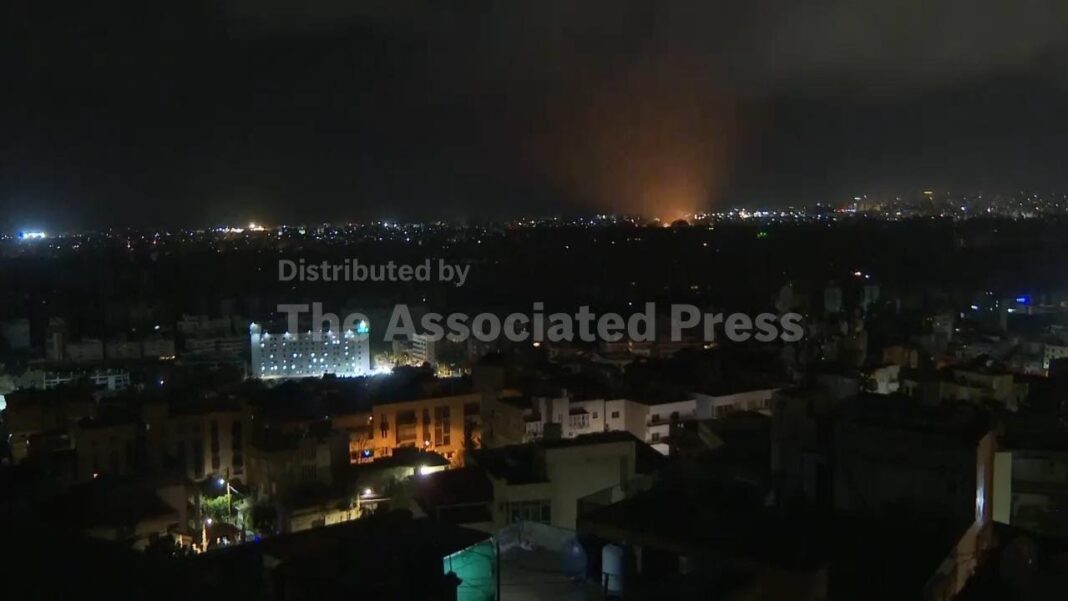
Over the course of a single day, Israeli Air Force fighter jets executed more than one hundred targeted strikes across Beirut, focusing particularly on the southern neighborhoods long regarded as Hezbollah’s operational stronghold. As reported by Israel National News, these operations were guided by highly refined intelligence, enabling the identification and destruction of key command-and-control centers used by Hezbollah’s senior leadership.
Among the most consequential targets were several high-rise structures that, according to Israeli intelligence assessments, functioned as central nodes for Hezbollah’s elite Radwan Force. These buildings, outwardly indistinguishable from civilian residential towers, were allegedly repurposed as operational headquarters, facilitating the coordination of attacks and the management of strategic assets.
The footage released by the Israel Defense Forces captures the final moments before impact, with pilots receiving authorization and confirming the successful collapse of targeted structures. The stark clarity of these images serves as both a testament to the precision of the strikes and a visual representation of the broader campaign’s objectives.
Israel National News has emphasized that these operations are not indiscriminate but are part of a deliberate strategy aimed at dismantling Hezbollah’s command infrastructure while minimizing collateral damage. The use of advanced targeting systems and real-time intelligence reflects a level of operational sophistication that has become a hallmark of Israel’s military doctrine.
Central to the recent operations has been the targeting of the Radwan Force, Hezbollah’s elite unit tasked with executing high-impact operations, including cross-border incursions into Israeli territory. The destruction of facilities associated with this unit represents a significant setback for the organization, potentially disrupting its ability to coordinate complex attacks.
Israel National News reported that the Radwan Force has long been regarded as one of Hezbollah’s most formidable components, combining advanced training with a mandate to carry out strategic missions. By targeting the infrastructure that supports this unit, the Israel Defense Forces aim to degrade not only its immediate capabilities but also its long-term operational viability.
The choice of targets reflects a broader strategic calculus: the recognition that modern warfare increasingly depends on the disruption of command-and-control networks. By severing these networks, Israel seeks to create operational paralysis within Hezbollah’s ranks, limiting its capacity to respond effectively.
While the aerial campaign has captured much of the public’s attention, Israel National News has also highlighted the critical role of ground operations in southern Lebanon. Brigade 226, operating under the command of the 146th Division, has been conducting targeted raids designed to eliminate remaining pockets of Hezbollah activity.
These operations, described as part of a “forward defensive posture,” involve a combination of reconnaissance, precision strikes, and direct engagement with hostile elements. Over the course of the campaign, Israeli forces have reportedly carried out more than two hundred strikes against Hezbollah targets in the region.
The results, as detailed by Israel National News, include the elimination of multiple terrorist cells and the dismantling of dozens of structures used for military purposes. These structures encompass a range of facilities, from weapons storage sites to operational headquarters, each contributing to Hezbollah’s broader warfighting capability.
The integration of air and ground operations underscores the comprehensive nature of Israel’s approach. By combining these elements, the Israel Defense Forces aim to achieve a level of operational synergy that maximizes effectiveness while minimizing exposure.
The recent developments also bring into sharp focus Hezbollah’s longstanding strategy of embedding its military infrastructure within civilian environments. This approach, while providing a degree of protection against conventional attacks, also exposes civilian populations to significant risk.
Israel National News has noted that the use of residential buildings as command centers complicates the operational landscape, requiring a high degree of precision and restraint on the part of Israeli forces. The challenge lies in neutralizing legitimate military targets without causing undue harm to civilians.
This dynamic has been a recurring feature of the conflict, reflecting a broader pattern in which non-state actors leverage urban environments to offset conventional military disadvantages. For Israel, the response has been to invest heavily in intelligence and targeting capabilities, enabling it to navigate this complex terrain.
The confrontation with Hezbollah cannot be understood in isolation from the broader regional context, particularly the role of Iran. Israel National News has consistently emphasized that Hezbollah operates as a proxy for the Iranian regime, receiving funding, training, and strategic guidance from Tehran.
This relationship has significant implications for the current conflict. By targeting Hezbollah’s infrastructure, Israel is effectively engaging a key component of Iran’s regional network, seeking to curtail its ability to project power beyond its borders.
The Israel Defense Forces have made clear that their operations are not merely reactive but are part of a broader effort to counter the influence of Iran and its affiliated groups. This perspective aligns with Israel’s longstanding view that the Iranian regime represents a primary strategic threat.
In statements accompanying the release of the footage, the Israel Defense Forces reiterated their commitment to continuing operations against Hezbollah with “determination.” This language, as highlighted in the Israel National News report, reflects a broader posture of resolve, signaling that the campaign is far from over.
The emphasis on protecting Israeli civilians remains a central theme, underscoring the defensive rationale behind the operations. By targeting the sources of threats before they can materialize, Israel seeks to create a buffer of security that extends beyond its immediate borders.
This approach, while controversial in some quarters, is rooted in a strategic doctrine that prioritizes preemption and deterrence. The objective is not merely to respond to attacks but to prevent them from occurring in the first place.
The intensification of operations in Beirut carries significant implications for the broader region. As the Israel National News report observed, the targeting of high-profile sites within the Lebanese capital represents a notable escalation, potentially altering the dynamics of the conflict.
For Lebanon, the consequences are multifaceted. The destruction of infrastructure, even when linked to military activity, has the potential to exacerbate existing economic and political challenges. At the same time, the presence of Hezbollah within civilian areas complicates efforts to separate military and non-military spheres.
For Israel, the operations serve as both a tactical necessity and a strategic signal. They demonstrate a willingness to act decisively in defense of national security, even in the face of potential international scrutiny.
The images emerging from Beirut—of collapsing structures and precision strikes—are emblematic of a conflict that is both intensely local and profoundly global. They reflect the convergence of advanced military technology, complex intelligence operations, and deeply entrenched geopolitical rivalries.
As the Israel National News report noted, one theme remains clear: the campaign against Hezbollah is not merely a series of isolated actions but part of a sustained effort to reshape the strategic landscape.
The outcome of this effort will have far-reaching implications, not only for Israel and Lebanon but for the broader Middle East. It will influence the balance of power, the trajectory of regional alliances, and the prospects for stability in a region that has long been defined by volatility.
In the meantime, the operations continue—methodical, calculated, and unyielding—driven by a determination that shows no sign of abating.
