



|
Getting your Trinity Audio player ready...
|
By: Fern Sidman
As the fourth week of a widening Middle Eastern conflict unfolds, a dramatic and consequential divergence has emerged between military momentum and diplomatic urgency. At the center of this tension stands Benjamin Netanyahu, who, according to a report on Wednesday by Israel National News, has issued sweeping directives to intensify Israel’s offensive against Iran’s military infrastructure within an extraordinarily compressed timeframe.
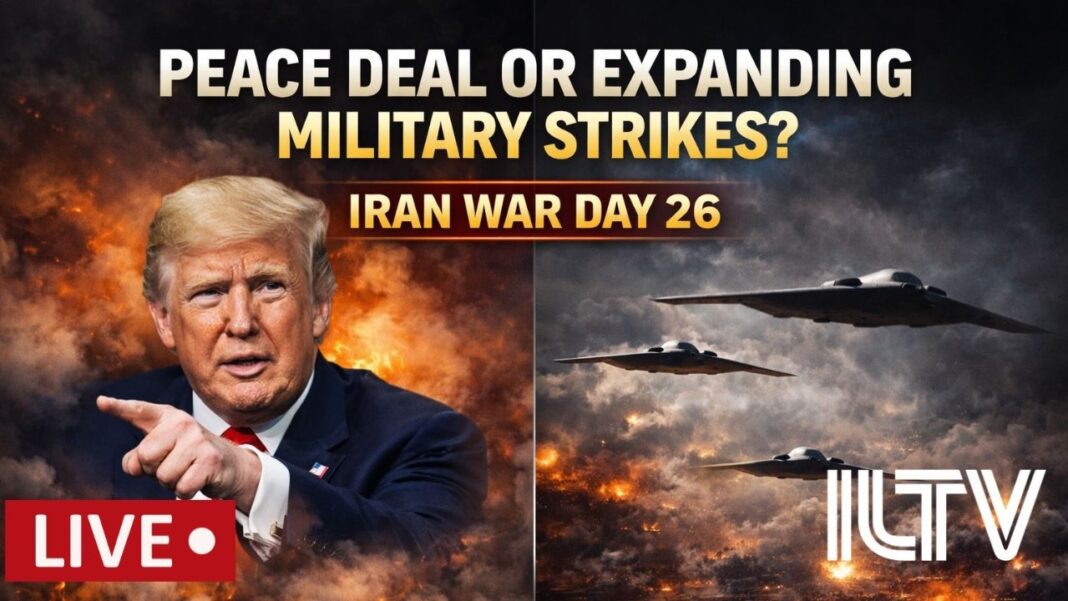
The order—to destroy as much of Iran’s arms industry as possible within 48 hours—reflects a strategic calculus shaped not only by battlefield dynamics but by the accelerating push for a negotiated end to hostilities led by President Donald Trump. It is, in effect, a race against diplomacy: a final attempt to secure irreversible military gains before political constraints potentially curtail further operations.
Israel National News has consistently emphasized that Netanyahu’s directive was issued in direct response to Washington’s evolving diplomatic posture. The catalyst appears to have been a detailed American proposal—described as a 15-point framework—aimed at ending the war through negotiated terms addressing Iran’s nuclear ambitions, missile programs, and regional activities.
For Israeli leadership, the receipt of this plan appears to have clarified the narrowing window for decisive military action. The implication is stark: if negotiations succeed, or if a ceasefire is imposed, the opportunity to dismantle Iran’s military-industrial capacity may be significantly constrained.
Thus, Netanyahu’s order is not merely an escalation but a preemptive consolidation of gains. As Israel National News reported, Israeli planners view the current phase of operations as uniquely advantageous, with Iranian defenses weakened and allied forces operating with unprecedented effectiveness.
In public remarks, Netanyahu has articulated a dual-track approach that combines openness to diplomacy with unwavering commitment to military objectives. Following a conversation with President Trump, he acknowledged the potential for negotiations to achieve the war’s aims, yet underscored that Israel’s security imperatives remain paramount.
“We will safeguard our vital interests under all circumstances,” Netanyahu declared, signaling that while Israel is prepared to engage with diplomatic initiatives, it will not allow them to dictate the terms of its national defense.
This position reflects a longstanding tenet of Israeli strategic thinking: that negotiations are most effective when conducted from a position of strength. By accelerating operations against Iran’s military infrastructure, Israel seeks to ensure that any eventual agreement is shaped by the realities established on the battlefield.
The scale of the ongoing military campaign is staggering. According to updates detailed by Israel National News and corroborated by official briefings, the United States and Israeli forces have collectively targeted thousands of sites across Iran.
Brad Cooper, commander of United States Central Command, provided a comprehensive assessment of the operation—known as Operation Epic Fury—highlighting its unprecedented scope and effectiveness. More than 10,000 Iranian targets have been struck, a figure that underscores the intensity and precision of the campaign.
The targets encompass a broad spectrum of military assets, including missile production facilities, drone manufacturing sites, naval shipyards, and command infrastructure. The Israel National News report noted that the objective is not merely to degrade Iran’s capabilities temporarily but to dismantle them in a manner that prevents rapid reconstitution.
The results according to Cooper’s assessment, have been profound. Iran’s naval capacity has been reduced by approximately 92 percent, effectively neutralizing its ability to project power across regional waterways. Missile and drone launch capabilities have declined by over 90 percent, significantly diminishing the regime’s capacity to threaten both regional actors and global shipping routes.
Central to the campaign’s success has been the establishment of overwhelming air superiority. United States and Israeli forces have conducted more than 10,000 combat flights over Iranian territory, a feat that Israel National News has described as indicative of near-total operational control of the skies.
This dominance has been facilitated by advanced aerial refueling operations, precision-guided munitions, and the deployment of strategic bombers capable of delivering massive payloads. The role of long-range bombers, particularly those capable of carrying tens of thousands of pounds of ordnance, has been instrumental in targeting hardened facilities and deeply embedded infrastructure.
The cumulative effect of these operations has been to overwhelm Iran’s air defenses, rendering them increasingly ineffective and exposing critical assets to sustained attack.
Despite the severity of these losses, Iran has signaled little willingness to compromise. Reports cited by Israel National News indicate that Tehran has rejected the American proposal, reverting instead to baseline conditions that had previously been deemed unacceptable by Washington.
Statements from Iranian officials reflect a posture of defiance, even as their military capabilities are systematically degraded. A spokesperson for the Revolutionary Guard’s emergency command dismissed the diplomatic initiative as inconsequential, characterizing it as a unilateral exercise by the United States.
This rhetoric, while consistent with Iran’s historical approach, belies the strategic reality described by Israel National News: a regime under increasing pressure, facing both external military assault and internal uncertainty.
In parallel with large-scale strikes on infrastructure, Israel has continued to pursue high-value targets within Iran’s scientific and military leadership. Netanyahu’s remarks, as reported by Israel National News, confirmed the recent elimination of additional nuclear scientists—a move aimed at disrupting the intellectual and technical foundations of Iran’s nuclear program.
Such operations reflect a broader strategy of targeting not only physical assets but also the human capital that sustains them. By removing key figures, Israel seeks to impede Iran’s ability to rebuild its capabilities, even if a ceasefire halts further strikes.
The conflict is not confined to Iran alone. Israel National News has highlighted ongoing operations against Hezbollah in Lebanon, underscoring the interconnected nature of the regional threat.
Netanyahu’s reference to simultaneous strikes in Lebanon indicates a comprehensive approach that addresses both state and non-state actors aligned with Iran. This dual focus reflects Israel’s assessment that weakening Iran’s influence requires confronting its network of proxies as well as its domestic capabilities.
As the military campaign intensifies, the diplomatic landscape grows increasingly complex. The prospect of a ceasefire—whether negotiated or unilaterally declared by the United States—introduces a set of uncertainties that Israel must navigate carefully.
Israel National News has underscored the potential risks associated with premature cessation of hostilities. A ceasefire that leaves critical elements of Iran’s military infrastructure intact could allow for gradual recovery, undermining the long-term objectives of the campaign.
Conversely, continued escalation carries its own risks, including the possibility of broader regional involvement and sustained economic disruption. The challenge lies in balancing these competing considerations in a manner that preserves both immediate gains and future security.
The current phase of the conflict represents a defining moment in Israeli strategic doctrine. The decision to intensify operations in the face of impending diplomacy reflects a willingness to prioritize decisive action over cautious restraint.
The report at Israel National News has characterized this approach as emblematic of a broader philosophy: that enduring security cannot be achieved through partial measures or temporary compromises. Instead, it requires the systematic dismantling of threats at their source.
This philosophy is evident not only in the scale of the operations but in their precision and coordination. The integration of Israeli and American efforts has created a level of effectiveness that would have been difficult to achieve independently.
As the situation continues to evolve, the coming days will be critical. The outcome of the accelerated campaign, combined with the trajectory of diplomatic efforts, will shape the next phase of the conflict.
Israel National News has emphasized that the decisions made during this period will have long-lasting implications, not only for Israel and Iran but for the broader regional order. The balance between military success and diplomatic resolution will determine whether the current conflict transitions into a period of stability or remains a source of ongoing tension.
In the final analysis, Netanyahu’s directive encapsulates a central tenet of statecraft in times of conflict: that the terms of peace are often determined by the realities of war. By ordering a rapid and comprehensive assault on Iran’s arms industry, Israel seeks to ensure that any eventual settlement reflects its strategic priorities.
The interplay between force and diplomacy, as chronicled extensively by Israel National News, is not a contradiction but a continuum. Military action creates the conditions for negotiation, while diplomacy seeks to consolidate the gains achieved through force.
As the world watches the unfolding events, one reality remains clear: the decisions made in this narrow window of time will reverberate far beyond the immediate conflict, shaping the contours of regional security and international relations for years to come.
