



|
Getting your Trinity Audio player ready...
|
By: Carl Schwartzbaum
In the tense days leading up to Saturday’s coordinated U.S. and Israeli military strikes on Iranian targets, American intelligence agencies were already grappling with a question that has long haunted policymakers in Washington: if Iran’s supreme leader were removed from power, what — or who — would replace him?
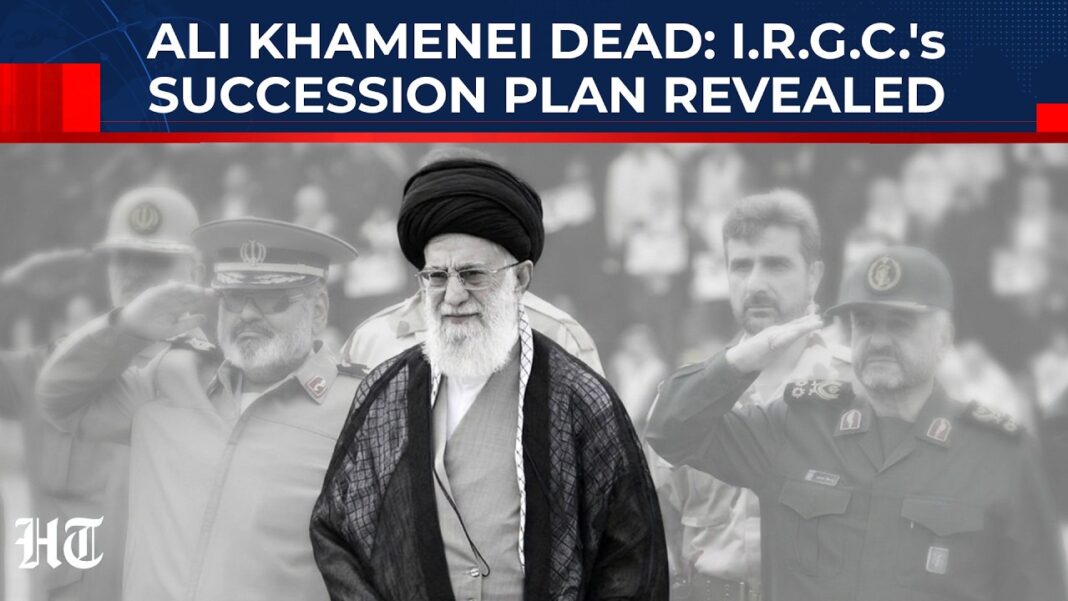
According to two sources briefed on the matter, the U.S. Central Intelligence Agency assessed in recent weeks that even if Supreme Leader Ayatollah Ali Khamenei were killed in a military operation, his likely successors would emerge from the ranks of the Islamic Revolutionary Guard Corps (IRGC), the elite military institution charged with safeguarding Iran’s clerical system. The assessment, reported by Reuters and cited by The Algemeiner in its coverage of the unfolding crisis, suggested that the removal of Khamenei might not produce the kind of systemic transformation some in Washington have publicly advocated.
The intelligence estimates were compiled over the past two weeks, as deliberations intensified within the Trump administration over whether to proceed with a direct intervention in Iran. According to Reuters, the reports examined a range of potential outcomes following U.S. military action, including the prospects for regime change and the stability of Iran’s political order. While the analysis did not reach definitive conclusions, the sources emphasized that none of the modeled scenarios guaranteed the collapse of the Islamic Republic.
The Central Intelligence Agency declined to comment publicly, in keeping with its longstanding practice regarding operational assessments. Nevertheless, the substance of the analysis, as conveyed by individuals familiar with its findings, underscores a critical tension in U.S. policy: the aspiration for political transformation in Tehran versus the entrenched power of Iran’s security establishment.
President Donald Trump has in recent weeks signaled increasing openness to the notion of regime change. In an early morning video address on Saturday, delivered shortly after the strikes commenced, he referred to Iran’s leadership as a “terrorist regime” and urged the Iranian people to seize the moment. The military action, he argued, would “set the stage” for a popular uprising that could reshape the country’s future.
Yet as Reuters reported and The Algemeiner echoed in its own analysis, intelligence officials cautioned against assuming that the removal of a single figure — even one as central as Khamenei — would automatically produce a democratic or moderate successor. The IRGC, formed in the aftermath of the 1979 revolution, has evolved into a formidable military, economic and political force. Its mandate is explicitly tied to preserving Shi’ite clerical rule. Over decades, it has entrenched itself across sectors of Iranian society, from defense industries to infrastructure projects.
The CIA’s assessment reportedly reflected this institutional reality. Even in a scenario where Khamenei were incapacitated or killed, the IRGC’s senior leadership would likely exert decisive influence over succession. Reuters noted that the intelligence reports explored how military intervention could reverberate within Iran’s power structure but did not identify a clear pathway to wholesale regime transformation.
The strikes themselves followed weeks of escalating tension. Deadly protests erupted in Iran in December, prompting renewed debate in Washington over how to respond. Internal discussions within the administration weighed the risks of military engagement against the possibility of diplomatic resolution. U.S. officials sought to revive negotiations aimed at curbing Iran’s nuclear program, hoping to avert confrontation.
Those diplomatic efforts culminated in talks in Geneva, which ultimately failed to produce an agreement. According to the information provided in the Reuters report, Secretary of State Marco Rubio briefed the bipartisan congressional leadership group known as the “Gang of Eight” last week, informing them that a U.S. operation was likely to move forward. At the same time, he emphasized that President Trump retained the authority to alter course, particularly if negotiations yielded progress.
Two sources familiar with the briefing told Reuters that Rubio notified lawmakers again on Friday night that military action could commence within hours. Even then, he reportedly reiterated that the president could change his mind. The delicate choreography of informing congressional leaders reflected both the gravity of the impending operation and the fluidity of the decision-making process.
As The Algemeiner observed in its coverage, the intelligence community’s caution contrasted with the administration’s more assertive public rhetoric. While Trump encouraged Iranians to “take over” their government, the CIA’s internal modeling suggested that entrenched hardliners could consolidate power rather than relinquish it. The IRGC’s command structure, loyalty networks and control over significant military assets position it as a likely arbiter of succession.
The implications are profound. If the removal of Khamenei merely results in the elevation of another hardline figure from within the IRGC, the strategic calculus underpinning regime change could be fundamentally altered. Reuters reported that intelligence analysts refrained from drawing categorical conclusions, acknowledging the inherent unpredictability of political upheaval. Nonetheless, their findings injected a note of realism into policy deliberations.
The IRGC’s role extends beyond Iran’s borders. It oversees and coordinates regional proxy forces, manages missile programs and wields influence over key aspects of foreign policy. A leadership transition dominated by its upper echelon could potentially intensify, rather than moderate, Iran’s confrontational posture. The Algemeiner report highlighted this possibility in examining how succession dynamics might affect regional stability.
Meanwhile, the military campaign itself unfolds against a backdrop of heightened volatility. The strikes on Saturday marked a significant escalation, targeting Iranian military infrastructure. Iranian retaliation, including missile launches toward Israeli and regional targets, has raised fears of a protracted confrontation.
In Washington, the prospect of regime change remains both an aspiration and a gamble. The intelligence assessments described by Reuters reflect an awareness that political systems rarely unravel in linear fashion. Removing a supreme leader does not automatically dismantle the institutional framework that sustains his authority.
As The Algemeiner report noted, the question of who might lead Iran in a post-Khamenei era remains opaque. The Assembly of Experts, the clerical body formally empowered to appoint a new supreme leader, could face immense pressure from the IRGC. The interplay between religious legitimacy and military power would shape the contours of any transition.
For now, the intelligence community’s measured analysis serves as a reminder of the complexities inherent in engineering political change from the outside. While public rhetoric may emphasize liberation and transformation, the internal assessments described by Reuters suggest a more constrained range of plausible outcomes.
The coming days will test both the durability of Iran’s institutions and the assumptions underlying Washington’s strategy. Whether military force can catalyze the kind of systemic shift envisioned by some policymakers remains uncertain. One conclusion from the CIA’s analysis stands out: even in the face of dramatic upheaval, entrenched power structures often endure.
In the shadow of airstrikes and political exhortations, the future of Iran’s leadership — and the broader trajectory of the region — hangs in the balance.
