



|
Getting your Trinity Audio player ready...
|
By: Svetlana Pincus
In a development that has rapidly escalated from municipal policy debate to federal oversight confrontation, a United States Senate committee has turned its attention to the administration of New York City Mayor Zohran Mamdani, raising profound questions about the intersection of public health governance, political advocacy, and compliance with federal civil rights law. At the center of the controversy lies the city’s Department of Health and Mental Hygiene and its newly formed “Global Oppression and Public Health Working Group,” whose framing of international conflict has triggered sharp criticism and an intensifying inquiry from Washington.
As reported in detail by The New York Post on Tuesday, the working group described Israel’s actions in Gaza as “genocide” while notably omitting any reference to the Hamas-led attack of October 7, 2023—a barbaric assault that resulted in over 1,200 fatalities, including American citizens. This omission, combined with the language used in the group’s discussions, has raised concerns among federal lawmakers regarding both factual completeness and potential bias within a publicly funded health initiative.
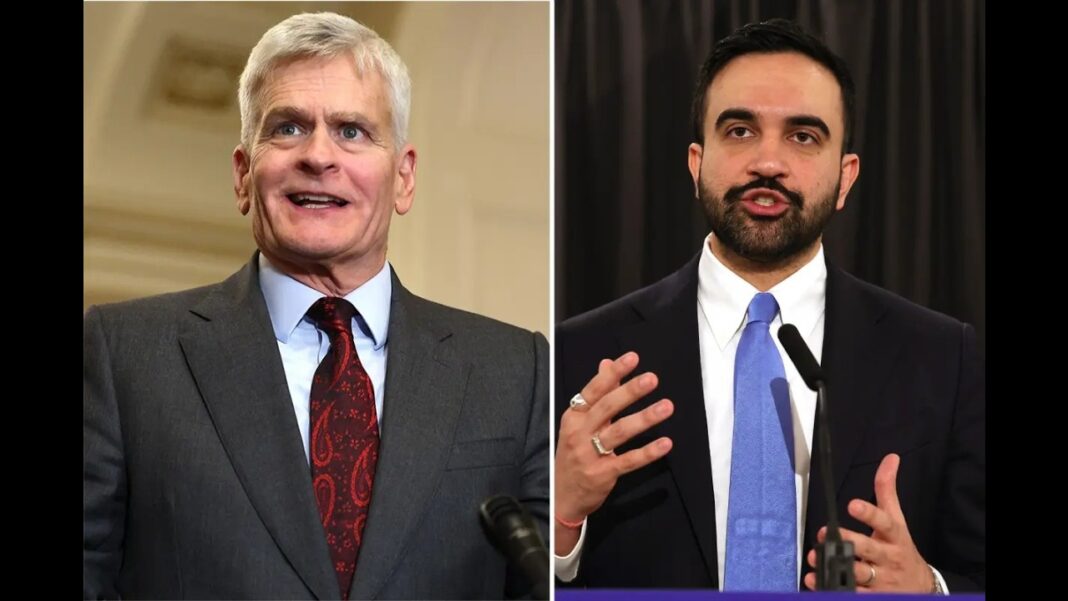
The response from Capitol Hill has been swift and pointed. Bill Cassidy, chairman of the Senate Health, Education, Labor and Pensions Committee, has formally requested detailed explanations from Mayor Mamdani’s administration. In a letter dated March 23, Cassidy articulated concerns that the activities of the working group may conflict with federal nondiscrimination statutes—particularly given that the city’s health department receives approximately $600 million annually in federal funding.
According to The New York Post report, Cassidy’s correspondence emphasizes a broader principle: that federal funds allocated for public health must be administered in a manner consistent with legal and ethical obligations. “Prioritizing a political agenda over compliance with these requirements risks both federal funding and the public health of New York City residents,” Cassidy wrote, emphasizing the potential consequences of any perceived deviation from statutory standards.
The letter demands a comprehensive accounting of the working group’s purpose, its use of federally funded resources, and the steps taken to ensure adherence to civil rights requirements. Cassidy also posed a series of pointed questions regarding the scope of the initiative, including whether similar working groups would be established to address other global conflicts or whether the focus on the Israeli-Palestinian issue represents a singular emphasis.
The origins of the dispute can be traced to early February, shortly after Mayor Mamdani assumed office on January 1. The inaugural meeting of the “Global Oppression and Public Health Working Group” sought to explore the relationship between international events and local health disparities, framing its mission within the broader concept of “health equity.”
However, as The New York Post reported, the language employed during the session quickly became a focal point of controversy. Presenters characterized the situation in Gaza as an “ongoing genocide,” a description that carries significant political and legal implications. Equally notable was the absence of any discussion of Hamas’ October 7 attack, a gap that critics argue undermines the credibility and balance of the initiative.
This combination of assertive terminology and selective framing has fueled accusations that the working group is engaging in advocacy rather than analysis—a distinction that carries particular weight in the context of a public health agency.
City officials have thus far offered limited public comment on the Senate inquiry. However, remarks by Health Commissioner Alister Martin suggest an awareness of—and resistance to—federal scrutiny. In an interview cited by The New York Post, Martin acknowledged that the federal government may be critical of the department’s approach but indicated a willingness to continue its efforts regardless of potential funding implications.
“We have pretty specific evidence that the federal government is not a fan of the work that we’re doing on equity,” Martin said, adding that the department would persist “even if the federal government comes and messes with our money.” This statement, while reflecting a commitment to the department’s priorities, also highlights the tension between local autonomy and federal oversight.
The mayor’s office has not yet issued a formal response to Cassidy’s latest letter, and it remains unclear whether the administration has addressed earlier inquiries. The absence of a detailed public defense has only intensified speculation about the city’s strategy and its assessment of the risks involved.
The controversy surrounding the working group is further compounded by broader concerns about antisemitism in New York City, home to the largest Jewish population outside Israel. The New York Post has reported extensively on these concerns, noting that they have been a central element of Cassidy’s inquiry.
In his initial letter, the senator highlighted the administration’s decision to rescind executive orders that had established the Mayor’s Office to Combat Antisemitism and opposed the Boycott, Divestment and Sanctions movement against Israel. These policy reversals, Cassidy argued, could weaken institutional safeguards for Jewish residents and potentially conflict with federal civil rights obligations.
The linkage between these decisions and the activities of the working group has reinforced perceptions that the administration’s approach may reflect a broader shift in priorities—one that has significant implications for community relations and legal compliance.
At the heart of the dispute lies a fundamental question: what is the appropriate role of a public health agency in addressing global political issues? The concept of health equity, which seeks to address disparities in health outcomes across different populations, has increasingly incorporated considerations of social and environmental factors. However, the extension of this framework to international conflicts remains contentious.
Proponents of the working group argue that global events can have tangible impacts on local communities, influencing mental health, access to resources, and overall well-being. From this perspective, examining such issues falls within the legitimate scope of public health.
Critics, however, contend that the selective framing of these issues—particularly when accompanied by charged language and omissions—risks transforming a health initiative into a platform for political advocacy.
The involvement of federal funding adds a critical dimension to the controversy. With approximately $600 million in annual support at stake, the city’s health department operates within a framework that requires adherence to specific legal and regulatory standards. Any determination that these standards have been violated could result in significant financial consequences.
Cassidy’s letter makes clear that this possibility is not merely theoretical. By setting an April 6 deadline for a response, the senator has signaled an intention to pursue the matter with urgency and rigor. The New York Post report noted that such deadlines often serve as precursors to further action, including hearings or additional investigations.
The dispute also reflects broader political dynamics, both within New York City and at the national level. Mayor Mamdani’s administration represents a departure from previous leadership, bringing with it new priorities and approaches. The reaction from federal lawmakers, in turn, illustrates the extent to which local decisions can resonate on a national stage.
The New York Post’s coverage situates the controversy within this larger context, emphasizing the interplay between municipal governance and federal oversight. It is a reminder that in an interconnected political system, actions taken at one level can have far-reaching implications.
As the deadline for the city’s response approaches, the stakes continue to rise. The Senate inquiry has transformed a local policy initiative into a focal point of national debate, raising questions about the boundaries of public health, the responsibilities of government agencies, and the mechanisms of accountability.
For Mayor Mamdani and his administration, the challenge lies in articulating a coherent and legally sound justification for their actions—one that addresses both the substantive concerns raised by the working group’s activities and the procedural requirements of federal funding.
For federal lawmakers, the inquiry represents an opportunity to assert oversight and to clarify the standards that govern the use of public resources. And for the residents of New York City, it is a moment that underscores the importance of transparency, balance, and adherence to the principles that underpin public service.
As The New York Post report noted, the outcome of this dispute will likely serve as a precedent for similar cases, shaping the contours of the relationship between local initiatives and federal authority. In this sense, the controversy is not merely about a single working group but about the broader question of how governance adapts to an increasingly complex and contested world.
