



|
Getting your Trinity Audio player ready...
|
By: Chaya Abecassis
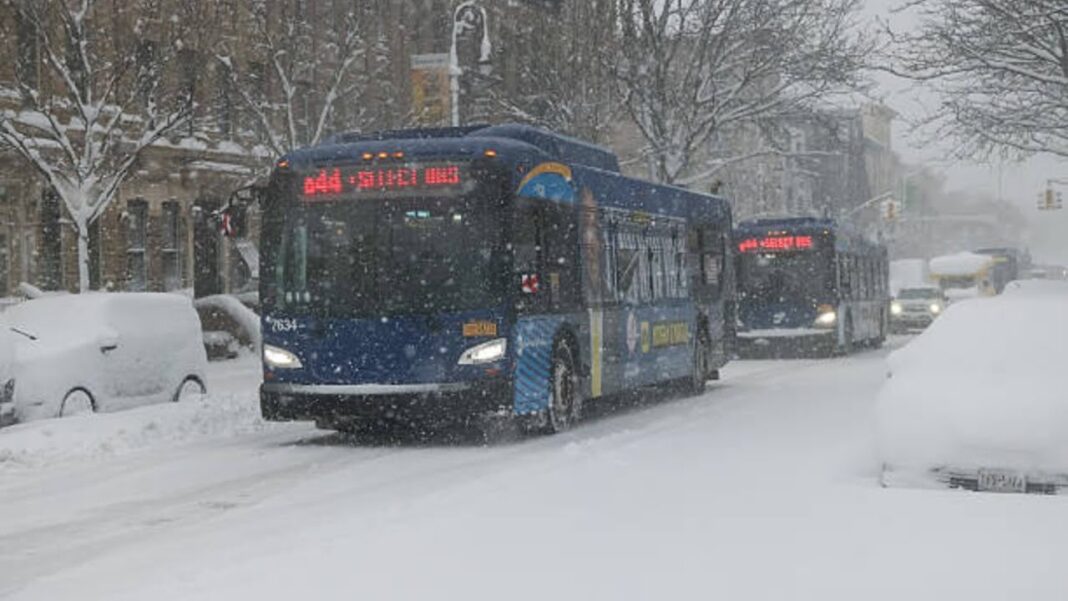
New York awoke Tuesday to a city still locked in the aftershocks of a historic winter storm, its streets scraped raw by plows, its sidewalks heaped with sodden drifts, and its transit arteries strained to the point of dysfunction. As commuters attempted to resume the rituals of ordinary life, the promise of stability offered the previous day by Metropolitan Transportation Authority leadership rang hollow in the echoing caverns of shuttered platforms and overcrowded trains.
On Tuesday, The New York Post, chronicling the cascading failures across the transit network, reported a city caught between official assurances and the lived reality of immobilization.
On Monday, the MTA’s chairman and chief executive, Janno Lieber, had sought to project reassurance, telling anxious New Yorkers that the agency “is here for you” and that “the system is running.” By the time dawn broke on Tuesday, however, the dissonance between rhetoric and reality was unmistakable. The New York Post report described a morning commute defined not by routine but by rupture, as entire subway lines were suspended, express services curtailed, and riders forced into already congested alternatives that strained both patience and capacity.
The most dramatic disruption was the complete shutdown of the C line, a vital artery linking Washington Heights in upper Manhattan with East New York in Brooklyn. With the line suspended in its entirety, riders were funneled onto the A train, itself already burdened by the loss of express service and the cumulative pressures of storm recovery.
Platforms filled to the edge of safety, trains arrived groaning under the weight of human cargo, and the ordinary choreography of the commute dissolved into a jostling contest for standing room. The New York Post reported that the C line remained out of service well into the afternoon, prolonging a state of disarray that seemed to mock the notion of a swift return to normalcy.
The paralysis was not confined to a single route. The Nos. 1, 2, 5 and 7 trains, pillars of the city’s north–south and borough-spanning connectivity, staggered through the rush hour with delays that compounded the sense of systemic fragility. Elsewhere, the F, M, L and N lines were likewise beset by lateness, a pattern that suggested not isolated mechanical mishaps but a network-wide struggle to regain equilibrium after the storm’s assault.
Express service on the No. 3, A and D lines was suspended, robbing commuters of the speed and efficiency on which the city’s tempo depends. The J train, reduced to a limited schedule, became another emblem of a system operating in a diminished, emergency mode.
The New York Post report noted that the Staten Island Railway, often treated as an afterthought in the broader narrative of the city’s transit woes, remained only partially restored. Its riders, already accustomed to a sense of marginalization within the MTA’s vast apparatus, found themselves further isolated by the slow pace of recovery. On the surface streets, several bus routes were detoured to allow plows and sanitation crews to clear lingering snowbanks, a necessary intervention that nonetheless added to the labyrinthine complexity of navigating the city that morning.
The day’s tribulations were punctuated by moments of visceral alarm. On the G line in Queens, a subway car filled with smoke, forcing passengers to evacuate in a scene that conjured the specter of far more catastrophic events. Fire Department officials later attributed the incident to an overturned transformer and confirmed that no injuries were reported, but for riders already on edge, the episode was a jarring reminder of how quickly inconvenience can tip into fear. The New York Post report recounted the evacuation as yet another chapter in a day defined by uncertainty, as commuters confronted not only delays but the unsettling possibility of danger in spaces meant to be mundane.
Beyond the subterranean world of subways and tunnels, the region’s broader transportation ecosystem was similarly strained. The Long Island Rail Road, a lifeline for suburban commuters pouring into Manhattan each day, was operating only six of its eleven branches during the Tuesday morning rush. The partial restoration offered little solace to the thousands of riders left scrambling for alternatives.
LIRR officials, in an afternoon statement reported by The New York Post, promised a return to regular weekday service for Wednesday morning’s commute, albeit with unspecified schedule modifications. The pledge, while welcome, carried the implicit admission that the network had not yet emerged from crisis mode.
Amtrak, too, found itself entangled in the storm’s lingering effects. Dozens of cancellations left hundreds of passengers stranded at Penn Station, that grand but often beleaguered nexus of intercity rail. Travelers bound for destinations along the Northeast Corridor paced the concourses beneath the station’s vaulted ceilings, their itineraries rendered provisional by the unpredictable rhythms of post-blizzard recovery. The New York Post depicted scenes of frayed tempers and weary resignation as passengers confronted the prospect of missed connections and indefinite delays.
In the skies above the metropolitan region, the turmoil was no less pronounced. Thousands of flights in and out of the area’s airports were canceled as blizzard-related disruptions rippled through airline schedules. The New York Post, tracking the cumulative impact of the storm, underscored how the paralysis of one sector inevitably propagated through others, transforming a weather event into a multi-day ordeal for the city’s mobility. Airports that serve as gateways to the world became bottlenecks of frustration, their terminals crowded with travelers stranded by forces beyond their control.
What emerged from this tableau was a portrait of a metropolis struggling to reconcile its self-image as a paragon of resilience with the realities of infrastructure stretched thin by both age and circumstance. New York has long prided itself on an almost mythic capacity to absorb shocks—whether natural disasters, terrorist attacks, or economic upheavals—and resume its relentless forward motion. Yet the scenes chronicled by The New York Post suggested that resilience, in the context of contemporary urban infrastructure, is neither automatic nor inexhaustible.
The tension between official messaging and commuter experience was perhaps the most corrosive element of the day’s chaos. Lieber’s assurances, offered in good faith or otherwise, collided with the lived experience of riders confronted by shuttered platforms, stalled trains, and an ambient sense of disorder. The MTA’s failure to respond to The New York Post’s requests for comment only deepened the perception of an agency struggling not merely with operational challenges but with the demands of transparency and accountability in a moment of public frustration.
At stake in these daily disruptions is more than convenience. The city’s transit system is its circulatory system, the infrastructure through which economic activity, social life, and civic vitality flow. When that system falters, the consequences ripple outward, touching not only individual commuters but the broader rhythms of commerce and culture. Missed shifts, delayed deliveries, canceled meetings, and frayed nerves accumulate into a collective cost that is difficult to quantify yet impossible to ignore.
The post-blizzard chaos also revived perennial questions about preparedness and investment. Extreme weather events, once treated as aberrations, are increasingly the norm, demanding a level of infrastructural resilience that New York’s aging transit network has struggled to achieve. The New York Post has repeatedly highlighted the vulnerability of the city’s transportation systems to storms, floods, and heat waves, and Tuesday’s disruptions served as another case study in the price of deferred maintenance and incremental reform.
As the day wore on and the city slowly clawed its way toward functionality, the promise of a more orderly Wednesday commute hovered as a fragile hope. Yet the memory of Tuesday’s immobilization lingered, a cautionary tale about the fragility of urban systems in the face of environmental extremes. For New Yorkers, accustomed to navigating inconvenience with stoic humor, the day was a reminder that the machinery of the city, however monumental, remains susceptible to the elemental forces of wind, snow, and cold.
In the end, the story of Tuesday’s commuter chaos was not merely one of delayed trains and canceled flights, but of a metropolis confronting the limits of its infrastructure in an era of increasingly volatile weather. The gap between the city’s aspirational narrative of resilience and the operational realities of its transit network is one that will demand sustained attention, investment, and candor. Until then, each storm threatens to expose anew the fault lines beneath the city’s ceaseless motion, freezing not only rails and runways but the confidence of those who depend upon them.
