



|
Getting your Trinity Audio player ready...
|
By: Fern Sidman
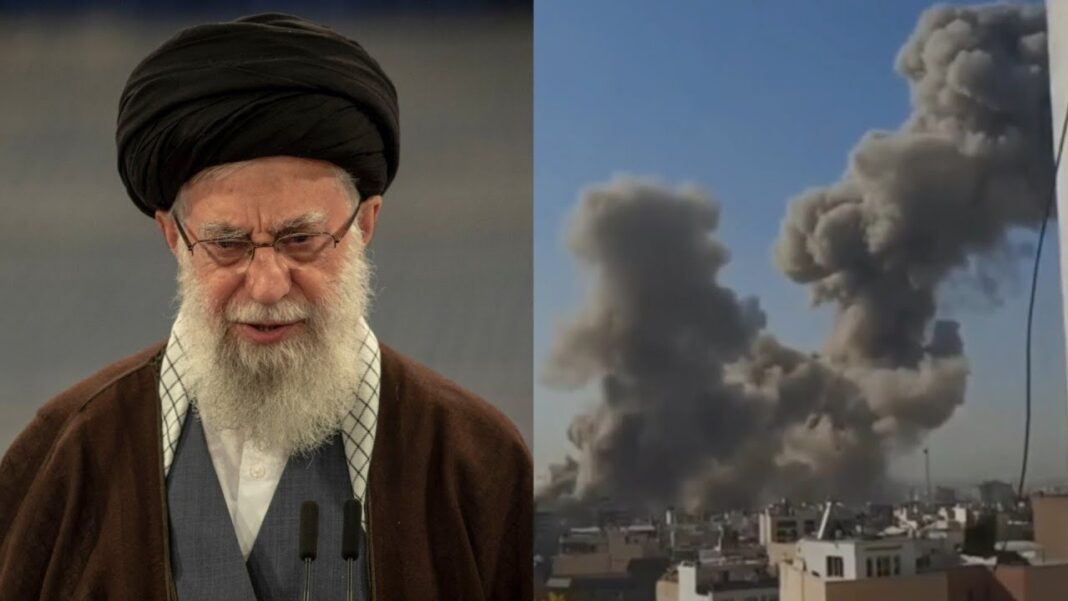
Ayatollah Ali Khamenei, Iran’s supreme leader for more than three decades and the central architect of the Islamic Republic’s modern identity, has been killed in U.S.-Israeli airstrikes, according to an announcement by the Iranian government on Sunday — a declaration that marks one of the most consequential geopolitical ruptures in the Middle East in a generation.
President Trump had announced the death hours earlier, asserting in a televised statement that the longtime cleric had been eliminated during the sweeping military campaign launched Saturday morning against Iranian military, nuclear and leadership targets. Initially, Iranian officials dismissed the claim as psychological warfare or bravado. But by Sunday morning in Tehran, as reported by The New York Times, the Iranian state news agency confirmed that Ayatollah Khamenei was indeed dead.
The confirmation came amid continuing waves of explosions across Iran as the war entered its second day. According to The New York Times report, it was not immediately clear whether the strike that killed Khamenei had been carried out by American or Israeli forces, nor was it evident who had assumed command of the country’s fractured leadership structure.
Khamenei, 86, had ruled as supreme leader since 1989, overseeing the consolidation of the Islamic Revolutionary Guard Corps (IRGC), the expansion of Iran’s regional proxy network and an enduring posture of hostility toward both Israel and the United States. His death, long considered one of the most destabilizing hypothetical scenarios in Middle Eastern politics, now threatens to unravel a system he spent decades fortifying.
The New York Times reported that in the hours before Iran formally acknowledged his death, thousands of Iranians poured into the streets of Tehran and other cities. In scenes that appeared both jubilant and uncertain, fireworks illuminated the skyline, and loud Persian dance music echoed through neighborhoods. For some, President Trump’s announcement was greeted as liberation. Others expressed grief online, mourning the cleric they regarded as the guardian of the revolution.
The duality of reaction reflects the profound divisions within Iranian society. The New York Times has chronicled in recent months the simmering unrest that gripped the country following mass protests earlier this year. President Trump had publicly vowed in January to support antigovernment demonstrators, and rights groups later reported that thousands were killed in the regime’s crackdown. Those protests revealed a society straining under economic pressure, political repression and generational disillusionment.
Now, with the supreme leader gone, Iran stands at a perilous crossroads.
President Trump and Israeli Prime Minister Benjamin Netanyahu had made little secret of their broader objectives when announcing the coordinated military campaign. Both leaders described regime change as an explicit goal. “When we are finished, take over your government,” Trump urged the Iranian people in a video statement cited by The New York Times. “It will be yours to take.”
Whether that exhortation translates into a viable political transformation remains uncertain. The Islamic Republic’s power structure is deeply entrenched. The IRGC, which answers directly to the supreme leader, has demonstrated its capacity for decisive repression. The New York Times report noted that many officials in positions of authority owe their careers and allegiance to Khamenei, raising the possibility that his death may produce continuity rather than reform.
Still, the elimination of the supreme leader represents a seismic rupture. The Assembly of Experts — a conservative clerical body tasked with selecting the next supreme leader — now faces a decision of historic magnitude. Given Khamenei’s age and reported health concerns, deliberations over succession were almost certainly underway prior to the strikes. Yet selecting a successor amid active warfare and external pressure introduces unprecedented complications.
In the immediate aftermath of the announcement, the IRGC vowed retaliation against what it described as U.S. and Israeli aggression. According to the information provided in The New York Times report, Iran fired waves of ballistic missiles toward Israel, where authorities reported at least one fatality. The confrontation swiftly expanded beyond the immediate combatants.
The United Arab Emirates, Qatar, Bahrain and Kuwait — all hosts to American military bases — reported coming under attack, as did Jordan. The New York Times report detailed that falling debris from an Iranian ballistic missile killed at least one person in the Emirates, underscoring the regional spillover. Major airports, including Dubai International, were shuttered, and a broad swath of airspace across the Gulf was closed to civilian flights.
Perhaps most consequentially for the global economy, shipping through the Strait of Hormuz — the narrow passage through which roughly one-fifth of the world’s oil supply transits — was effectively halted. Shipping companies and Iran’s semiofficial Tasnim news agency confirmed the disruption, while the U.S. Maritime Administration advised vessels to avoid the strait. The New York Times reported that oil markets braced for a sharp spike in prices, with energy analysts warning of cascading economic effects.
The crisis unfolds against the backdrop of failed diplomacy. American and Iranian officials had held a final round of mediated talks in Switzerland on Thursday, focused on Tehran’s nuclear program. Those discussions ended without a breakthrough, as The New York Times report noted, clearing the path for military escalation. President Trump has repeatedly argued that Iran’s nuclear ambitions left no alternative but decisive action.
Yet the prospect of a prolonged conflict looms large. Analysts cited by The New York Times cautioned that Iran retains significant military capabilities and an extensive network of proxy forces across Lebanon, Syria, Iraq and Yemen. Those actors could sustain asymmetric resistance, complicating any swift resolution.
Civilian casualties within Iran remain difficult to verify. HRANA, a Washington-based Iranian human rights group, reported that at least 133 civilians had been killed and 200 injured as of late Saturday. These figures could not be independently confirmed, The New York Times report emphasized. Iranian state media claimed that dozens of children were killed at a girls’ elementary school near a naval base — an allegation that U.S. and Israeli officials have not publicly addressed.
Inside Tehran, celebrations were tempered by fear. As The New York Times report described, the spectacle of fireworks and dancing unfolded beneath the persistent threat of additional airstrikes. The exhilaration of witnessing the end of a long-dominant leader mingled with apprehension over what might follow.
International reaction was swift and divided. Canada and Australia expressed support for the American action, while many other world leaders urged restraint. The New York Times reported diplomatic efforts underway to prevent further escalation, though few observers believe that the immediate trajectory can be easily reversed.
President Trump, for his part, signaled that operations would continue. “U.S. strikes will continue, uninterrupted throughout the week or, as long as necessary to achieve our objective of PEACE THROUGHOUT THE MIDDLE EAST AND, INDEED, THE WORLD!” he wrote in a statement quoted by The New York Times. The capitalized language reflected both resolve and rhetorical flourish.
For the Iranian populace, the coming days may prove decisive. The call from Washington to “take over your government” presumes a capacity for organized political action that decades of repression have suppressed. The IRGC’s enduring influence, the Assembly of Experts’ authority, and the absence of a clear opposition leadership create a complex matrix in which outcomes are anything but certain.
What is indisputable is that the death of Ayatollah Ali Khamenei has altered the strategic calculus across the region. The cleric who guided Iran through sanctions, proxy wars and nuclear brinkmanship is gone. In his place lies an uncertain vacuum.
The Middle East confronts a moment that may redefine its political architecture. Whether this rupture leads to democratization, intensified authoritarianism, or prolonged conflict will depend on forces both internal and external.
For now, Tehran’s streets reflect a nation suspended between celebration and dread, between the promise of transformation and the specter of chaos. The death of a supreme leader, achieved through foreign military action, is not merely a tactical development. It is a historical inflection point — one whose consequences will reverberate far beyond the smoke rising over Iran’s capital.
