



|
Getting your Trinity Audio player ready...
|
Iran Closes Strait of Hormuz, Sending Shockwaves Through Global Energy Markets and Raising Alarm in New Delhi
By: Ariella Haviv
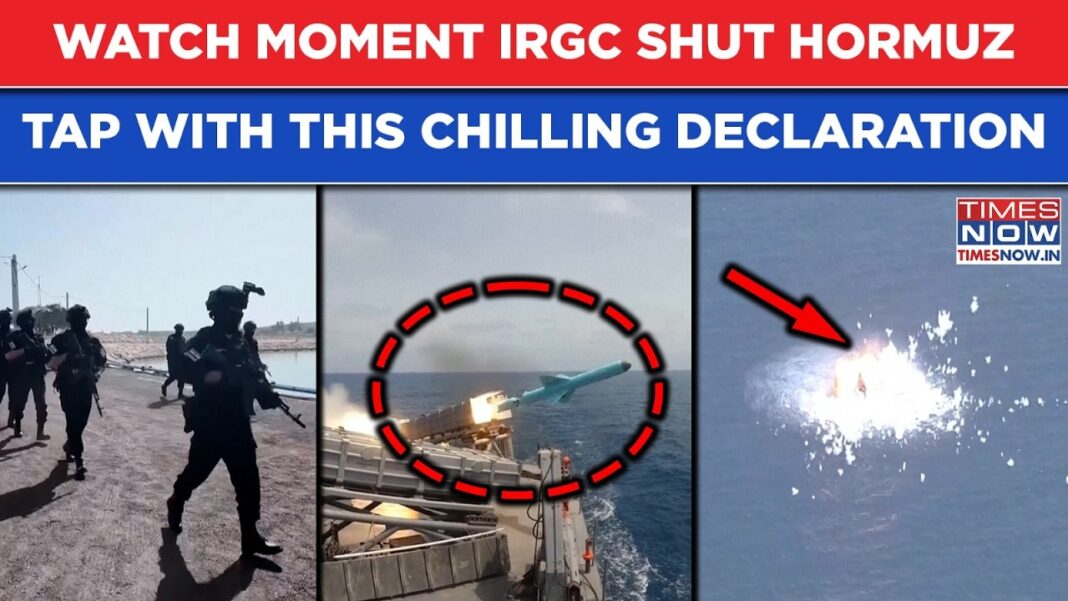
In a dramatic late-evening move that has reverberated across global energy markets and diplomatic corridors alike, Iran announced the closure of the Strait of Hormuz on Saturday, triggering immediate concerns over soaring crude oil and natural gas prices and the stability of vital supply chains. The development, reported on Saturday night by The Tribune of India, has cast a long shadow over energy-dependent economies, including India, which relies heavily on crude oil shipments passing through the strategic waterway.
The Strait of Hormuz, a narrow maritime corridor connecting the Persian Gulf with the Gulf of Oman and the Arabian Sea, is among the most critical energy chokepoints in the world. According to figures cited by The Tribune of India, between 17 and 21 million barrels of crude oil and fuel traverse the strait daily — accounting for roughly one-fifth of global oil flows. For India alone, approximately 2 million barrels per day of its crude imports transit through this artery, underscoring the vulnerability of its energy security to disruptions in the region.
The closure announcement was communicated in a manner that has raised both legal and operational questions. The United Kingdom Maritime Trade Operations (UKMTO), a key monitoring body for maritime security, issued an advisory late Saturday night noting that vessels operating in the Arabian Gulf had reported VHF Channel 16 broadcasts claiming that the strait had been shut. Mariners attributed these transmissions to Iranian authorities. The Tribune of India reported that the advisory cautioned against interpreting these broadcasts as legally binding or constituting a lawful restriction on navigation under international law, including the United Nations Convention on the Law of the Sea (UNCLOS).
Despite the ambiguity over the enforceability of Iran’s declaration, the symbolic and practical implications are profound. The mere assertion of closure has injected uncertainty into global markets, where perceptions often move prices as swiftly as physical shortages. Energy analysts cited by The Tribune of India warned that even a temporary halt in shipments through Hormuz could ignite a sharp escalation in crude prices, particularly given the volume of oil that flows daily through the strait.
For New Delhi, the ramifications are immediate and complex. India, the world’s third-largest oil importer, sources a substantial share of its crude from producers in the Gulf region. As The Tribune of India highlighted, approximately 2 million barrels per day of India’s total crude imports pass through the Strait of Hormuz. Any sustained disruption could strain domestic fuel supplies and exert upward pressure on retail prices, with cascading effects across transportation, manufacturing and household consumption.
The situation is somewhat mitigated by the structure of India’s liquefied natural gas (LNG) supply chain. The Tribune of India report pointed out that Qatar, India’s principal LNG supplier, does not route its shipments through the Strait of Hormuz for supply to India. This logistical distinction offers a measure of insulation for natural gas imports, though broader regional instability could still affect shipping insurance costs and maritime operations.
The geopolitical context surrounding the closure adds further volatility. Iran’s move follows intensifying hostilities in the region, marked by military exchanges and diplomatic breakdowns. The decision to signal closure of such a pivotal maritime passageway is widely interpreted as both a strategic warning and a demonstration of leverage. By targeting the strait — even rhetorically — Tehran underscores its capacity to influence global energy markets and exert pressure on adversaries.
However, international maritime law complicates the picture. The UKMTO’s advisory emphasized that statements indicating closure do not in themselves constitute a lawful restriction under UNCLOS. The convention upholds the principle of transit passage through international straits, allowing ships and aircraft to navigate without hindrance. Whether Iran intends to enforce its claim through physical interdiction remains unclear.
Shipping companies are now navigating a landscape fraught with uncertainty. Insurance premiums for vessels transiting the Gulf have already shown signs of escalation, reflecting heightened risk perceptions. Energy traders are closely monitoring satellite data and tanker movements to assess whether physical blockades or military activity accompany the broadcast declarations.
The economic stakes extend well beyond oil. The Strait of Hormuz also facilitates the transit of refined fuels and petrochemical products integral to global supply chains. Disruption could ripple through industries ranging from aviation to agriculture. As The Tribune of India report noted, the strait’s strategic centrality renders it not merely a regional issue but a global concern.
Indian policymakers are likely to weigh contingency measures in response. Strategic petroleum reserves, diversification of supply sources and diplomatic engagement with Gulf partners form part of the calculus. The Tribune of India underscored that while India has made strides in broadening its supplier base in recent years, the structural reliance on Gulf crude persists.
Market reactions were swift. Early trading in energy futures reflected heightened volatility, with analysts projecting potential price spikes should tanker traffic be impeded. The specter of constrained supply, even if temporary, amplifies concerns amid already fragile global economic conditions.
Diplomatic channels are also expected to intensify. The closure announcement has drawn attention from major maritime powers, whose naval assets routinely patrol the region to safeguard freedom of navigation. The interplay between military posture and legal interpretation will shape the coming days.
Within Iran, the decision to broadcast closure may serve domestic and strategic objectives, signaling resolve amid external pressure. Yet the broader consequences — particularly if enforcement actions materialize — carry significant risk of escalation.
For India, the episode reinforces the intricate interdependence between geopolitics and energy security. As The Tribune of India has frequently observed in its coverage of Gulf developments, New Delhi’s economic trajectory remains closely linked to stability in the region. The potential for crude price surges could strain fiscal balances and complicate inflation management.
The coming hours and days will determine whether the closure remains a declaratory maneuver or evolves into tangible maritime disruption. Shipping lanes may continue operating under heightened alert, while diplomatic overtures seek to avert further destabilization.
In the delicate balance of global energy markets, perception and reality often intertwine. Iran’s announcement has already shifted expectations, casting uncertainty over a waterway that underpins a fifth of global oil flows. Whether that uncertainty translates into sustained disruption will depend on actions yet to unfold.
As The Tribune of India continues to track developments, the world watches a narrow stretch of water whose significance belies its size — a maritime corridor where geopolitics, economics and law converge with profound consequence.
