



|
Getting your Trinity Audio player ready...
|
By: Chaya Sora Jungreis-Gertzulin
“Vehi sheh’am’da la’avoseinu v’lanu……And this is what stood by our fathers and us…” (From the Pesach Haggadah)
This past week, a four-year-old, recognizably Jewish boy was violently shoved to the ground for no apparent reason by a US Postal worker. Like so much of everything else in our world, the entire incident was captured on camera, and the clip went viral. Boruch HaShem, the little boy wasn’t seriously injured, and was able to pick himself up, and run off.
There have been many comments about this incident on line. All in shock. All wondering how a Federal employee could push a little four-year-old. There was one video comment that really touched me. A man, a non-Jew, commented that his “beautiful wife” picked up on something that he was oblivious to. She told him to look at the little boy and observe what happens immediately following him being knocked down. She said, “He is just a baby, but picked up his kippa and put it back on.”
In that defining moment, a little boy became a super hero. The commentator continued, “That is what I admire about the Jewish people as a whole.” The boy was hurt and must have been frightened, yet he instinctively reached for his yarmulke. A young child, who was proud to be identified as a Jew. A child who was raised and taught to hold on to his Torah, his traditions, his G-d. The takeaway for many was no longer just the act of violence, but the child’s instinctive response—his dignity, his identity, his pride. Bruised and startled, he held on to who he was. A small action that spoke volumes.
Seder night is filled with layers of meaning and teachings, many of them hidden beneath familiar words. The commentators offer different explanations for the word “vehi—and this”. The Abarbanel finds a deep meaning in each letter of the word vehi. A message that tells us the key to our survival, our source of strength, our protective armor. Vehi is spelled vov-hei-yud-aleph. Vov has a numerical value of six, symbolizing the six books of the Mishna. Hei has a value of five, alluding to the five books of the Torah. Yud, having a value of ten, connotes the Aseres HaDibros, The Ten Commandments. And finally, aleph, one, stands for HaShem Echad, our one and only G-d.
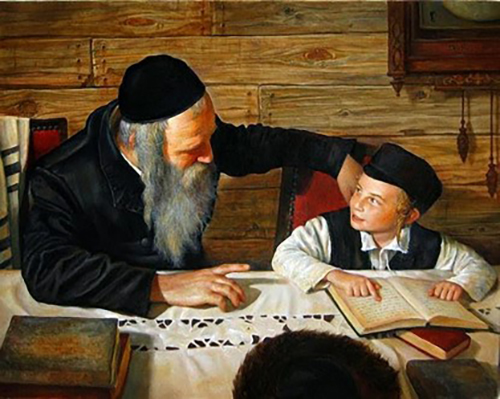
Vehi Sheh’am’da, this is what keeps us. The study of the holy books. The belief in a G-d above. That immersing oneself in Torah study is paramount. A lesson my parents taught us by example. A lesson made part of our lives. And, as a rabbi and rebbetzin, they inspired countless individuals to embrace a life of meaning and commitment, continuing to live on as proud Jews.
My mother wrote several books on living one’s life as a committed Jew. Salomé, a French speaking young girl from New Caledonia, was vacationing with her family in France. There, she came across one of my mother’s books, translated into French. For her, it was a life changer. After reading the book, she only wanted to study and learn Torah. She came to New York, met with the Rebbetzin, and attended Hineni Torah classes. Salome became Shlomit, and today she is a proud ema, raising a beautiful family in Yerushalayim.
The power of a Torah education. We are Am Hasefer, the People of the Book. A nation that cherishes learning and teaching.
Rabbi Norman Lamm shares a story about Torah learning in India. He writes about a visit to the small Jewish community in Fatehpur Sikri, an ancient poverty-stricken town. He had just come out of a lecture in a ‘prayer hall’. A number of young teenage boys crowded around him, and he was told that they had something to ask. Rabb Lamm wondered what the question could possibly be. They were all barefoot. Do they want shoes? They looked hungry. Do they desire food? Many of them sleep in the street. Do they want help securing a roof over their heads? To his surprise, the answer to all these questions was no. They turned to him, and in a broken English, said, “Rabbi, give us Hebrew books”. Young boys who needed so much, but their priority at that that moment to increase their Torah knowledge.
Vehi Sheh’am’da. Once again, it is our nation’s love of learning, the desire for Torah education that sustains us through the ages.
Vehi. One small word with so many teachings. Pesach night is our time for ve’higgadeta l’vincha, and you shall tell your children. A time for us to recount not only the story of our nation’s exodus from Egypt, but as parents, grandparents and family, to share stories of past generations. Each of us has our own personal ‘vehi’. Stories of emuna and bitachon, stories of families finding strength from their unwavering belief in HaShem. Memories that keep us intact and connected to Torah. It is a night to inspire our children, enabling them to be the leaders of tomorrow, the future of Am Yisroel.
Vehi Sheh’am’da continues, stating “Sheh’b’chol dor vodor omdim aleinu l’chaloseinu, In every generation there are those who stand up against us and wish to annihilate us…” Haunting words in the reality of today’s world.
There is yet another “b’chol dor vodor” in the Haggadah.
“B’chol dor vodor…. In every generation and generation, one is obligated to see himself as if he personally had gone out of Egypt.” To close our eyes, and try to imagine what was to leave the bondage in Egypt behind, crossing the sea, experiencing HaShem’s miracles.
Mitzrayim, Egypt, connotes much more than a physical land. Within the word Mitzrayim we find the word meitzar, meaning a narrow, confining place. There are times in life when we experience own personal “Mitzrayim”, when we feel stuck in a hard place, wondering how we will ever extricate ourselves. On Pesach night, when we remember the mizrayim of Egypt, how HaShem helped our nation break the shackles of slavery, that should give us hope that we, too, will merit being liberated from that which confines us.
We conclude the vehi sheh’am’dah with “ve’haKodosh Boruch Hu matzileinu mi’yadam, But HaShem, Blessed be He, rescues us from their hands.” Vehi—through Torah, through mitzvos, through emuna. Through the identity we refuse to abandon, even when knocked down. Just as that child instinctively reached for his kippa, we too must reach for our Torah. It is through the teachings of Torah that our nation is able to go from the darkness of slavery to the light of freedom. Teachings that give us the power to survive the ages.
Wishing all my readers Shabbat Shalom and a Chag Kosher V’sameach!
Chaya Sora
Chaya Sora can be reached at [email protected]
This article was written L’zecher Nishmas / In Memory Of HaRav Meshulem ben HaRav Osher Anshil HaLevi, zt”l and Rebbetzin Esther bas HaRav Avraham HaLevi, zt’l
