



|
Getting your Trinity Audio player ready...
|
By: Chaya Sora Jungreis-Gertzulin
“Ha lachma anya…. This is the poor man’s bread.” The bread of our affliction. Kol dichfin yaisai v’yechol…. Whoever is hungry, let him come and eat…. Kol ditzrich yaisai v’yifsach… Whoever is needy, let him come and celebrate Pesach…” (From the Pesach Haggadah)
Seder night. As we sit around our beautifully set table, we begin the maggid section of the Haggadah, telling over the story of yetzias Mitzrayim, our nation’s exodus from Egypt. The story of our redemption, a story that is told and retold, a story for generations.
We all have our personal seder memories. Oftentimes, memories from years ago, recalled with great fondness.
My mother a”h would often be a guest speaker at Pesach programs, and our family, along with my siblings and their families, would join.
First seder night. Time for urchatz, to wash our hands. As we walked through the dining room to the washing station, my then seventeen-year-old son, Yosef Dov, noticed someone we didn’t see. A person easily missed. There was an elderly man sitting at a table for one. My son turned to us and remarked that no one should be alone for seder. “Let’s invite him to join us. Don’t we say ‘kol ditzrich… Anyone who is needy, let him join us”? Needy could be being lonely, needy for companionship. Needy to hear a kind word. Needy for an invite.
We knew what we had to do. Together, we walked over to the gentleman’s table and asked him to join us. All of a sudden, a forlorn face turned bright and smiley. In no time, he picked himself up and came to our table. With a strong southern drawl, he told us that he was from Norfolk, Virginia. During the course of the evening, he regaled us with stories about Jewish life in Norfolk. And every year, as I say kol ditzrich, it brings back memories of our friend from Norfolk. That simple invitation transformed both his seder and ours.
There’s an age old question about Ha lachma anya. Isn’t it a bit late in the game to invite one to a seder? Why, then, as we sit down around our table do we say “all who are hungry, come and eat, all who are needy, come and join us”?
As the one who prepares the food and sets the table, I look at the question through the lens of a woman. So often, we are intimidated to extend an invitation. We think we can’t cook up a multi-course gourmet meal. I don’t have the time, the strength, the know-how. Preparing for company is so much more work.
Ha lachma anya teaches us differently. One doesn’t have to cook and prepare weeks in advance. It doesn’t have to be a five-star Michelin dinner. Our tablescape doesn’t have to be magazine worthy. It’s okay to invite in the last minute, and share whatever you have. People are so grateful for the company. Just to be at another’s table and share conversation. I remember my mother saying, “A burger with friends tastes better than a steak eaten alone.”
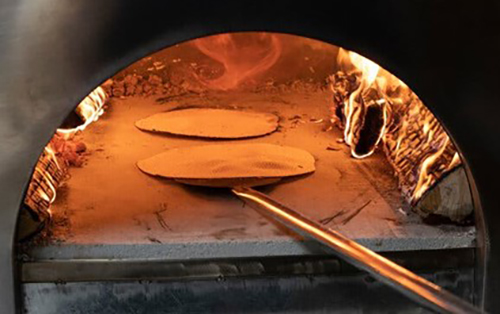
“This is the poor man’s bread.” Is that the “chef’s choice”? Is that the best we can offer? What about inviting for a tasty piece of salmon, a savory portion of short ribs. A sweet taste of apple crumble. Our seder is our seudas ho’da’ah, our gratitude dinner. We emphasize the matzah to help us focus on our beginnings in Egypt. Days of slavery and deprivation. A life of matzah and marror. Bitter, painful days. But then, a miracle occurred. HaShem took us out of Egypt with His strong hand, with miracles the world have never seen before.
But it’s not just about the past. Beginning the seder with the bread of affliction, the poor man’s bread, should remind us that while we, too, may experience struggles and challenges, the “I can’t take it any longer days”, we also have days of gratitude. We should take a minute while we are sitting at the seder to contemplate all of the things that we personally have to be grateful for. It is a night to remember that HaShem was with us in the past, and acknowledge that He continues to be with us, on both a personal and global level.
“The bread of affliction that our fathers ate in the land of Mitzrayim”. But don’t we eat matzah to commemorate our ancestor’s leaving Egypt in a rush, not having time to let the dough rise? Wasn’t it a bread of liberation and not a bread of affliction?
Matzah is both the bread of affliction, the food of slavery, and the taste of redemption. Another message of sharing our table with others.
No matter where life takes us, we can share. With the ongoing war in Israel, with missiles flying and sirens blaring, there has been a lot of “shelter time”. With that comes opportunities of giving and caring. I recently saw a clip of a crowded shelter, filled with people from all walks of life. As can be expected, there were lots of cranky little ones. One mother grabbed a little snack bag for her toddler as she ran from her apartment to the shelter. But she was happy to share whatever small items she had with the other little ones. The beauty of Am Yisroel.
To share, no matter what, no matter where. Be it the food of our affliction in times of difficulty, or food of our redemption in times of celebration. With small acts of kindness, our nation rises to its glory.
As I was looking over the Haggadah, the last of the Four Questions stood out. “…ha’leila hazeh kulanu mesubin… on this night, we all recline.” Night, darkness, is usually associated with challenge, difficulty, and uncertainty. Yet, the Haggadah says we recline, a form of relaxing. I understood it to mean that no matter how dark the night may be, we place our emuna and bitachon, our faith and trust in HaShem. We recline. We take a breather. We say, HaShem, I will do mine, and after that, I have total trust in faith in Your miraculous hand. I leave it up to You. With that spirit, even in the darkest of dark, we can recline.
Pesach. A night to open our tables and hearts. A night to recall the bread of affliction and the bread of redemption. To have gratitude for what was, what is, and what will be. A night to joyfully sing, l’shana ha’ba’ah b’Yerushalayim.
Shabbat Shalom and Chodesh Tov!
Chaya Sora
Chaya Sora can be reached at [email protected]
This article was written L’zecher Nishmas / In Memory Of HaRav Meshulem ben HaRav Osher Anshil HaLevi, zt”l and Rebbetzin Esther bas HaRav Avraham HaLevi, zt’l
