



|
Getting your Trinity Audio player ready...
|
Simchas Torah – Dancing With the Stars
By: Chaya Sora Jungreis-Gertzulin
“Torah tzivah lanu Moshe, The Torah that Moshe commands us, morasha kehilos Yaakov, is the heritage of the congregation of Yaakov.” (Devarim/Deuteronomy 33:4)
Words found in the final Torah portion, “V’zos Ha’bracha, And this is the blessing…” Words put to song, a song that generations of parents raised their children with.
When my children were just babies, I would cradle them in my arms, and sing “Torah… Torah… tzivah lanu Moshe…” I would sing these words to them as they woke in the morning, and then again as I put them to sleep at night.
“V’shinantam l’vanecha, And you shall teach it your children.” Parents have the awesome responsibility of raising their children imbued with a life of Torah and mitzvos. A responsibility which begins when they are just babies in our arms.
The words come with a powerful message. Morasha kehillas Yaakov, the heritage of the congregation of Yaakov. The first Torah lesson given to our children is, you have a morasha, a beautiful heritage, a G-d given gift. The Torah is yours to treasure. Study it, make it yours.
The word morasha, heritage, shares a root with the word yerusha, an inheritance. Similar, yet different. An heir receives a yerusha, an inheritance, without having to exert any effort. On the other hand, a morasha, a legacy, while passed down from generation to generation, comes with an obligation. It must be attained. To become one with Torah, we must study and learn it. We must practice it and follow its precepts. We must make it the roadmap of our life.
It is no coincidence that we read these very words, found in Parshas V’zos Ha’bracha, on Simchas Torah. The yom tov on which we celebrate our Torah.
Simchas Torah celebrates endings and beginnings. The completion of the weekly parsha cycle, and the beginning of a new one. On the same day that we complete the Book of Devarim/Deuteronomy, we begin the Book of Bereishis/Genesis.
Torah learning is a lifetime study. We can study the same parsha year after year, each time learning something new, gleaning fresh insights, and appreciating different nuances. One never graduates from Torah study, but returns to it again and again. How amazing it is that the Chumash can be studied by young and old alike, each one on their level. Each one gaining different understandings.
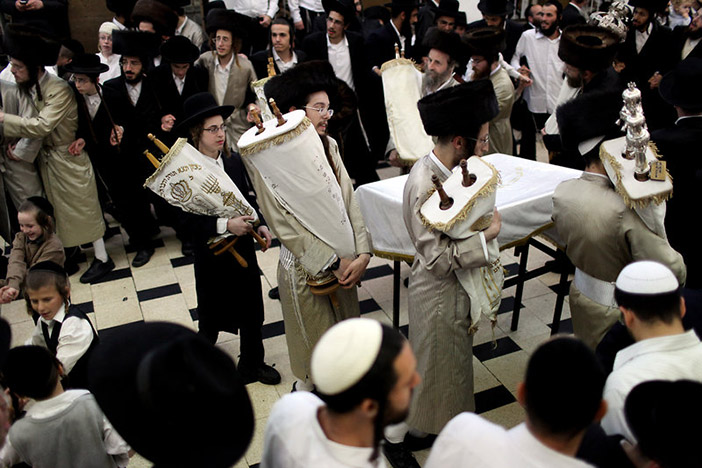
Together with our children, we sing and dance with the Torah. We make a circle, symbolizing the cycle of learning that goes round and round, never to stop.
We dance seven hakofos (series of circles around the bimah) with the Torah, expressing the desire that our love and commitment to Torah should be with us all seven days of the week. Seven hakofos also recalls the merits of our three patriarchs and four matriarchs. Additionally, seven symbolizes our yearning that the heartfelt joy we experience on Simchas Torah transcends all seven Heavens, and reaches the throne of HaShem.
HaShem promised Avraham that his descendants will be many, like the stars in the heavens above. On Simchas Torah, we dance with our stars – our children. We lift them on our shoulders, we carry them like a living Sefer Torah. We dance and celebrate with them in our circles.
Rabbi Shimon Schwab (1908-1995) merited as a young adult to study under the famed Chofetz Chaim, Rabbi Yisroel Meir Kagan (1839-1933). Rabbi Schwab shared a teaching of the Chofetz Chaim about the miracle of the manna. How one desired it to taste, so it tasted. If a person wished it to taste like meat – so it did. And if one desired fish, his portion tasted like fish.
The Chofetz Chaim posed a question to his students. What if one’s mind was blank? What if he didn’t wish a taste? What would it taste like? The students remained quiet, pondering the question. After waiting a few moments, the Chofetz Chaim explained that the portion of one with mindless intent would be tasteless. It would be like eating sawdust, completely devoid of any flavor.
The Chofetz Chaim then applied this teaching to both Torah study and mitzvos. If one approaches Torah learning with a blank, empty mind, in a daze and without concentration, his learning and performance of mitzvos would similarly be tasteless, bland, without any flavor. However, if one looks to Torah study as sweet and enjoyable, so it will be. As we say in our morning prayers, “V’ha’arev nah HaShem, Please HaShem, sweeten the words of your Torah in our mouths…”
The Talmud teaches that after 120, when we ascend to the Heavenly court, we will be asked, “Kovata itim l’Torah, Did you set aside time for Torah study?” (Shabbos 31a)
As we start the new parsha cycle, let’s commit ourselves to make time for Torah study. Let’s internalize the words of the Chofetz Chaim, and make sure our Torah time is sweet time, and then the Torah will be sweet for us. As Pirkei Avos, Ethics of the Fathers teaches “Great is Torah, for it promises one life both in this world and in the next world”.
As Simchas Torah approaches, we cannot forget the horrific tragedy that befell our nation on this very day, two years ago. Today, the entire world waits with bated breath for the homecoming of the remaining hostages. Those who are alive, yet suffered unspeakable horrors, and those who unfortunately were either murdered on that day of perished during captivity. As we dance and rejoice on Simchas Torah, let’s have all of these precious souls in mind. They, too, are amongst the shining stars that make up our people.
In the merit of our celebrating the light of the Torah on Simchas Torah, may we soon see the ultimate geulah and yeshuah, redemption and salvation for Am Yisroel.
Shabbat Shalom and Chag Sameach!
Chaya Sora
Chaya Sora can be reached at [email protected]
This article was written L’zecher Nishmas /In Memory Of HaRav Meshulem ben HaRav Osher Anshil HaLevi, zt”l and Rebbetzin Esther bas HaRav Avraham HaLevi, zt”l