



|
Getting your Trinity Audio player ready...
|
By: Fern Sidman
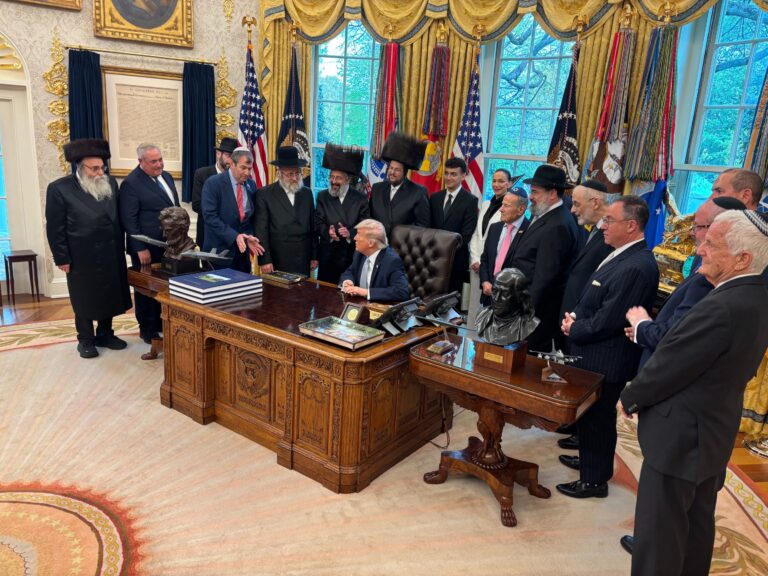
In a moment laden with religious symbolism and geopolitical significance, President Donald Trump convened a distinguished delegation of Orthodox and Haredi Jewish leaders at the White House during the intermediate days of Passover, transforming a traditional season of reflection and liberation into a forum for high-level dialogue on security, diplomacy, and communal concerns. According to a report on Tuesday by VIN News, the gathering, which took place on Monday, offered a rare convergence of faith, policy, and personal narrative at a time when Jewish communities worldwide are navigating heightened uncertainty.
The event, orchestrated by Jewish liaison Martin Marks, unfolded in two distinct phases: an initial reception held within the stately confines of the Eisenhower Executive Office Building, followed by a more intimate and consequential meeting in the Oval Office itself. As VIN News reported, the transition from ceremonial gathering to substantive discussion reflected the administration’s intent to move beyond symbolic engagement and address pressing issues facing Jewish communities both domestically and abroad.
The delegation assembled for the occasion represented a cross-section of prominent rabbinical figures, communal leaders, and public servants whose influence extends across diverse sectors of Jewish life. Among those present were Rabbi Levi Shemtov, Rabbi Dovid Zwiebel of Agudath Israel, Rabbi David Niederman of the United Jewish Organizations of Williamsburg, Rabbi Moshe Margaretten, and Rabbi Meir Soloveichik, alongside civic leaders such as Gedalya Segedin of Kiryas Joel.
Their presence underscored the administration’s recognition of the Orthodox and Haredi communities as vital constituencies within the broader American Jewish landscape. These communities, often characterized by strong institutional cohesion and deeply rooted traditions, have increasingly sought direct engagement with policymakers on issues ranging from religious liberty to security funding.
Also in attendance were notable figures whose personal stories lent additional resonance to the gathering. Holocaust survivor Jerry Wartski, whose life embodies both the trauma and resilience of the Jewish experience, joined the delegation, as did Edan Alexander, a recently released hostage from Gaza, accompanied by his parents. Their inclusion served as a poignant reminder of the enduring challenges confronting Jewish communities in an era marked by both historical memory and contemporary conflict.
The substantive portion of the meeting, held within the Oval Office, addressed a range of critical issues, many of which have taken on heightened urgency in recent months. According to VIN News, President Trump reiterated his administration’s commitment to enhancing security funding for Jewish institutions—a priority that has gained prominence amid rising concerns about antisemitic threats.
Such funding, often allocated through federal programs designed to bolster the physical security of houses of worship, schools, and community centers, has become an essential component of communal resilience. Participants in the meeting emphasized the importance of sustained and expanded support, noting that the evolving threat landscape requires both vigilance and resources.
Beyond domestic concerns, the discussion extended to international developments, particularly the ongoing tensions involving Iran. As VIN News reported, Trump provided an overview of the administration’s approach to the conflict, reaffirming his steadfast support for Israel and outlining the strategic considerations underpinning current policy.
This dimension of the conversation reflects the intrinsic connection between American Jewish communities and the broader geopolitical context of the Middle East. For many attendees, the security of Israel is not merely a foreign policy issue but a deeply personal concern, intertwined with identity, history, and collective destiny.
Amid the policy discussions, the meeting also included moments of personal reflection and connection. In a gesture that blended the personal with the political, Trump placed a phone call during the gathering to his daughter Ivanka Trump and son-in-law Jared Kushner, both of whom have maintained close ties to Jewish communal life.
As noted by VIN News, the call served as a reminder of the familial and cultural connections that have shaped the administration’s engagement with Jewish communities. Ivanka Trump’s conversion to Judaism and Kushner’s longstanding involvement in Jewish philanthropy have contributed to a unique dynamic, one that has often been cited as influencing the administration’s approach to issues of particular relevance to Jewish Americans.
Another notable topic addressed during the meeting was the case of Sholom Mordechai Rubashkin, whose prosecution and subsequent sentencing were a subject of debate within Orthodox Jewish circles. Trump reportedly characterized the sentence as unjust and reminded the attendees that you had issued a pardon for Rubashkin during his first term in office and did so right before Chanukah.
As the VIN News report highlighted, the inclusion of this issue in the discussion reflects the administration’s willingness to engage with matters that resonate deeply within specific communities, even when they fall outside the conventional scope of national policy debates.
The timing of the event during Chol HaMoed Passover imbued the gathering with additional layers of meaning. Passover, a festival commemorating the liberation of the Israelites from bondage, occupies a central place in Jewish religious and cultural life. Its themes of freedom, redemption, and collective memory resonate across generations, shaping both spiritual practice and communal identity.
Hosting such a meeting during this period, as observed by VIN News, can be interpreted as a deliberate acknowledgment of these themes. The juxtaposition of ancient narrative and contemporary reality underscores the enduring relevance of Passover’s message in a world still grappling with issues of oppression, conflict, and resilience.
Notably, the White House did not issue a formal statement following the event. This absence of official documentation has left much of the meeting’s substance to be conveyed through participant accounts and media reporting, including that of VIN News.
The lack of a formal communiqué may reflect the sensitive nature of the discussions, particularly those related to international security and diplomatic strategy. It may also suggest an intent to maintain a degree of discretion, allowing for candid dialogue without the constraints of public scrutiny.
The gathering at the White House represents more than a singular event; it is indicative of a broader pattern of engagement between the administration and Orthodox Jewish communities. This relationship, characterized by direct communication and mutual responsiveness, has become an increasingly prominent feature of the political landscape.
As the VIN News report noted, such interactions have implications that extend beyond the immediate participants. They shape perceptions, influence policy priorities, and contribute to the evolving dynamics of representation within American society.
In bringing together religious leaders, policymakers, and individuals whose lives embody the complexities of contemporary Jewish experience, the White House meeting during Passover stands as a moment of convergence between faith and power, tradition and modernity.
Through its blend of ceremonial observance and substantive dialogue, the event encapsulated the multifaceted nature of leadership in a time of uncertainty. As reported extensively by VIN News, it offered both a reaffirmation of longstanding commitments and a platform for addressing the challenges that lie ahead.
In the end, the significance of the gathering lies not only in what was discussed, but in what it represents: a recognition that in moments of both celebration and crisis, the voices of community, memory, and faith continue to shape the contours of public life.
